<
article id=”post-951661″>
Iran’s rapid post-strike recovery of its Eagle 44 airbase proves that hardened mountain shelters remain a decisive shield against precision firepower, transforming how inferior air forces survive and deter superior adversaries.
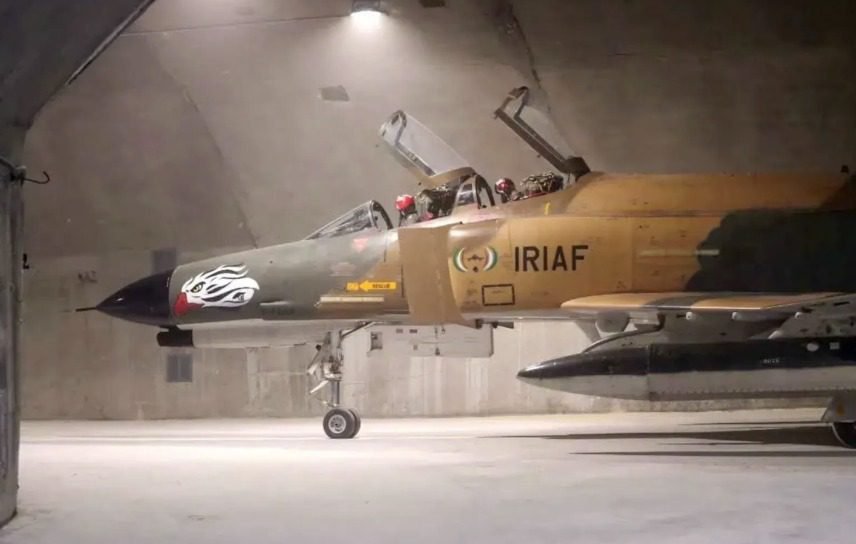
This month, The War Zone (TWZ) reported that Iran is actively repairing and expanding its subterranean Eagle 44 airbase in Hormozgan province, despite having absorbed at least three rounds of joint US and Israeli airstrikes this year, according to Planet Labs satellite imagery.
The mountain-carved complex — built roughly 160 kilometers northwest of the Strait of Hormuz to shield fighter jets, drones and missiles — was targeted in March and July under the US-led Operation Epic Fury to sever its underground hangars from the 4.35-kilometer runway.
However, late-September imagery shows Iran bulldozing strike debris, clearing runway obstructions, finishing paving on a primary western taxiway segment, and beginning subgrade preparation on an adjacent section to establish a redundant access link.
While three support buildings remain heavily damaged and deep portal conditions remain obscured, the rapid reconstruction shows Iran prioritizing critical subterranean infrastructure by deploying engineering units to restore sortie capabilities amid an ongoing naval blockade.
This resilience directly contradicts assessments from the US Department of Defense (DoD) and the Trump administration asserting Iran’s air force and missile infrastructure have been functionally eliminated.
Iran’s wartime preservation of combat aviation through hardened subterranean facilities demonstrates how inferior air forces can absorb pre-emptive strikes and conduct asymmetric counter-offensives—offering a viable strategic blueprint for a survival doctrine against superior airpower.
Dylan Malyasov mentions in an April 2026 Defense Blog article that Iran’s fortress doctrine of sheltering combat aircraft inside hardened subterranean facilities—such as the Eagle 44 complex—validated its strategic value by preserving an estimated two-thirds of the country’s operational air fleet under heavy US and Israeli airstrikes.
For context, Harrison Kass writes in a March 2026 article for The National Interest that before Operation Epic Fury, Iran had 250 to 300 combat aircraft, including about 135 fighters, but only a fraction of them may have been airworthy at any given time.
Despite heavy US and Israeli airstrikes, Malyasov says Iran lost only 38 exposed aircraft by then, dispersing its aircraft into deep mountain tunnels rather than engaging a technologically superior US-Israeli coalition.
He notes that while US and Israeli strikes cratered portal entrances and obstructed runways — trapping jets and highlighting sortie vulnerabilities — post-ceasefire flights of surviving F-4s, MiG-29s, and Mi-28s proved the underground network successfully achieved its primary objective: surviving a first-strike bombardment.
While Iran’s remaining fighter fleet consists of pre-1979 combat aircraft, they can still inflict substantial damage under the right circumstances.
For instance, Paul Iddon mentions in a May 2026 Forbes article that in April 2026, an Iranian F-5 fighter bombed US Camp Buehring in Kuwait, while Iranian F-4 fighters struck another US base using standoff glide bombs, marking two rare instances of fixed-wing strikes on US bases.
Iddon also notes that Iran launched two Su-24 bombers towards Qatar, but the aircraft were shot down. He notes that Iran relied on the fog of war, air defense coverage gaps, and Vietnam War-era low-altitude tactics to evade enemy air defenses, inflict immediate casualties, and disrupt coalition operations across the Persian Gulf.
Severely constrained by an aging, obsolescent combat aircraft fleet, Iran employs its airpower as an asymmetric strike adjunct rather than seeking conventional air superiority against technologically dominant US and allied forces.
Iran integrates surviving aircraft with drone and missile forces to target US aircraft on the ground, runways, command-and-control facilities, and support infrastructure, thereby degrading US air operations, raising costs, and limiting what US forces can accomplish without directly challenging the US in the skies.
Iran’s asymmetric use of manned combat aircraft against the US may also offer useful lessons for Taiwan, which faces a similar position vis-a-vis China. TWZ reported in July 2022 that Taiwan relies on heavily fortified subterranean shelters, primarily the Chiashan and Shizishan mountain complexes along its Pacific-facing eastern coast, to shield its combat aircraft from an initial Chinese bombardment.
TWZ notes that the three-story tunnel network at Chiashan, excavated inside granite mountains and protected by massive steel blast doors, can shelter up to 200 fighters, along with independent power generators, medical facilities, and months of fuel supplies.
The report says that under Taiwan’s wartime dispersal doctrine, it plans to evacuate main fleet elements into these hardened mountain redoubts, preserving vital F-16Vs armed with anti-ship missiles to resist subsequent amphibious invasion attempts.
Matthew Revels notes in an April 2023 article for the Journal of Indo-Pacific Affairs that in the opening phase of an amphibious invasion, China plans to neutralize Taiwan’s air force on the ground through a concentrated joint firepower strike campaign.
According to Revels, China views Taiwan’s crewed fighter fleet and airfield runways as the primary center of gravity; the People’s Liberation Army Air Force (PLAAF) and Rocket Force (PLARF) would launch massive barrages of precision ballistic and cruise missiles to paralyze command nodes, overwhelm stationary defenses, crater runways, and destroy exposed aircraft before they can sortie.
Characterizing Taiwan’s possible asymmetric air doctrine, Jimmy Chien mentions in a March 2026 Global Taiwan Institute (GTI) article that to survive a Chinese invasion, Taiwan must adopt an asymmetric fighter doctrine that treats combat jets as conditional strike assets.
Chien proposes a two-tiered framework, designating fighter jets as “Phoenix 2” forces, assets dispersed and protected in mountain bunkers during opening missile barrages. He says that once low-cost, runway-independent “Phoenix 1” drones and mobile ground air defenses deny Chinese air superiority, Taiwan would selectively sortie hidden fighters supported by rapid airfield runway repair units.
He notes that this asymmetric doctrine synchronizes air-delivered strikes with ground fires to saturate enemy air defenses while decisively conserving survivable fighter strength.
A surviving fleet of F-16s could force China to divert significant military resources from tracking, targeting, and hunting down dispersed, mobile allied assets, such as anti-ship missile batteries, rather than executing a definitive, one-time first strike.
Beyond the Taiwan Strait, these operational dynamics could also redefine deterrence on the Korean Peninsula, where North Korea’s network of hardened, subterranean airfields presents the US and South Korea with the same operational dilemma.
North Korea could operate MiG-29s and Su-25s from those facilities to defend major cities or to conduct strikes using tactics similar to those Iran used against US bases in the Middle East.
Iran’s wartime preservation and asymmetric employment of combat aviation demonstrate that hardened subterranean shelters offer a viable operational blueprint for Taiwan and the Korean Peninsula, proving that mountain-carved redoubts can absorb preemptive bombardments, survive runway-denial campaigns, and sustain critical counter-strike deterrence.
By denying attackers a decisive, one-time victory and forcing costly, protracted suppression efforts, underground basing will remain an indispensable asymmetric counterweight to high-tech air supremacy.