<
article id=”post-951556″>
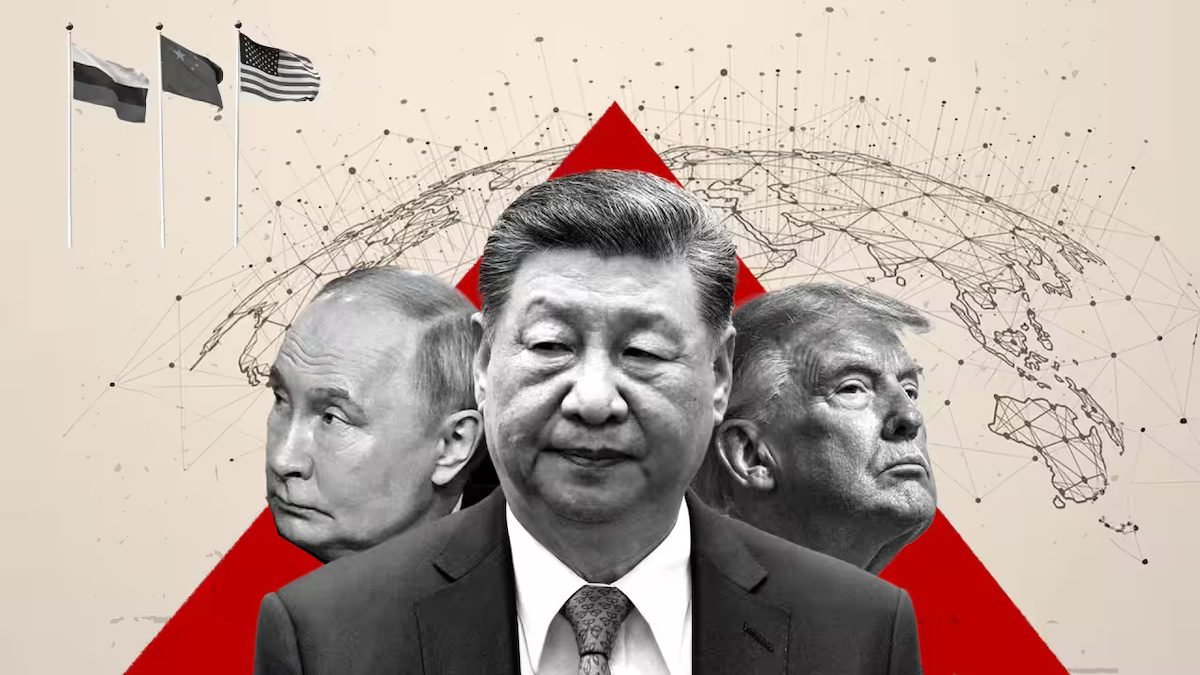
In July 1971, Henry Kissinger developed a convenient stomachache in Pakistan, vanished from public view and turned up in Beijing. The secret trip that led to Nixon’s opening to China rested on a simple piece of geometry: in a world of three great powers, the smart move is to stand closer to each of your rivals than they stand to one another.
The Sino-Soviet split gave Washington the hinge of the triangle, and Kissinger made sure America sat on it. Half a century later, Donald Trump is being invited to draw a triangle of his own.
According to the Wall Street Journal, Vladimir Putin used an October 9 phone call with Trump, the same call in which the two men agreed that Washington would buy Russian diesel, to propose a three-way summit with Xi Jinping on the sidelines of the APEC meeting in Shenzhen on November 18–19.
The Kremlin has confirmed the talks; Beijing has made it known it won’t object; and Trump, never one to turn down a stage, said that if Xi wants such a meeting, he will be there. He even described Xi’s stance on the war as “very fair.”
The reaction in Kyiv, Brussels and much of Washington has been something close to horror. Ukraine’s foreign minister warned that a Russia-China-US summit would only encourage Putin to keep fighting. Commentators have reached for the most loaded word in the diplomatic dictionary: Yalta.
I want to resist that reflex, at least at first. And then I want to explain why, on reflection, the critics may be right for reasons they themselves rarely articulate.
The case the Blob won’t make
Let us start with some uncomfortable truths. The same foreign policy establishment that now clutches its pearls over Shenzhen spent years assuring us that Ukraine was on a path to NATO, that sanctions would cripple the Russian economy within months and that a counteroffensive would restore the 1991 borders.
None of that happened. The war is now in its fifth year, and settlements are written by the realities on the battlefield, not by op-ed pages. Wars between great powers, or between a great power and a state backed by other great powers, end through bargaining among those who hold the cards.
China is Russia’s economic lifeline, its largest customer and its most important supplier of the components that keep its war machine running. Any settlement that is meant to last will need Beijing’s acquiescence, if not its active guarantee.
A president who recognizes that is not a traitor to the liberal order. He is acknowledging a multipolar world that Washington’s foreign policy class still refuses to see. So the instinct to bring China into the room is not crazy. In fact, it is the most realist thing Trump has said about Ukraine in months.
The geometry is upside down
But realism is not only about recognizing power. It is about counting it accurately. And here is where the Shenzhen triangle starts to look less like Kissinger and more like a reversal of Kissinger.
In 1972, Washington was the pivot. In Shenzhen, the pivot would be Xi. He would be the host, the convener, the man with the most leverage over Moscow and the man whose cooperation Washington needs most. Russia and China would arrive as partners who have spent the past decade declaring a friendship “without limits.”
The United States would arrive as the odd man out, a suitor courting two capitals that are closer to each other than either is to Washington. That is not a triangle with America at the apex. It is a Sino-Russian condominium with an American guest.
Consider also the price of admission. Xi does not hand out diplomatic favors on Chinese soil for free. A three-way summit would mark his debut as the great power broker of Eurasia, a role Beijing has coveted since it floated its vague “peace plan” in 2023.
What would he want in return? The obvious candidates are softer American positions on Taiwan, on technology export controls, or on both. Trading the Western Pacific for a ceasefire line in the Donbas would be the worst bargain an American president has struck since, well, Yalta.
And Trump has already shown a habit of paying before he negotiates. The diesel deal, announced in the very conversation in which Putin pitched the summit, reversed years of American energy policy and handed Moscow a concession before a single map was laid on the table.
A merchant who pays in advance should not be surprised when the goods never arrive.
Yalta without an army
The Yalta comparison is overused, but here it is instructive for a reason most critics miss. At Yalta, Roosevelt and Churchill had millions of soldiers in Europe. They could negotiate over the continent’s future because they were physically present in it. Whatever one thinks of the outcome, it reflected the balance of power on the ground.
In Shenzhen, the two powers with the most at stake on the ground would be absent. Ukraine, whose soldiers are holding the line, would not be at the table. Neither would the Europeans, who will be asked to pay for reconstruction, to absorb the refugees and, most likely, to police any ceasefire.
A settlement imposed on Kyiv without Kyiv’s signature is not a settlement. It is an intermission. Ukrainians have a vote in how this war ends because they are the ones with guns in their hands, and a deal they reject will not hold.
This is not an argument for Washington to keep writing blank checks. I have argued for years that Europe must stop outsourcing its security to America and that a war on the European continent is first and foremost a European responsibility.
But that argument cuts both ways. If Europe is to own the outcome, Europe must help shape it. A summit that excludes Paris, Berlin and Warsaw while lecturing them to take up the burden is both incoherent and self-defeating.
What restraint actually looks like
A genuinely realist approach would not reject Shenzhen out of hand. Rather, it would reshape it.
First, keep the core negotiation where it belongs: between Washington, Moscow and Kyiv, with the Europeans closely consulted. A Trump-Putin-Zelensky meeting, as the Ukrainians themselves have proposed, is a better format than a Trump-Putin-Xi one.
Second, give China a role, but the right one. Beijing can be a guarantor of a settlement, a participant in reconstruction, and a source of pressure on Moscow. It should not be the arbiter of European security.
Third, stop pre-paying. Every concession Washington offers before talks begin, whether on sanctions, energy or weapons deliveries, is leverage surrendered for nothing.
And finally, keep Asia and Europe separate. The moment the Ukraine file becomes entangled with Taiwan, Washington will be negotiating against itself in two theaters at once.
The irony of the triangle
Nixon went to China in 1972 to make Moscow nervous. If Trump goes to Shenzhen next month on the terms now on offer, he will make only Kyiv and Brussels nervous, while Moscow and Beijing toast their good fortune.
Kissinger would have recognized the triangle. He would not have recognized who was sitting at the top of it.