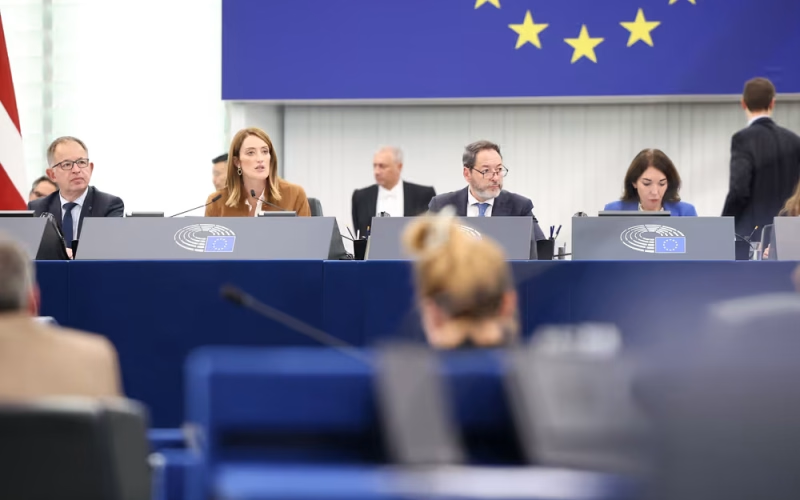
Members of the European Parliament’s foreign affairs and development committees voted Monday to back a larger budget for the European Union’s main external funding tool, rejecting Council proposals for significant cuts.
The draft position on the Global Europe Instrument, which would fund EU external action from 2028 to 2034, was adopted Oct. 19 by 63 votes to 27, with five abstentions. MEPs said the instrument’s purpose is to uphold and promote the EU’s values, principles, and strategic and geopolitical interests and, in the long term, to help eradicate poverty.
The committees endorsed a €25 billion increase, in current prices, on the European Commission’s original proposal of €200 billion. They also called for a dedicated minimum of €25 billion for humanitarian aid, and for separate budget lines for a Gaza reconstruction fund and for candidate countries. Other proposals include spending 20% of official development assistance on human development and setting aside a share of funds for the EU’s Global Gateway strategy and for strategic autonomy and economic resilience.
Under the position, the EU could suspend funding where democracy, human rights and the rule of law deteriorate in a partner country. The Commission could also fully or partially suspend payments if a partner country has serious shortcomings in meeting its obligation to readmit its own nationals. MEPs also want entities not aligned with Europe’s strategic interests excluded from funding.
On enlargement, the lawmakers said the instrument should help candidate and potential candidate countries align with EU values and legislation, with clearer incentives to deliver reforms. It would also support Ukraine in response to Russia’s war of aggression without drawing funds from other priorities and partner countries.
The Commission would have to give Parliament meaningful reports on implementation and hold regular dialogue with MEPs. Lawmakers also want Global Gateway anchored in the instrument, with greater parliamentary involvement.
“Current and future challenges, crises, and wars … demand collective action and adequate resources, if we wish to effectively safeguard our interests,” said Michael Gahler, a German member of the European People’s Party and co-rapporteur for the Committee on Foreign Affairs. He said many countries now have heightened expectations of the EU following the withdrawal of the United States as a partner.
Robert Biedroń, a Polish member of the Socialists and Democrats and co-rapporteur for the Committee on Development, called Global Europe the EU’s “foreign and development policy superpower.” He said that “if we fail now, we will have to deal with the much more expensive consequences later.”
The committees also endorsed a mandate for negotiations with the Council by 61 votes to 34, with two abstentions. The position and mandate are expected to go to a plenary session scheduled for November 2026. Talks can begin once member states adopt their full mandate, including overall funding levels for the EU’s long-term budget.
The legislation is part of the EU’s 2028-2034 long-term budget package. Parliament wants the budget to remain a strong investment tool and argues that new revenue sources are needed to fund it.