<
article id=”post-951441″>
For years, the idea of speaking forthrightly to China would evoke an admonition from the US State Department and most of the American policymaking class: “We can’t do that. They won’t like it.”
They’d often add, “China has red lines, don’t you know?”
There are things you are told you just can’t say – questioning China’s political system, Taiwan, democracy, human rights and China’s ‘development rights’ (challenging China’s right to do anything it wants – legal or illegal – to develop its economy and industry). In short, you can’t mention any of the things that make communist China such a threat to peace and prosperity.
That sort of advice from the “experts” was rampant during the communist Soviet Union era as well.
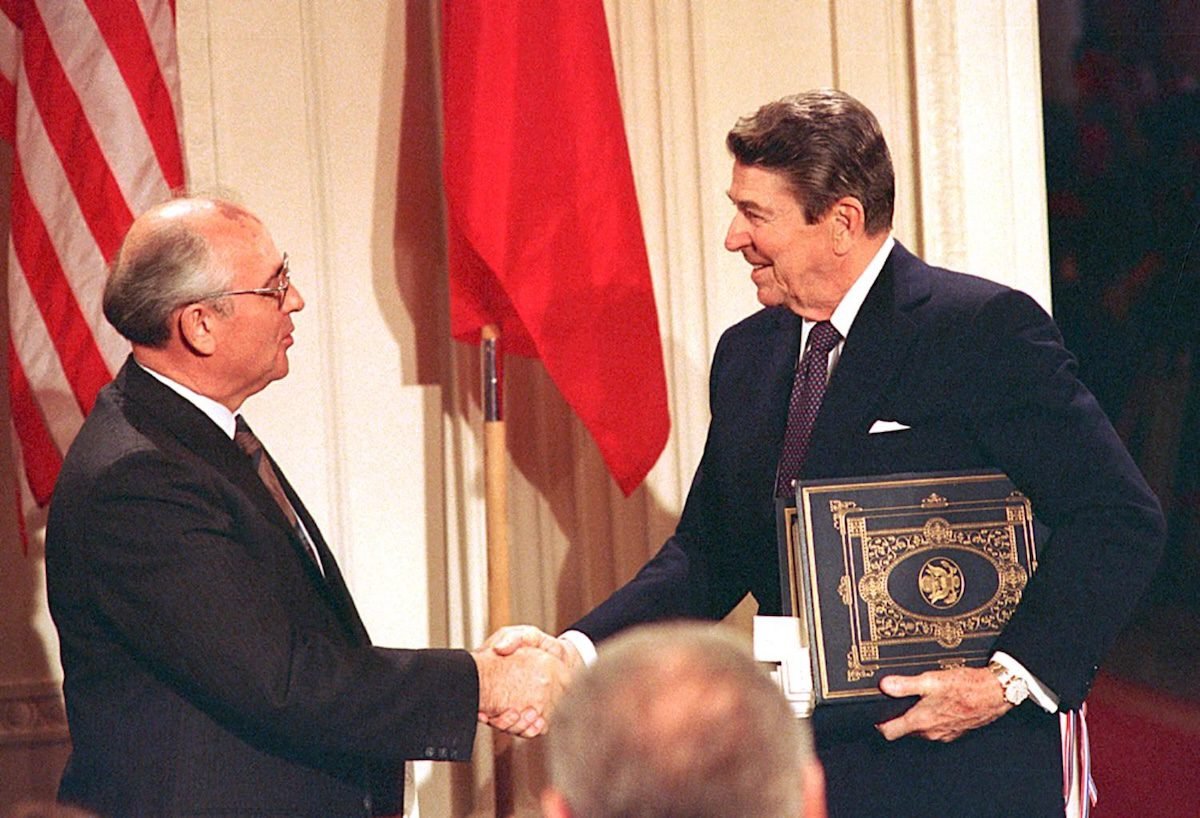
Remember President Ronald Reagan’s speech at the Berlin Wall’s Brandenburger Gate in 1987 when he slipped in a line: “Mr. Gorbachev,” he said, “tear down this wall.”
Many of Reagan’s advisors and staff told him: “You can’t say that.”
Even his respected Secretary of State George Schulz was opposed.
But Reagan followed his instincts and was proven right.
The Trump-Xi summit in Washington last month suggests the restraining habits of the foreign policy class die hard.
The DC visit included only two fairly short public speeches.
It is, of course, possible that President Trump was more direct in his private meetings with Chairman Xi. But, assuming decades of experience are anything to go by, if the idea is that when you show restraint Beijing will reciprocate, and even change its behavior, you will always be disappointed.
When it comes to the Chinese Communists, if you won’t say it in public – as Reagan did with the Soviets – it’s a win for the communists.
So what should be said in public? A good starting point is not giving an unchallenged platform to Xi’s cognitive warfare, designed to distort history, claim unearned legitimacy, and fracture American alliances.
Correct distortions
First, tell the truth about history. Xi mentioned the Flying Tigers implying the Chinese communists fought together with the U.S. against Japan during World War Two. That is not true. The Flying Tigers fought alongside the Nationalist Kuomintang (KMT), which bore the brunt of the fighting, rather than Mao’s Communists, who fought relatively little.
Unfortunately, the White House’s official visit read-out reinforced Xi’s self-serving distortion of history.
President Xi also pointedly criticized Japan, warning of resurging Japanese ‘militarism.’ That should have been countered by noting that Japan, once a fierce enemy, has become a true friend, a consensual, humane democracy that has done much good in the region and worldwide.
It should also have been stated that Japan is America’s strongest ally and that the US will not let it be bullied.
Highlight what the CCP has done to Americans
Apart from correcting distortions, what would help America’s position in the region, and show Americans at home that their government puts them first, is bringing up areas where communist China has caused direct harm to Americans.
One example is fentanyl and precursors from China killing upwards of 800,000 Americans since 2013 – as the death toll rises. Xi could stop it in an afternoon. Such is the nature of China’s “beyond Orwellian” surveillance state.
However, the White House’s official readout stated the US and China are in fact cooperating to end the fentanyl assault. That is delusional.
And there is the murderous Covid that China unleashed on the United States and the world in 2019 and did nothing to help solve, much less take responsibility. This should not be allowed to fade into the memory void – long Covid is still killing Americans. And millions have not recovered from the economic destruction that destroyed business dreams and likely cost Trump the 2020 election.
Show why our way is better
Xi liberally talks nonsense about how communist China is good for the world. Why not accurately talk about the benefits of our own system? Especially in this 250th year since the Declaration of Independence, talk about human rights, consensual government, freedom of speech, expression, movement, and religion – all the things Xi describes as bad.
Speak up for the freedom of expression that Americans enjoy – and simultaneously have US marshals, Secret Service, FBI, and local police crack down on Chinese thugs illegally threatening and attacking the democratic rights of anti-CCP protesters in Washington and elsewhere. Collar them, arrest them, imprison them, and deport them. And kick out of the country any Chinese embassy and consulate officials involved. And even close a consulate, as happened in Houston during the first Trump administration, to show the president is serious.
Instead, the administration did nothing. Talk about letting someone walk over you.
Finally, Taiwan deserved a mention as a friend of America and an example of what the Chinese people can be, without the yoke of communism.
Trump does have his own style – especially when dealing with leaders such as Xi Jinping, who rule by force rather than popular consent.
But he can fairly assess whether the standard policy-community approach has yielded useful results.
During his first term in office, his administration spoke clearly about China – with Secretary of State Mike Pompeo’s speech at the Nixon Library in 2020 that followed successive speeches on China by National Security Advisor Robert O’Brien, Attorney General William Barr and FBI Director Christopher Wray, as well as two speeches in Mandarin by Deputy National Security Advisor Matt Pottinger suggesting the Chinese people could do better than a dictatorship.
It rattled Chinese communists and – had Covid not come along and had Trump been reelected in 2020, the world might be very different.
The lesson here: An American president gains nothing by being too afraid to speak up for the nation’s principles, especially when it’s a fight over liberty and between a system that embodies freedom and one that enslaves.
Trump will be meeting Xi twice more this year. He might stop taking counsel from the foreign policy blob and get back to the Trump of the first term, or even the Trump of the 2016 campaign who said: “We can’t continue to allow China to rape our country… we’re going to turn it around, don’t forget it. We’re like the piggy bank that’s being robbed. We have the cards. We have a lot of power with China.”
But maybe Xi would refuse to meet that Trump?
Maybe. And that’s fine.
Grant Newsham is a retired US Marine officer and former US diplomat. He was the first Marine liaison officer to the Japan Self Defense Force. He is the author of the book When China Attacks: A Warning To America.