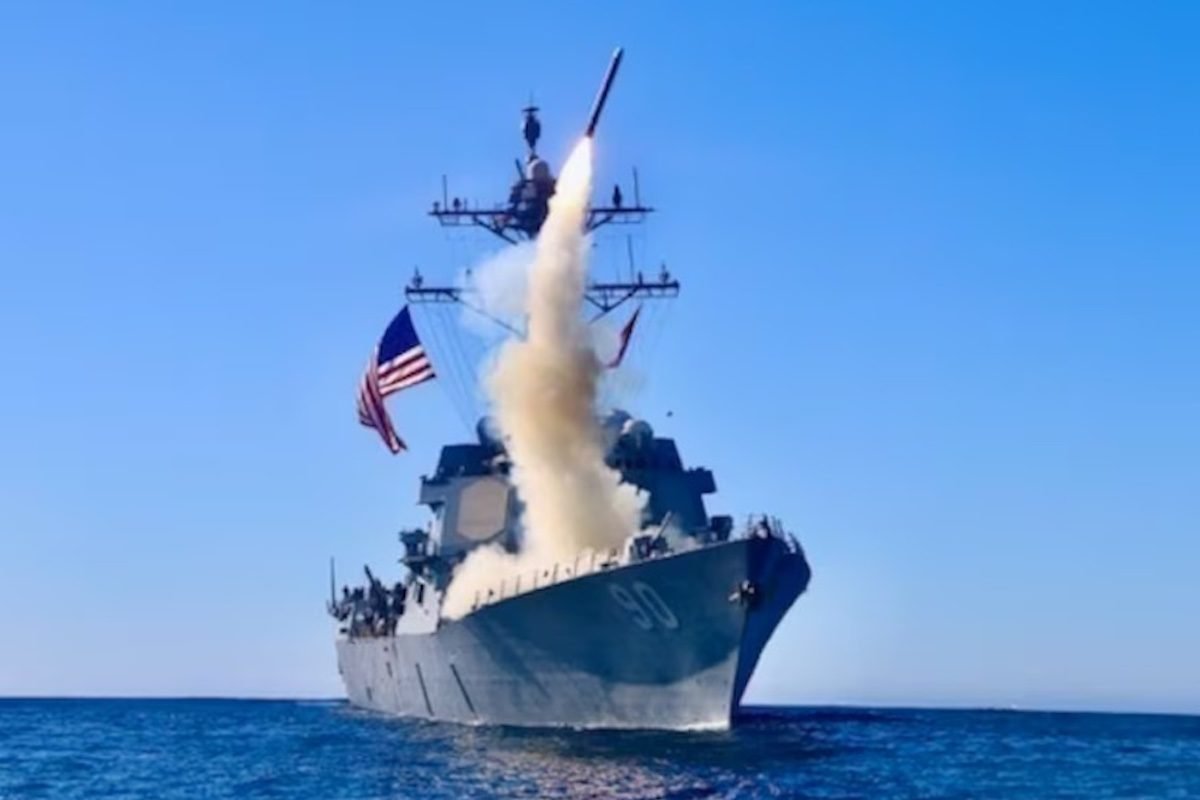
The US Navy’s bunker-busting Tomahawk push reflects growing recognition from the Iran war that striking deeply buried missile sites protected by robust air defenses requires long-range standoff weapons. But the missile faces serious operational, logistical and escalation challenges against China.
The US Navy plans to award Raytheon an exclusive, sole-source contract for low-rate initial production of the Joint Multiple Effects Warhead System (JMEWS), advancing a bunker-busting variant of the Tomahawk cruise missile from development to operational manufacturing, multiple media outlets reported.
According to a pre-solicitation notice published by Naval Air Systems Command, the procurement will equip the Tomahawk Block Vb with a two-stage warhead that combines penetration capability and blast-fragmentation effects to destroy hardened underground bunkers, missile silos, and command centers from about 1,600 kilometers away.
The US Navy justified the non-competitive award by citing the RTX subsidiary’s proprietary technical data and continuous role since 1994 as the missile’s sole developer and manufacturer, noting no other contractor could meet deployment timelines without duplicative costs.
While exact dollar figures, delivery schedules and production volumes were withheld, recent budget plans slated funding for 35 re-certified missiles with upgrade kits ahead of a projected 2027 initial operational capability.
The initiative, overseen by Patuxent River’s PMA-280 office with work centered in Tucson, Arizona, gives surface destroyers and submarines standoff precision-strike options against fortified adversarial infrastructure without placing manned aircraft inside hostile air-defense envelopes.
The performance of US munitions on Iranian underground sites during Operation Epic Fury may leave much to be desired, prompting the development of the JMEWS Tomahawk Block Vb.
While intense US and Israeli strikes initially crippled Iranian ballistic missile operations, Iran rapidly reconstructed damaged facilities and resumed daily strikes. Iranian forces were bulldozing and unearthing sealed bunkers hours after attacks, preserving an estimated half of their mobile launchers and firing 15 to 30 ballistic missiles daily.
Despite enduring more than 20,000 strikes targeting infrastructure and logistics, Iran leveraged deep mountain fortifications, spare component stockpiles and deceptive decoys to sustain its primary deterrent.
Dwindling US stocks of standoff munitions may have prompted the development of a bunker-busting Tomahawk. Shortages may have forced the US to rely on shorter-range weapons like the Joint Direct Attack Munition (JDAM), requiring aircraft to fly closer to targets and potentially enter enemy air defense range.
Those lessons carry critical operational implications for a potential conflict over Taiwan. In a July 2023 report for the James Martin Center for Nonproliferation Studies (CNS), Decker Eveleth notes that the People’s Liberation Army Rocket Force (PLARF) relies heavily on subterranean networks opposite the Taiwan Strait to protect its frontline strike assets from counter-battery bombardment.
According to Eveleth, Base 61 — headquartered in Huangshan, Anhui — disperses its conventional missile brigades across Fujian, Jiangxi, and Zhejiang into subterranean facilities excavated by Base 68 engineering units upon receiving strategic warning.
Eveleth observes that these mountain tunnel complexes house transporter-erector-launchers (TELs) for hypersonic DF-17s, DF-16s, and DF-15s, enabling crews to service and mate warheads inside hardened bunkers before rolling out to pre-surveyed launch pads.
He adds that Base 61 links these launch sites to subterranean command posts via dedicated fiber-optic networks, ensuring high survivability and enabling rapid “shoot-and-scoot” salvos during a cross-Strait conflict.
As such, “shooting the archer” – destroying TELs before they launch their missiles – may no longer be sufficient to suppress the missile threat the PLARF poses to Taiwan and to US and allied forces – it is now imperative to destroy those underground missile facilities.
But China’s dense air defense network may preclude attacking those underground facilities with traditional bunker-buster bombs such as the BLU-109 and GBU-28, both of which are dropped from aircraft. Hence, a standoff bunker-buster option such as the JMEWS-armed Tomahawk Block Vb may be necessary to attack those targets.
Still, the bunker-busting Tomahawk may not be a wonder weapon against China’s missile forces. While the Tomahawk proved devastating against adversaries with obsolete, non-existent, or disjointed air defenses, such as Iraq, Afghanistan and Iran, its performance against a peer adversary with a modern and dense air defense network, such as China, is debatable.
The Russia-Ukraine War may offer a glimpse of how subsonic cruise missiles perform against modern air defenses.
In the aftermath of a July 2026 Russian air attack on Ukraine, the Ukrainian media outlet Militarnyi reported that Ukrainian air defenses destroyed 31 of 33 Kh-101 air-launched cruise missiles and all six Kalibr ship-launched cruise missiles launched during the attack – but failed to destroy any Russian ballistic missiles during the attack, owing to a shortage of Patriot interceptors.
While the Russian Kh-101 and Kalibr are functionally equivalent to the US Tomahawk, their effectiveness may also depend on the quality of mission planning behind the strikes.
Although the US Tomahawk may be much slower than ballistic missiles, extensive US intelligence, surveillance and reconnaissance (ISR) capabilities, combined with the Tomahawk’s long range, could enable complex flight paths through pre-identified gaps in enemy air defenses. US strike packages may also include suppression/destruction of enemy air defenses (SEAD/DEAD), whereas Russia may rely more on sheer numbers.
Beyond target-end interception, the survival of US launch platforms within Chinese anti-access coverage presents an equally pressing dilemma.
For instance, while the US Army has forward-deployed the land-based Typhon launcher to the Philippines, the battery’s sizable multi-vehicle footprint, constrained archipelago geography, and limited road infrastructure leave it vulnerable to persistent Chinese ISR tracking and rapid counter-battery strikes.
US ships with Tomahawk cruise missiles may also be vulnerable to saturation strikes that deplete their limited missile interceptors, while US submarines must contend with China’s growing ability to track them within the First Island Chain, especially in the South China Sea.
Industrial capacity also poses an acute bottleneck. Before Operation Epic Fury in February 2026, the US military maintained roughly 3,100 Tomahawks in its pre-war inventory; by April, US forces had expended more than 1,000 rounds.
With unit replacement costs running at US$2.6 million and procurement lead times stretching to 47 months per missile, a high-intensity conflict against China would exhaust existing inventories far faster than US assembly lines can replace them.
The kill chains guiding Tomahawk missiles to their targets may also be vulnerable, as China could disrupt or destroy the sensors and networks involved, or misdirect Tomahawk strikes through deception and concealment.
Cruise missile strikes on the Chinese mainland also raise the issue of nuclear ambiguity. While current US Tomahawk missiles are strictly conventional, the US is currently developing a Nuclear-armed Sea-Launched Cruise Missile (SLCM-N), a move that can complicate identifying an attack as nuclear or conventional. That ambiguity may heighten the risk of an inadvertent nuclear escalation.
Whether the JMEWS-equipped Tomahawk Block Vb can fundamentally alter the cross-Strait operational balance will ultimately depend less on its penetrating warhead alone than on the US’s broader ability to expand munitions production, harden launch platforms against preemptive strikes and establish robust escalation guardrails to prevent conventional subterranean strikes from triggering a strategic nuclear response.