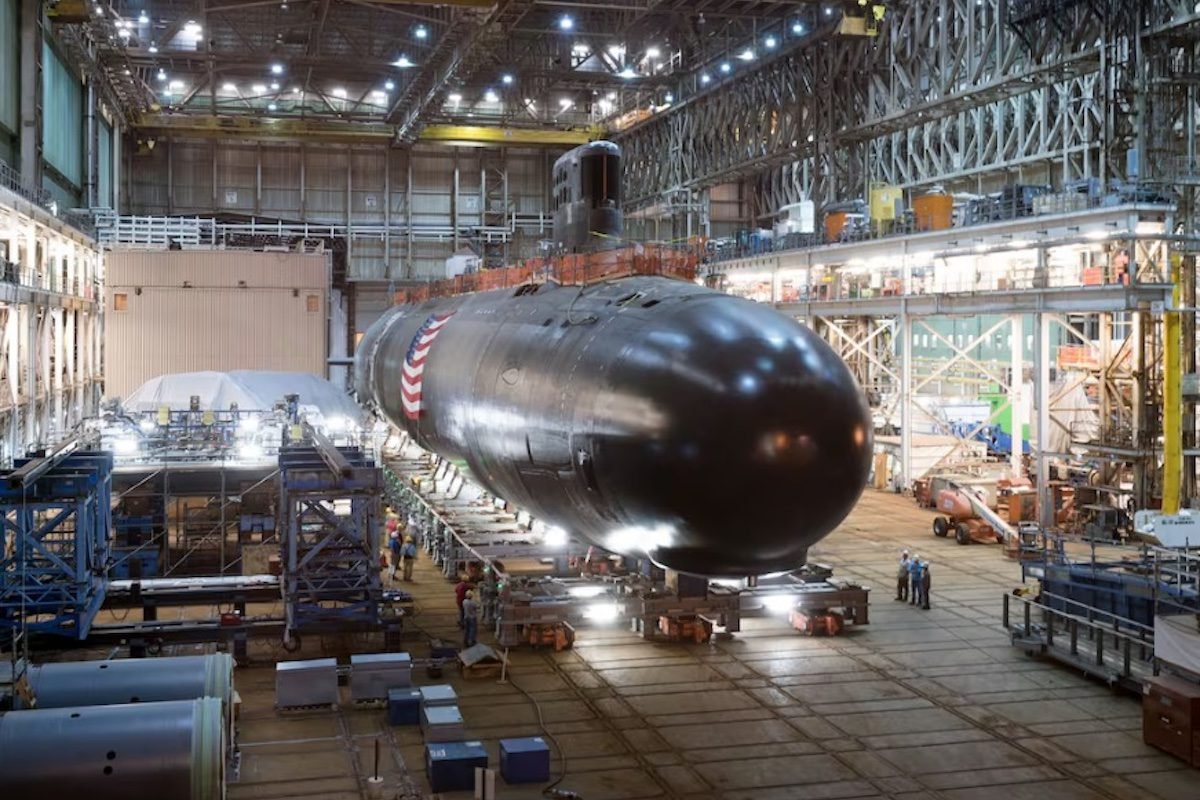
As the US Navy lays the groundwork for its next-generation SSN(X) attack submarine to replace its aging fleet, the US’s longstanding undersea supremacy faces an intensifying test against China’s rapid naval buildup, advancing acoustic stealth and superior shipyard capacity.
The US Navy’s Naval Sea Systems Command (NAVSEA) issued a sources-sought notice to survey domestic shipyard capacity to build its next-generation SSN(X) nuclear-powered attack submarine, multiple media outlets reported.
Managed by Team Submarine and the SSN(X) program office, the market research initiative seeks detailed technical and capital-expenditure data from prospective prime contractors capable of complex hull fabrication, modular outfitting, precision systems integration and nuclear reactor compartment installation.
The assessment aims to establish a baseline for US industrial infrastructure, drydock availability, and specialized shipbuilding labor as the military prepares an acquisition strategy for the long-duration combatant program, which targets initial construction around 2034 to succeed the Virginia-class fleet.
Because qualifying facilities require certified graving or floating drydocks and heavy gantry crane systems, the stringent technical criteria effectively narrow primary prospective builders to General Dynamics Electric Boat and Huntington Ingalls Industries’ Newport News Shipbuilding.
The SSN(X) program represents the US Navy’s premier undersea effort, though severe budget constraints have deferred procurement to fiscal 2040.
The US Navy’s rationale centers on countering adversary threats in strategic undersea competition by fielding a larger, highly capable combatant that merges the speed and heavy payload of the Seawolf class, the stealth and sensors of the Virginia class, and the operational availability of the Columbia class.
Envisaged to conduct full-spectrum undersea warfare, SSN(X) will deploy expanded torpedo-room capacities and coordinate remote autonomous systems as force multipliers.
The US Navy must ultimately replace its Virginia-class attack submarines because the vessels will inevitably wear out at the end of their operational lifespans.
Although improved material and construction methods extended the Virginia class’s operational life to 33 years, sustaining planned force levels requires commissioning successor hulls when the earliest boats retire around 2037.
Beyond replacing hulls nearing the end of their service lives, the US must maintain fleet numbers to keep pace with China’s expanding undersea fleet. In a prospective conflict over Taiwan, US submarines represent the few survivable assets that can penetrate China’s anti-access/area denial (A2/AD) envelope within the First Island Chain, which straddles Japan, Taiwan, and the Philippines.
The SSN(X) is engineered to build upon the Virginia-class’s signature acoustic stealth. As Natasha Bajema noted in a December 2024 Foreign Policy article, US nuclear submarines maintain a distinct stealth advantage over their Chinese counterparts, which remain noisy and easy to detect.
Bajema emphasizes that Virginia-class SSNs rank among the quietest ever constructed, leveraging advanced nuclear propulsion, sound-absorbing anechoic hull tiles, vibration-damping machinery mounts, and wake-reducing pump-jet propulsors to evade acoustic tracking.
However, China may be steadily closing this acoustic gap, with Russian technical assistance potentially proving decisive.
Anton Oksentiuk notes in an April 2025 Ukrainian Prism report that, after Western sanctions over Russia’s 2014 Crimea annexation, Russia expanded defense cooperation with China under a 2017 roadmap, which Russia extended through 2025 in 2021.
According to Oksentiuk, the roadmap formalized joint development of naval and submarine technology, giving China access to key Russian innovations despite historical friction over reverse engineering.
Russia’s latest nuclear submarines, such as the Yasen-class SSN, rank among the quietest in global service, featuring acoustic signatures comparable to US Virginia- and Seawolf-class boats. However, it remains debatable whether the Russian government would willingly transfer such crown-jewel quieting technologies to China.
Even without overt Russian assistance, China’s accelerated design iteration is shrinking the US technological lead. In March 2026 testimony before the US Congress, Vice Admiral Richard Seif noted that marginal improvements carry outsized weight in undersea warfare, where slight advances in quieting, endurance, or acoustic detection decisively shift tactical outcomes.
China’s rapid rollout of new hulls—including the Type 09V (or 95) in February 2026, followed by an unconventional “sailless” submarine observed in June 2026—underscores an aggressive design cycle supported by a formidable shipbuilding complex capable of rapidly placing prototypes in the water.
That design agility is matched by unprecedented manufacturing scale. In a February 2026 International Institute for Strategic Studies (IISS) report, Henry Boyd and Tom Waldwyn note that China’s nuclear submarine production hub, Bohai Shipbuilding Heavy Industry Co., has reached unprecedented manufacturing capacity and output.
According to Boyd and Waldwyn, after major expansions between 2019 and 2022—including a second construction hall in Huludao—the yard surpassed the US in total launches and combined tonnage between 2021 and 2025.
With massive Chinese state backing, they say Bohai achieved a sustained “1+2” annual tempo, launching one Type-094 SSBN and two Type-093B SSGNs in both 2024 and 2025, and debuting the Type 09V in early 2026.
Even with these high construction rates, the US still maintains an overall quantitative lead in nuclear submarines. According to US Congressional Research Service (CRS) data, the all-nuclear US active fleet as of January 2026 comprises 20 Los Angeles-class SSNs, three Seawolf-class SSNs, 26 Virginia-class SSNs, four Ohio-class guided-missile submarines (SSGNs), and 14 Ohio-class ballistic missile submarines (SSBNs).
By contrast, Boyd and Waldwyn note that China possessed only 20 to 24 nuclear-powered submarines as of February 2026.
Yet that US undersea buffer is evaporating rapidly. Rear Admiral Mike Brookes stated in March 2026 congressional testimony that China operates over 60 submarines overall — a fleet projected to reach 70 hulls by 2027 and 80 by 2035, with nuclear combatants comprising nearly half the force, before adding another 20 to 30 next-generation SSNs and SSBNs by the early 2040s to project power globally.
Meanwhile, US shipyard bottlenecks undermine efforts to maintain parity. A January 2026 CRS report indicates current Virginia-class construction rates languish at just 1.1 to 1.2 boats per year—roughly half the US Navy’s target of two hulls annually — and may be inadequate to support allied transfers under the AUKUS pact.
Systemic structural flaws in the US industrial base perpetuate this shortfall. In a Bloomberg column this month, Thomas Black argues that domestic submarine manufacturing suffers from chronic output deficits driven by an uncompetitive duopoly between General Dynamics and Huntington Ingalls, along with fragile supply chains.
Black emphasizes that post-pandemic attrition among specialized machinists, Cold War-era shared manufacturing arrangements that introduce single-point assembly choke points, aggressive US Navy price negotiations that compress builder margins, and the collapse of the broader commercial shipbuilding sector prevent US yards from matching China’s naval expansion.
Ultimately, the SSN(X) program’s success will depend not only on mastering next-generation acoustic stealth, but also on whether the US can fundamentally overhaul its strained domestic shipbuilding base before China’s surging industrial capacity and narrowing technological gap erase the US Navy’s undersea supremacy.







 attack submarine to replace its aging fleet, the US's longstanding undersea supremacy)