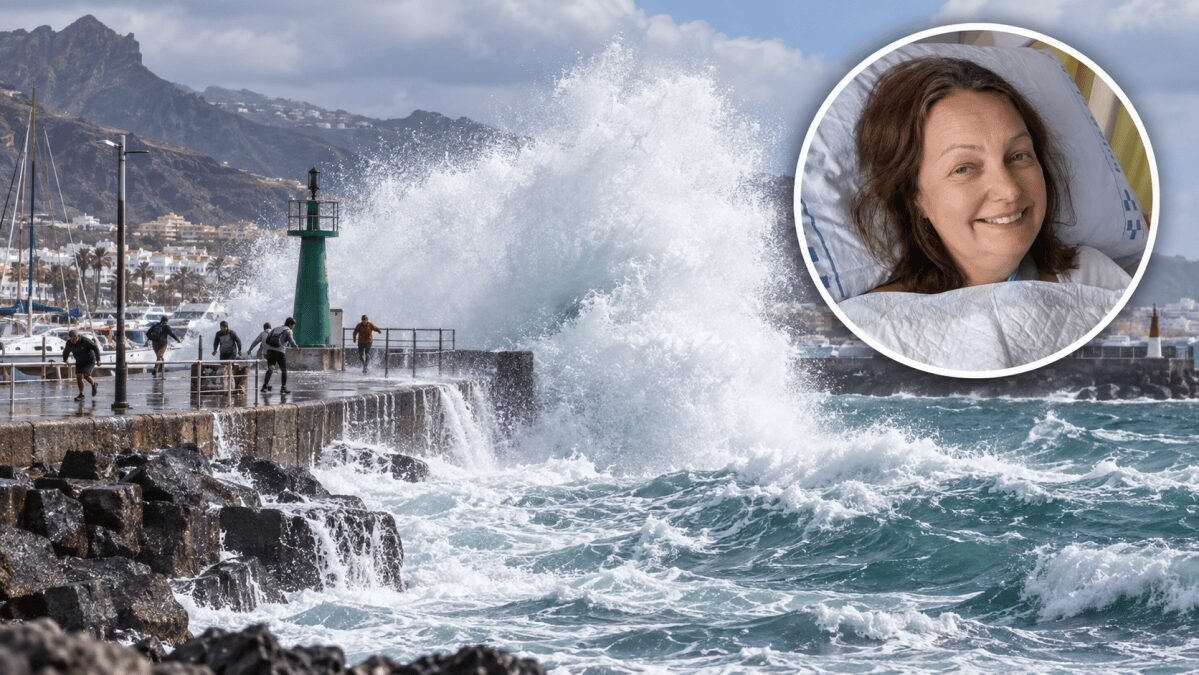
What was supposed to be one last peaceful walk during a family vacation turned into a terrifying fight for survival when a massive wave swept a woman and her husband off a pier and into the Atlantic Ocean.
Jane Bradshaw, 55, was visiting Tenerife, a popular Spanish vacation destination off the coast of Africa, with her husband Marcus and her elderly parents when disaster struck. Within seconds, the couple found themselves underwater, separated by powerful waves as horrified onlookers scrambled to save the people being dragged into the sea.
Now, nearly a year after the deadly incident, Jane is opening up about the horrifying experience, the serious injuries she suffered and the medical ordeal that followed her rescue.
The couple, from Stockport in Greater Manchester, England, had traveled to Tenerife to help Jane’s parents enjoy a relaxing getaway. Her mother has Alzheimer’s disease, while her father was awaiting hip surgery, making the couple’s assistance especially important.
On November 8, 2025, as the family prepared to return home, Jane and Marcus decided to take one final walk along the harbor at Puerto de la Cruz.
It was a decision Jane would come to regret.
As they walked along the pier, she noticed an enormous wave building beyond the harbor wall. Sensing the danger, she shouted for her husband to run, but there was almost no time to react.
The water crashed over the pier with tremendous force, sweeping people into the ocean and leaving Jane struggling to understand what had happened.
When she opened her eyes, she was deep underwater.
Somehow, she managed to fight her way back to the surface, where she could hear screams coming from the harbor. Her first thought was finding Marcus, who had disappeared in the chaos.
She eventually spotted him struggling against the powerful current near a harbor wall. Fortunately, he had rope in his backpack, which became an unexpected lifeline when someone above managed to grab it and pull him to safety.
Jane, however, remained trapped in the water with a broken arm and little strength to fight the waves.
Every surge threatened to drag her farther from safety, while the slippery harbor wall made escaping almost impossible.
As bystanders rushed to help, one man tied towels together and lowered them toward her, giving her something to grab. He managed to guide her along the wall toward a set of steps, where she desperately struggled to climb out.
Despite the pain, Jane knew she needed to escape before another wave struck.
She eventually reached safety but collapsed almost immediately, overwhelmed by her injuries.
The disaster was part of a series of dangerous coastal incidents that struck Tenerife that afternoon. Emergency officials reported that 10 people had been swept into the water at Puerto de la Cruz, where one woman died and nine others were injured, including three who suffered serious injuries.
Across the island, powerful waves and hazardous seas were linked to three deaths and at least 15 injuries that day. Authorities had warned of dangerous coastal conditions, including strong winds and powerful surges, before the incidents occurred.
For Jane, surviving the ocean was only the beginning.
Doctors initially diagnosed her with a broken upper arm, eight fractured ribs, chest injuries involving her lungs, severe swelling around her hip and extensive bruising across her back. Marcus also needed stitches for a serious cut to his arm.
After two days under observation at a public hospital, Jane was transferred to a private medical facility because she had travel health insurance.
She initially welcomed the move, believing private care might provide better treatment. Instead, she later described the experience as deeply distressing.
According to Jane, medical staff struggled to manage her multiple injuries, and she experienced serious problems with chest drains used during her treatment. She also claimed there were lengthy periods when she received little attention and that Marcus sometimes had to help with tasks normally handled by medical professionals.
Her lung complications complicated arrangements to return home, leaving her hospitalized in Tenerife for five weeks.
The prolonged hospitalization took an emotional toll, particularly as the couple struggled with the aftermath of an accident that had nearly cost them their lives.
Eventually, Jane was cleared to travel back to England accompanied by a doctor. An ambulance met her at Manchester Airport and took her directly to Manchester Royal Infirmary, where medical staff began a fresh assessment of her injuries.
It was there that doctors discovered two additional fractures involving her pelvis and sacrum, bones that form part of the lower spine and pelvic structure.
Jane said the difference in her treatment was extraordinary, recalling how relieved she felt when doctors began addressing her pain and thoroughly examining her injuries.
But another troubling discovery emerged during her recovery.
A physiotherapist noticed that medical notes from Tenerife incorrectly described her injuries as the result of a surfing accident.
The mistake helped explain why hospital workers had repeatedly asked Jane about surfing, even though she had been injured in a deadly coastal disaster.
Once the circumstances were clarified, her rehabilitation team recognized that she needed more than treatment for broken bones and damaged muscles. The psychological effects of nearly drowning, witnessing the chaos and enduring weeks of difficult medical treatment also required attention.
She was referred for specialist psychological support alongside physical rehabilitation.
Before the accident, Jane had been exceptionally active. She regularly ran races, cycled long distances, completed demanding hikes and enjoyed outdoor adventures with her husband.
Suddenly, activities she had once taken for granted became difficult or impossible.
In an account published by Manchester University NHS Foundation Trust on October 7, Jane revealed that she was still struggling with post-traumatic stress disorder, including flashbacks of the incident.
Although she has managed to return to cycling, she has not regained her previous fitness and remains unable to run. Her injured arm also continues to limit her movement.
She described the emotional difficulty of adjusting to a body that can no longer do everything it once could, explaining that looking healthier on the outside does not necessarily mean someone has fully recovered.
Jane now receives specialized rehabilitation through Manchester’s Major Trauma Enhanced Rehab Service, which combines intensive physical therapy with psychological treatment for people recovering from severe injuries.
The ordeal has also affected her family, particularly Marcus, who not only survived the same terrifying wave but took responsibility for helping Jane through weeks of uncertainty.
During the initial chaos, the couple lost their phones and glasses and were taken to different hospitals, leaving them unable to contact one another. Marcus eventually located his wife and notified their daughter and Jane’s parents before handling complicated arrangements involving medical care, insurance and travel.
Even after returning to England, he needed time away from work to help care for her.
While Jane continues to rebuild her strength, her experience also serves as a reminder of how quickly dangerous coastal conditions can turn an ordinary sightseeing trip into a life-threatening emergency.
The Canary Islands’ emergency authorities advise visitors to stay away from exposed piers, breakwaters and coastal areas during warnings for rough seas. Large waves can surge across seemingly safe walkways with little warning, particularly when powerful ocean swells reach harbor walls.
For Jane, the physical injuries are slowly healing, but the memories of that afternoon remain much harder to escape.
What began as a final stroll with her husband became a disaster that changed her life, leaving her grateful to have survived but still working toward the active future she once imagined.