Drone strikes in northern Ethiopia, competing claims over Red Sea access, and a new four-country diplomatic alignment threaten to deepen instability across the Horn of Africa
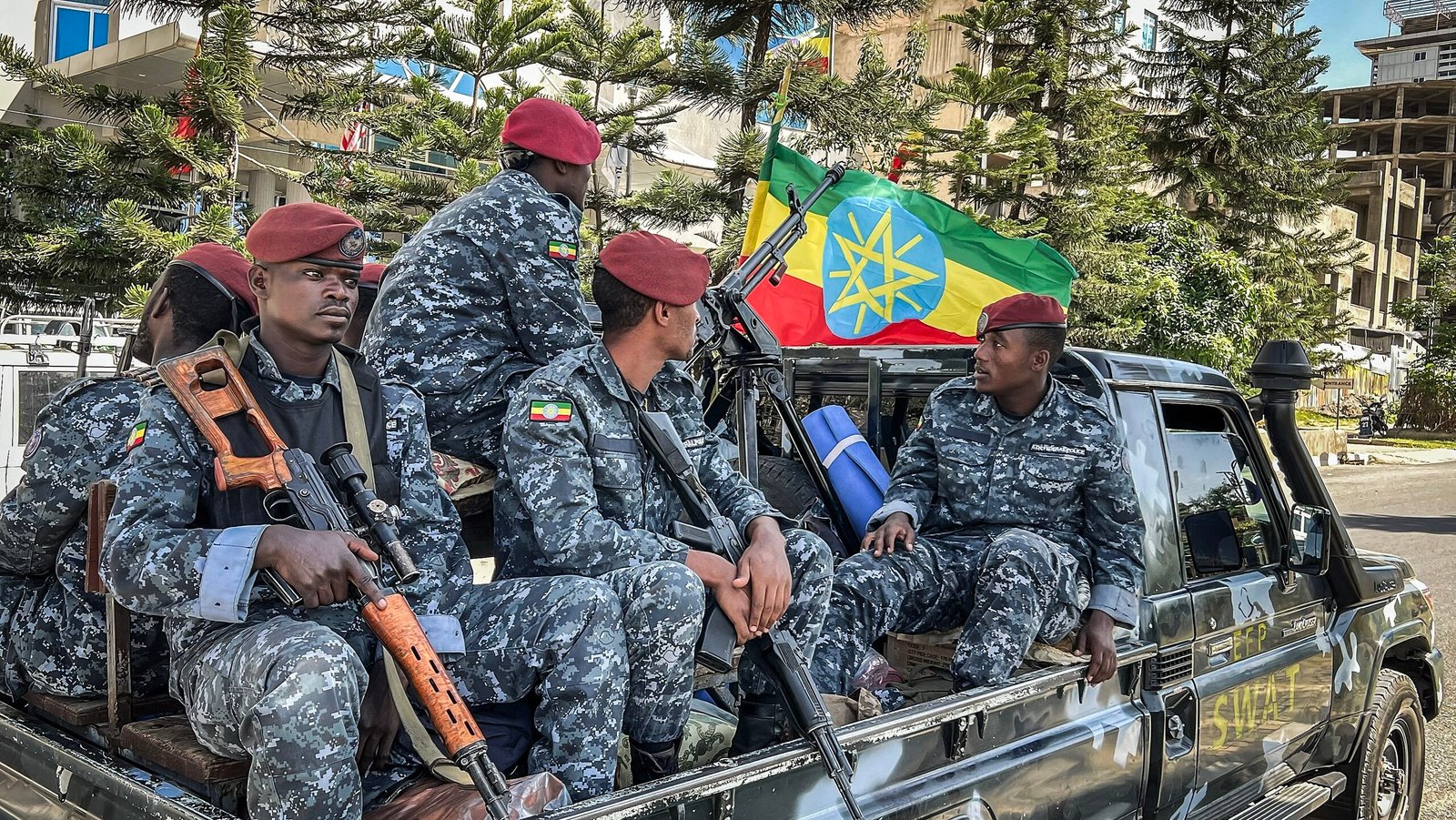
[CAIRO] Fears of a wider war in the Horn of Africa grew this week after Ethiopian drones reportedly struck Eritrean troops in northern Ethiopia, and Addis Ababa accused Eritrea of invading its territory. The confrontation threatens to destabilize a region already divided by disputes over Nile waters, access to the Red Sea, and control of strategic shipping routes.
The Armed Conflict Location & Event Data Project (ACLED), a nonprofit organization that monitors armed conflicts, reported that drones believed to have been launched by Ethiopian government forces struck Eritrean troops, vehicles, and ammunition near the northern Ethiopian town of Adigrat on Wednesday night and Thursday morning. Eritrean forces had crossed the border at Zalambessa and moved toward the road linking Adigrat and Idaga Hamus, according to ACLED.
In an October 8 letter to the UN Security Council, Ethiopian Foreign Minister Gedion Timothewos accused Eritrea of invading Ethiopian territory and demanded that its troops withdraw. Ethiopia said Eritrean forces had penetrated as far as 60 kilometers into its territory. Eritrea’s Information Minister Yemane Gebremeskel rejected the accusations, saying Addis Ababa was seeking a pretext for war.
By Friday, ACLED reported that Eritrean troops had withdrawn from Adigrat and that Ethiopian government forces and their allies had gained control of Idaga Hamus. The developments followed several days of rapidly shifting territorial control in the northern Tigray region.
Abiy’s army is weaker than at any other time
Yuri Tadesse, a Washington-based expert on Africa and the Middle East, said Ethiopia is poorly positioned for another war. “Abiy’s army is weaker than at any other time,” he told The Media Line, referring to Ethiopian Prime Minister Abiy Ahmed. He said armed groups inside Ethiopia are “coming at him from every corner.”
The latest fighting has also revived fears of a broader conflict within Ethiopia. Federal forces and their allies have been battling an opposition coalition led by the Tigray People’s Liberation Front (TPLF), which previously fought a devastating war against the Ethiopian government from 2020 to 2022. A government-aligned Tigrayan faction has joined the current campaign against the TPLF. Eritrea, which supported Ethiopian government forces during the earlier war, has since fallen out with Addis Ababa.
This week, the US State Department urged both governments to exercise restraint, warning that further conflict could jeopardize Washington’s cooperation with the two countries. On Wednesday, the US Embassy in Addis Ababa warned Americans of possible long-range attacks on military installations in the Ethiopian capital and advised them to avoid those areas.
Eritrea occupies a strategic stretch of the Red Sea’s western coastline, while neighboring Ethiopia, which lost its coastline when Eritrea became independent in 1993, has been seeking access to the waterway. The Red Sea connects the Indian Ocean and the Mediterranean through the Bab el Mandeb Strait and Egypt’s Suez Canal.
With the war involving Iran restricting traffic through the Strait of Hormuz, Gulf oil shipments through the Red Sea have become increasingly important. Yemen’s Iran-backed Houthis have also attacked shipping and Saudi targets from the opposite shore. A wider conflict involving Eritrea could expose another section of the Red Sea corridor to military threats.
The fighting comes days after Egypt, a major recipient of US military aid, brought Sudan, Eritrea, and Somalia together in a new diplomatic alignment. Two longstanding disputes are driving regional tensions: Egypt’s disagreement with Ethiopia over the Nile River and Ethiopia’s campaign to secure access to a seaport.
The four leaders met Sunday in the Egyptian resort city of New Alamein. Their joint declaration rejected recognition of Somaliland, a breakaway region of Somalia that Israel recognized in December 2025. It also affirmed that governance of the Red Sea is the responsibility of countries bordering it, supported Egypt and Sudan in opposing unilateral measures affecting Nile waters, and established a mechanism for continuing consultations.
Egyptian President Abdel Fattah el-Sisi reinforced that position Thursday during a visit to Seoul, where Egypt and South Korea upgraded their relations to a strategic partnership. Speaking alongside South Korean President Lee Jae Myung, el-Sisi rejected maritime access arrangements that would compromise the sovereignty of Red Sea coastal states. He said that “primary responsibility for Red Sea security and maritime governance rests squarely and exclusively with its littoral states.”
On October 1, Ethiopia closed its embassy in Eritrea and expelled 10 Eritrean diplomats, prompting Eritrea to sever diplomatic relations with Addis Ababa.
Ethiopia and Egypt also expelled diplomats from each other’s countries. Addis Ababa ordered an Egyptian diplomat to leave, and Cairo responded by expelling an Ethiopian diplomat. Ethiopia accuses Egypt, Eritrea, and Sudan of supporting an opposition alliance led by the TPLF. All three countries deny the allegations. Ethiopia’s Foreign Ministry said October 5 that any discussions about the Red Sea must take the country’s legitimate interests into account.
“Egypt wants to strengthen its regional presence, both in its backyard, represented by Sudan, and in the Horn of Africa,” Egyptian security analyst Hany El-Aasar, executive director of the National Center for Studies, told The Media Line.
El-Aasar said Egypt is concerned about both shipping through the Suez Canal and access to water. Egypt depends almost entirely on the Nile, and Ethiopia has built the Grand Ethiopian Renaissance Dam, Africa’s largest hydroelectric facility, upstream on the Blue Nile.
“Ethiopia has adopted policies that Cairo views as openly hostile,” he said. “Rival and hostile actors” are trying to gain control in the region, “even through proxies such as Ethiopia.”
A security analyst in Abu Dhabi, speaking to The Media Line on background, said the four countries had agreed to maintain consultations but made no commitment to defend one another and established no joint military command.
“I believe there is no interest in Egypt and Sudan intervening in the conflict directly,” Jalale Getachew Birru, an East Africa regional expert at ACLED, told The Media Line.
Tadesse said the summit was directed against Ethiopia, but he blamed Ethiopia’s leadership for the country’s growing diplomatic isolation. “I don’t blame these four countries. I blame Abiy Ahmed squarely,” he said.
It got all our neighbors to gang up against Ethiopia
He pointed to a 2024 agreement under which Abiy offered to recognize Somaliland in exchange for access to the sea. Abiy made “a historic, massive diplomatic blunder,” Tadesse said. “It got all our neighbors to gang up against Ethiopia.”
According to Tadesse, Egypt’s deeper concern is Ethiopia’s growing regional influence. “Egypt is not missing one drop of water, even after the completion of GERD,” he said, referring to the Grand Ethiopian Renaissance Dam. “Egypt’s fear is that if Ethiopia develops, it will become the hegemonic power of the Horn of Africa.”
Ethiopia is home to one of the world’s oldest Christian churches and, with more than 120 million people, is Africa’s second-most populous country. It lost its coastline when Eritrea became independent in 1993. In a September 2025 interview with Ethiopian state television, Abiy said regaining control of the Eritrean port of Assab was only “a matter of time.” He described Ethiopia’s loss of direct access to the Red Sea as a historical mistake that would eventually be corrected. This week, he told lawmakers that Red Sea access is “of vital importance to Ethiopia’s civilization.”
Somalia has offered Ethiopia another possible route to the sea. Its president, Hassan Sheikh Mohamud, said before the summit that Mogadishu would not object to Ethiopia using Somali ports for trade, provided Somalia consented to the arrangements.
Across the Red Sea, the Houthis have intensified attacks on Saudi Arabia, which exports crude oil from its Red Sea port of Yanbu. In recent days, the group claimed responsibility for missile attacks on Saudi airports and other targets. On October 7, the United Arab Emirates condemned Houthi attacks on Saudi civilian and economic facilities and Saudi vessels in the southern Red Sea and the Bab el Mandeb Strait. Saudi authorities have not independently confirmed every Houthi claim.
“The current US administration views developments in the Horn through the lens of its interest in the Red Sea,” Birru said.
Tadesse agreed that Washington’s priorities are shaped by its strategic interests. “They need that waterway,” he said. “The US does not lift a finger unless it’s related to US interests. And it should. Every country does that.”
Washington has taken several steps reflecting its regional priorities. On September 18, the US Treasury Department lifted sanctions imposed on Eritrea’s ruling party, military, and associated individuals during the previous Tigray war. This month, the State Department waived human rights conditions on $320 million in US military aid to Egypt, citing Cairo’s role in efforts to address the conflict with Iran.
In August, Massad Boulos, President Donald Trump’s senior adviser for Arab and African affairs, denied that Washington was supporting an anti-Ethiopia alliance. The administration “continues to pursue regional peace through diplomatic engagements with Egypt, Eritrea, and Ethiopia,” he said.
El-Aasar urged Washington to initiate talks between Ethiopia and Eritrea to prevent a war.
He also called for US military support for Saudi Arabia against the Houthis, even if that support were limited. He said people in the region viewed the current US position as “abandoning the kingdom and using that abandonment to pressure it toward normalization with Israel.”
Israel’s expanding diplomatic engagement in the Horn of Africa has raised particular concern in Cairo. Israel recognized Somaliland in December 2025 and has since appointed an envoy there. On September 10, Israel’s ambassador to Ethiopia, Avraham Neguise, publicly endorsed Ethiopia’s efforts to secure maritime access to the Red Sea.
Israel is behind Ethiopia in this effort. This is clear Israeli policy.
Speaking to the Ethiopian News Agency, Neguise said Israel regarded a stronger Ethiopia and a stable Red Sea as shared international interests. “Israel is behind Ethiopia in this effort. This is clear Israeli policy,” he said. Egyptian Foreign Minister Badr Abdelatty rejected Israel’s support for Ethiopia’s maritime ambitions.
Israel has reportedly trained Somaliland security personnel, and Israeli military delegations have visited the territory. A July investigation by Le Monde documented the development of military infrastructure at Berbera airport that could eventually be used by Israeli, American, and Emirati forces. The investigation described construction activity and potential military uses, but a permanent Israeli military deployment there has not been publicly confirmed.
An Israeli military presence in Somaliland “would create an encirclement of the Bab el Mandeb Strait and the Red Sea, which Cairo considers strategically vital,” El-Aasar said. He described Israel’s support for Somaliland as “destabilizing.”
Sudan’s civil war, now in its fourth year, is entangled in many of the same regional rivalries. On the sidelines of the summit, el-Sisi hosted Boulos and Sudan’s army chief, Gen. Abdel Fattah al-Burhan, at a lunch in New Alamein, according to Boulos. Washington is pressing Sudan’s army and its rival, the Rapid Support Forces (RSF), to accept a 90-day humanitarian ceasefire.
Sudan’s army-led government says it has submitted comments on the proposal rather than rejecting it. The El Alamein declaration supported Sudan’s national institutions and rejected “parallel entities,” a reference to the RSF, a powerful paramilitary group that has been fighting the Sudanese army for control of the country since April 2023.
The confrontation between Ethiopia and Sudan has added another complication to ceasefire efforts. On September 27, the Sudanese Armed Forces issued a statement rejecting Ethiopian accusations that Khartoum was supporting armed groups fighting Abiy’s government. Sudan’s military countered that the RSF was receiving assistance from within Ethiopia, including training, supplies, and access to Ethiopian territory for drone operations.
Ethiopia has denied supporting the RSF. The allegations have nevertheless attracted independent scrutiny. In February, Reuters reported that Ethiopia was hosting a secret military camp used to train thousands of RSF fighters. The investigation cited sources familiar with the operation and evidence of a military buildup near the Sudanese border.
The competing accusations reflect the increasingly interconnected conflicts in Ethiopia and Sudan, where both governments accuse their neighbors of backing armed opponents while seeking regional allies of their own.
There are 22 countries involved in the Sudanese crisis. It may end up divided into two countries.
Tadesse doubts a ceasefire will be reached soon. He said Burhan wants the RSF disarmed before any truce and that too many outside powers are involved in the conflict. “There are 22 countries involved in the Sudanese crisis,” he said. “It may end up divided into two countries.”
Before the summit, el-Sisi said the region’s problems require “a dialogue, not confrontation.” Tadesse agreed. “There is a way where Egypt’s interest is kept, and Ethiopia’s interest is kept,” he said. “Let’s come around the table.”