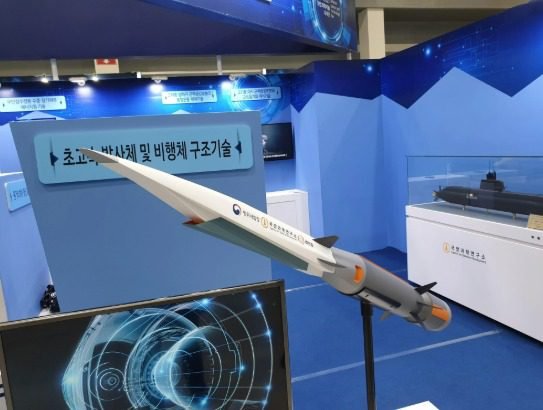
South Korea’s maiden flight test of a domestic hypersonic glide vehicle highlights an accelerating bid to field counterstrike assets capable of bolstering autonomous deterrence against North Korea’s expanding nuclear threat.
This month, multiple media outlets reported that South Korean President Lee Jae-myung oversaw the country’s first test launch of a domestically developed hypersonic glide vehicle, accelerating its drive to field high-speed conventional strike assets that can penetrate regional missile shields.
A booster rocket launched the weapon before it separated at high altitude, then descended and maneuvered both horizontally and vertically at low altitude to strike an offshore test target.
Although the South Korean government did not disclose the exact location, reports indicate the Agency for Defense Development conducted the test from a barge off Taean, approximately 130 kilometers south of Seoul. This trial verified guidance systems and ultra-high-temperature thermal shielding.
The test comes amid rising inter-Korean friction following a September border land mine blast that wounded South Korean soldiers and follows North Korea’s test of an intermediate-range hypersonic missile days earlier.
Seeking to counter North Korea’s evolving arsenal and reduce reliance on the US after scaled-back joint military drills, Lee urged researchers to swiftly deploy the strategic deterrent while also inspecting the military’s bunker-busting Hyunmoo-5 ballistic missile.
Although this hypersonic test sharpens South Korea’s prompt conventional counterstrike posture, deploying such assets directly collides with North Korea’s hardened missile architecture, pre-delegated nuclear doctrine, and South Korea’s capability and hedging limitations.
In an August 2026 Atlantic Council report, Markus Garlauskas and other authors note that non-nuclear hypersonic missiles are a viable counterstrike option to deter and respond to North Korean limited nuclear attacks.
Garlauskas and others recommend assessing posture adjustments that integrate “new US and allied non-nuclear counterstrike options such as hypersonic missiles” alongside South Korea’s heavy penetrating ballistic missiles to strike hardened adversary targets.
In a series of Beyond Parallel reports, Joseph Bermudez Jr. and other writers mention that North Korea operates an estimated 15 to 20 undeclared ballistic missile operating bases across tactical, operational and strategic belts.
Bermudez and others note that these bases are heavily hardened, using underground facilities, protective rock-and-dirt berms, and reinforced drive-through checkout bunkers to withstand airstrikes and artillery fire.
According to Bermudez and others, bases such as Sakkanmol, Sino-ri, and Sangnam-ni serve as dispersal and support hubs to provide conventional and nuclear first-strike capabilities against South Korean, Japanese, and US forces.
Against such threats, Garlauskas and others say that US and South Korean hypersonic strike capabilities aim to expand conventional response rungs between total inaction and regime-ending nuclear escalation.
They point out that fielding South Korean and allied conventional hypersonic and precision penetrators affords the alliance a flexible, survivable counter-battery tool to neutralize North Korean launch facilities and leadership command bunkers without causing catastrophic radiological fallout.
Such counterstrike options fit into a larger doctrine outlined in South Korea’s 2022 Defense White Paper. The document posits a pre-emptive military posture against North Korea, specifying a “Three-Axis System,” primarily spearheaded by the preemptive “Kill Chain” to rapidly detect and neutralize imminent nuclear and missile threats before launch.
The doctrine employs high-power ballistic and tactical surface-to-surface missiles, fifth-generation stealth fighters, and non-kinetic electromagnetic strike assets to destroy mobile launch vehicles and command infrastructure.
This preemptive strike tier is integrated with Korea Air and Missile Defense (KAMD) and Korea Massive Punishment and Retaliation (KMPR), all managed under a specific Joint Chiefs of Staff command structure.
However, the sheer number of North Korea’s mobile missile launchers may pose a significant operational risk, as such numbers can provide strategic depth against attrition while allowing dispersion to complicate enemy targeting and improve survivability.
In August 2024, North Korean Supreme Leader Kim Jong-Un oversaw the delivery of 250 tactical ballistic missile launchers to front-line troops. Operationally, detecting and destroying hundreds of mobile launchers and hardened underground facilities within a compressed launch window could severely strain South Korea’s intelligence and strike capacities.
Highlighting these strains, Chang-Young Lee notes in a September 2025 War on the Rocks article that South Korea’s intelligence, surveillance, and reconnaissance (ISR) capabilities lack a sovereign, persistent space architecture, leaving military planners dangerously reliant on allied data feeds during crises.
Lee notes that while South Korea possesses advanced conventional strike forces, it operates limited airborne assets and only recently began deploying military reconnaissance satellites, forcing it to depend on US and Japanese feeds to track North Korean nuclear sites.
He points out that those dependencies create blind spots if the US reprioritizes assets toward broader regional contingencies.
Furthermore, North Korea has been designing solid-fuel intercontinental ballistic missiles (ICBMs) such as the Hwasong-18 that do not need to be fueled before launch, can be kept in extended readiness, and can be launched with little warning.
The country has also been diversifying its nuclear delivery systems by introducing sea-based options such as the Amnok-class corvette—which could be equipped with nuclear-armed cruise missiles—conventional ballistic missile submarines, potentially nuclear-powered submarines, and possible nuclear-armed underwater drones to provide a second-strike option.
Crucially, preemptive and decapitation threats generate an acute “use-it-or-lose-it” dilemma, incentivizing North Korea to strike first or pre-delegate nuclear launch authority during crises.
North Korea’s leadership is acutely aware of that dilemma, with its September 2022 Law on Nuclear Forces explicitly codifying an automatic, pre-delegated nuclear retaliatory strike mechanism if the regime’s central leadership is incapacitated.
While the law designates the President of State Affairs (a position currently held by Kim Jong-Un) as holding monolithic, decisive command over the arsenal, it establishes that if hostile action endangers the command-and-control apparatus, a nuclear counterstrike is launched automatically and immediately.
Despite those developments, South Korea may be holding its own nuclear option in reserve. A June 2026 report by the National Bureau of Asian Research (NBR) shows low South Korean confidence in US commitment, while also showing high support (70% as of 2024) for having nuclear weapons.
However, the report notes that the discourse does not clearly distinguish between nuclear latency and nuclear hedging.
Nuclear latency is the state of possessing the knowledge, means, and resources to assemble a nuclear weapon without an active political decision or intent to weaponize, whereas nuclear hedging entails maintaining that capability while building the military and diplomatic groundwork to preserve a breakout option should the security situation deteriorate.
The report shows mixed opinions on nuclear latency and hedging in South Korea, with risk-averse positions prioritizing the country’s alliance with the US; bargaining positions that leverage nuclear rhetoric to extract stronger US commitment; entrepreneurial positions seeking space for civilian purposes; and risk-tolerant positions advocating an indigenous nuclear arsenal.
While South Korea’s push to field domestic hypersonic weapons marks an expansion of its conventional deterrence, its long-term security will ultimately hinge on whether it can adequately manage crisis escalation, bridge critical ISR gaps, and temper growing domestic pressure for an independent nuclear arsenal.