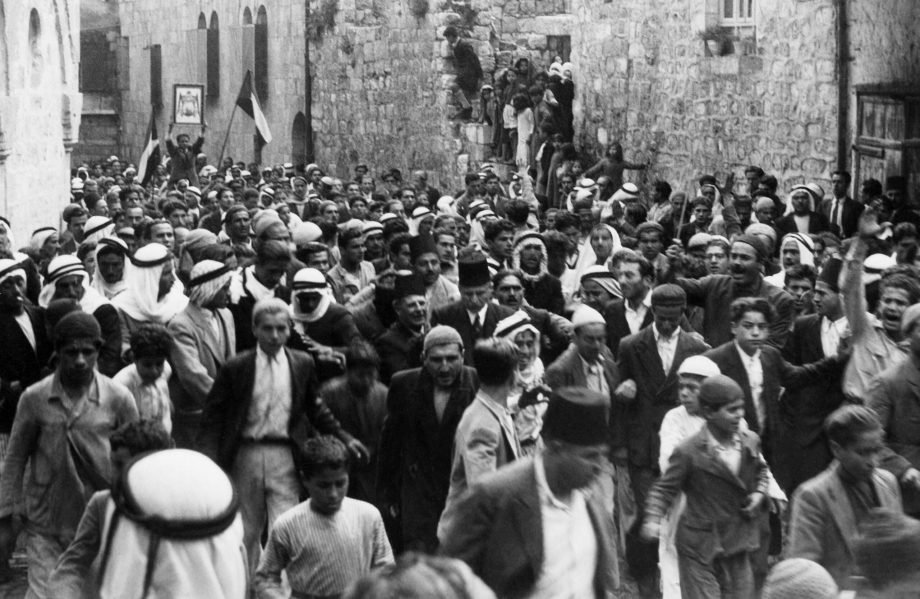
As the 2nd November 1917 anniversary of the infamous Balfour Declaration approaches, we are reminded of the fateful promise issued by the British government that would go on to define much of historical Palestine ever since. Eight years after issuing his government’s infamous pledge to establish a Jewish “national home” in Palestine—a promise that would later evolve into today’s Israel—Arthur Balfour visited Palestine for the first time in the spring of 1925. He was met by the Arab population, who constituted the overwhelming majority at the time, with a wave of fierce protests and general strikes. They acutely recognized that what he had set into motion in 1917 was the first structural nail driven by Great Britain—then governing Palestine under an imperial League of Nations Mandate—into the body of Palestine and its indigenous people, initiating a catastrophic process of displacement that continues to our very day.
Standing before the crowds during the dedication of the Hebrew University in Jerusalem, Balfour unblinkingly proclaimed the dawn of a new order, asserting: “A new epoch has begun within the Palestine which came to an end so many hundred years ago.” That grandiose declaration—utterly erasing the living, breathing Arab population looking on—reflected an aristocratic, colonial mindset completely detached from the daily realities of a people who were already beginning to fear for their homeland and their very survival.
The text of the 1917 Balfour Declaration itself exposes the fragility of one of modern history’s most enduring propaganda myths: the tired colonial slogan that Palestine was simply “a land without a people for a people without a land.” If Palestine were truly empty space, the British government would have had no legal or diplomatic reason to include the specific proviso that “nothing shall be done which may prejudice the civil and religious rights of existing non-Jewish communities in Palestine.” By explicitly acknowledging the indigenous Arab majority—even while deliberately reducing them to nameless “non-Jewish communities” to bypass their political and national rights—Balfour’s own language inadvertently refutes the myth of an empty land. For decades, Israel’s propaganda machine relied heavily on this fabrication to justify displacement, though mounting historical scrutiny and modern global awareness have thankfully rendered this talking point increasingly hollow.
From Jerusalem, Balfour moved on to Damascus, where popular demonstrations against him intensified to such a dangerous degree that crowds stoned his hotel, clashes broke out with security forces, and he was forced to cut his visit short.
Unable to safely deliver speeches or complete his itinerary, he had to flee under heavy guard to escape the roaring tide of Arab fury spanning Palestine, Syria, and the wider Levant.
Today, modern Britain appears to be trying—however belatedly and inconsistently—to reckon with the catastrophic legacy it set into motion over a century ago. For more than one hundred years since the 1917 Declaration, successive UK governments maintained an unyielding double standard: they rigidly guaranteed Israel’s security, military superiority, and diplomatic shielding, while treating Palestinian statehood as a distant abstraction. For decades, London resisted any notion of compelling Israel to accept a genuine Palestinian state, turned a blind eye to the ongoing denial of a common-sense refugee return, and routinely shielded Israeli leadership from international accountability over illegal land confiscations and systematic displacement.
READ: Saudi crown prince meets Syrian president in Riyadh
Yet, under relentless public pressure and the unbearable weight of unfolding humanitarian disasters, that armor of diplomatic complacency is finally beginning to crack. No one expects an overnight revolution in Whitehall, but the underlying posture is shifting. While London historically reduced its commitment to the two-state solution to hollow lip service, modern political reality has forced a deeper reckoning—culminating in formal steps toward Palestinian statehood and a growing willingness to challenge illegal settlements.
At the same time, the domestic political landscape inside the UK has undergone a structural transformation. Within the Labour Party, years of intense grassroots pressure made Palestinian rights a central feature of its election platform, with numerous candidates contesting seats explicitly under pro-Palestinian platforms. Following its return to power and particularly under new prime minister, Burnham, the government took concrete policy measures—banning imports of goods from illegal West Bank settlements, penalizing settlement expansion, and implementing targeted sanctions against extremist settlers—marking a restrictive shift against the colonial enterprise that succeeding governments will find politically difficult to reverse.
This shifting baseline culminated dramatically when the UK Green Party formally adopted a landmark policy position defining Zionism as a form of racism. Passing by a majority vote at its conference last week, the motion explicitly characterizes Zionism as an ethno-nationalist ideology that privileges one group over another through displacement, while backing a single democratic state across historic Palestine, a full arms embargo, and the Boycott, Divestment, and Sanctions (BDS) movement. While drawing sharp divisions with its own parliamentary MPs and fierce condemnation from Jewish community organisations, the move shatters long-standing Westminster taboos, bringing the foundational ideology of the Israeli state directly into the arena of mainstream British political debate.
In today’s language, if modern Britain is truly serious about breaking from its colonial past, it cannot continue to selectively enforce the Balfour Declaration. True accountability demands that Whitehall implement the declaration in its entirety—honoring not just the commitment to a Jewish “national home,” but fulfilling the fundamental moral and legal obligation to safeguard the indigenous population, a duty Britain has evaded for over a century.
Honouring the Balfour Declaration requires adhering strictly to what the document itself explicitly stipulated: that “it being clearly understood that nothing shall be done which may prejudice the civil and religious rights of existing non-Jewish communities in Palestine.”
For over a hundred years, London weaponised the first half of the text while burying the second; true integrity means honoring both.
For over a century, Britain treated its foundational promise to Palestine as fine print to be ignored. Until Whitehall matches its rhetorical shifts with the full weight of its historical obligations—ensuring that Palestinian rights and self-determination are finally realized—the shadow of 1917 will continue to define Britain’s moral standing in the world.
OPINION: How Gaza’s genocide is reshaping US domestic politics
The views expressed in this article belong to the author and do not necessarily reflect the editorial policy of Middle East Monitor.