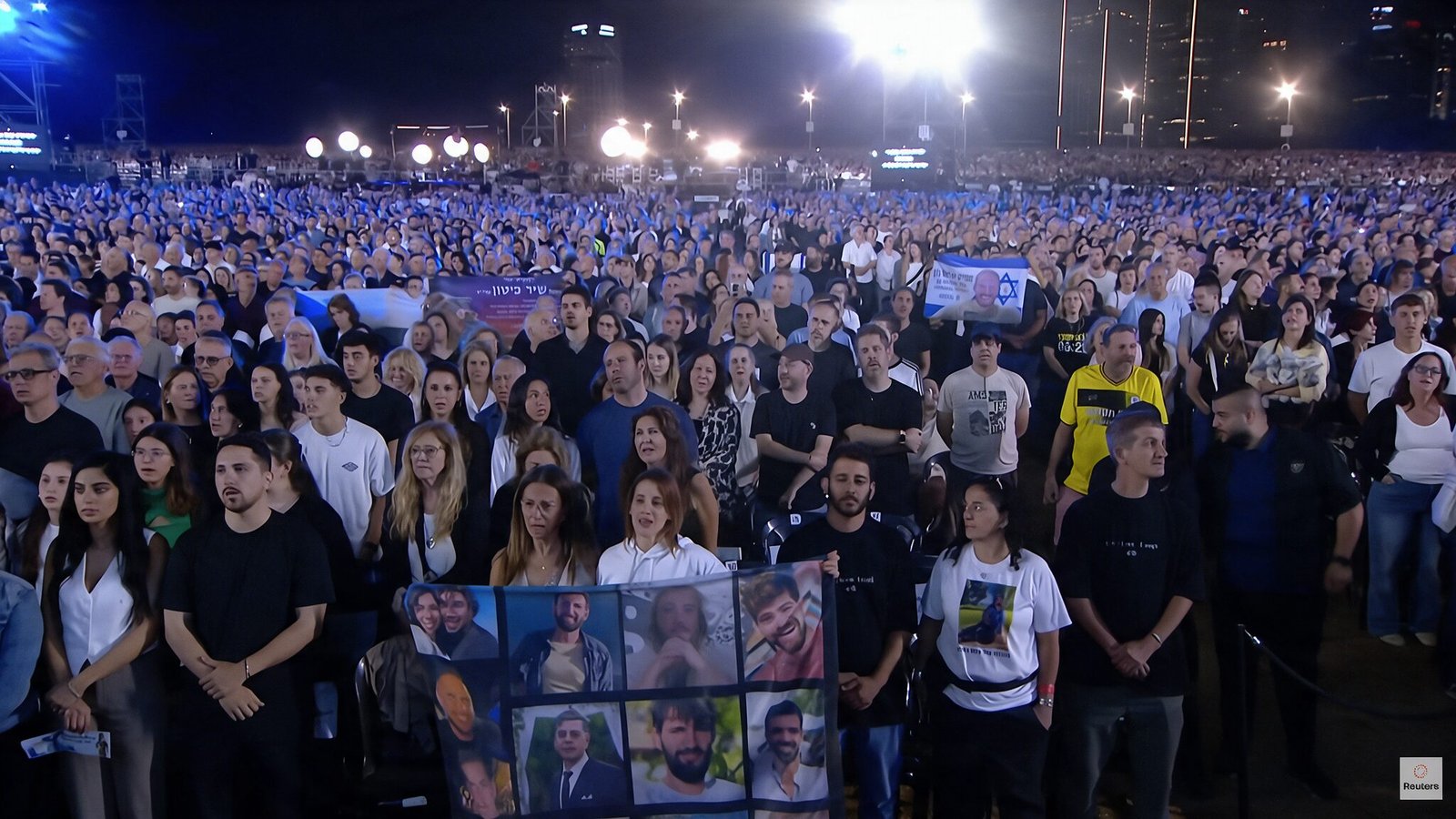
About 30,000 people attended Israel’s national October 7 memorial ceremony at Yarkon Park in Tel Aviv, honoring those killed in the Hamas attack, hostages murdered in captivity and Israelis who fought to protect others during the massacre three years ago.
The ceremony, organized by Kumu (“Rise Up”), a movement founded by families of victims, hostages and survivors, began with a moment of silence at 9:15 p.m. Former hostage Eli Sharabi and Shani Cohen hosted the event, which included testimony and performances by Israeli artists including Yuval Rafael and Idan Amedi.
“On that Shabbat morning, we lost so much. We lost friends, families, homes, and entire communities that were devastated. We lost the people we love most, we lost our sense of certainty, we lost a part of our innocence, and our hearts burned,” Sharabi said. “And on that day, which plunged the entire State of Israel into a deep abyss of sorrow, it seemed we had also lost the country we once knew.”
Sharabi’s wife and two daughters were killed in their Kibbutz Be’eri home, while his brother was taken captive and died in Gaza.
The ceremony honored civilian and military acts of heroism, including those of Maj. Ido Shani, Cpt. Sahar Saudyan, and Ofakim security guard Israel Chana. Ido Yakir, a member of the Kibbutz Magen security team, recited the Yizkor prayer, while Rabbi Benny Kalmanson, father of reservist Capt. Elhanan Meir Kalmanson, recited the Mourner’s Kaddish.
Former hostage Omer Shem Tov and Anat Angrest, mother of hostage Matan Angrest, were also among the speakers.
A separate tribute commemorated the 46 hostages taken alive to Gaza on October 7 who were later murdered in captivity, mainly by their captors, while some were inadvertently killed in Israel Defense Forces strikes.
Adi Marciano, whose daughter Noa was kidnapped alive from the Nahal Oz military base and killed in captivity, said, “They held on for weeks and months in the darkness, in fear, clinging to life, waiting for someone to come and save them.”
“We didn’t get our loved ones back; we received them for their final rest. And we gained a new family too — the family of the bereaved.”
In their closing remarks, Sharabi and Cohen spoke of remembrance, seeking answers and rebuilding.
“We must remember those who were murdered, those who fell, who left home and never returned,” Sharabi said
“Not just because we owe them the memory. But rather because we owe the truth to ourselves. To remember what happened. To investigate how it happened. Not to cut corners. Not to let time blur the truth, not to rewrite history, and not to let history repeat itself,” he concluded.