In late 1970, a Titan IIIC rocket launched from Space Launch Complex 40 at what was then called Cape Canaveral Air Force Station. It carried a top-secret payload for the US military.
Much has changed in spaceflight since then. The Titan IIIC would bow out in 1982 after dozens of launches. Various Titans continued launching from Space Launch Complex 40 until 2005, at which point the US Air Force—in a competitive process hotly opposed by United Launch Alliance—turned the pad over to a small, largely unknown startup called SpaceX. And Cape Canaveral is now a “Space Force” station.
But those unspecified payloads? Until last month, some of them were still flying operationally.
They were looking for missile launches
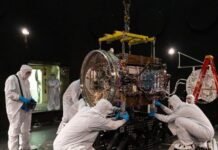
The US government would later disclose that the top-secret payload that launched in November 1970 was a “Defense Support Program” satellite. The initial block of these satellites, launched from 1970 to 1973, had a mass of about 1 metric ton, and each carried about 2,000 infrared detectors. They were essentially very sensitive telescopes, and each satellite was launched into geosynchronous orbit.
For a time, these were among the most important satellites flown by the US, as they served to detect the launch of a nuclear warhead at the country. As a result, the Defense Support Program would become one of the primary elements of American military space power during the Cold War.
These initial satellites transformed experimental infrared observations into an operational program that continuously monitored the globe for missile launches. Initially built to identify Soviet ICBMs, they were essential for nuclear deterrence; later, they also became useful in conventional warfare, such as detecting Iraqi Scud missile launches.
Over time, the military added to the constellation, improving reliability and expanding their capabilities. Each satellite ended up having more than 6,000 infrared detectors and a mass of about 2.5 tons. Satellites in the Defense Support Program kept on flying into space until 2007. One of them, DSP-16, even launched on a space shuttle (Atlantis) in 1991.
The program finally comes to an end
For more than 55 years, at least a handful of these satellites have been flying as silent sentinels—until last month.
On Thursday, the US Space Force said that the final two surviving Defense Support Program satellites (presumably DSP-20 and DSP-22) participated in an on-orbit maneuvering exercise in early September. Independent orbital tracking showed that these satellites subsequently both raised their orbits by a few hundred kilometers, a move typically associated with disposing of them into graveyard orbits above geostationary space. The Space Force statement confirmed this marked the program’s official retirement.
“The DSP constellation was foundational to the defense of our nation,” said US Space Force Col. Brandon Davenport, Mission Delta 4 Commander. “These last two satellites were the culminating end to over a half century of space-based early warning. The DSP constellation ensured deterrence during the Cold War and protected our deployed warfighters from the Gulf War until their retirement last month.”
Two replacement programs
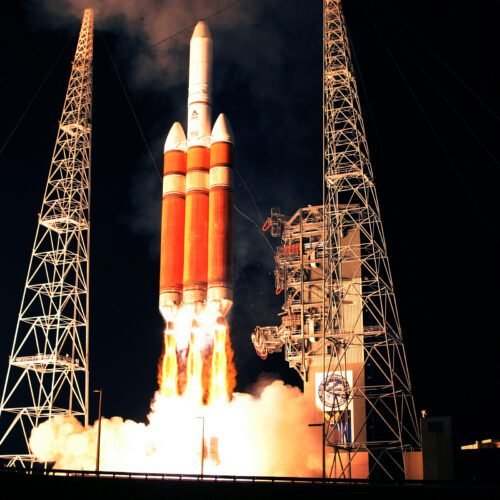
The program had a remarkable run in longevity. It began when such observations were still experimental, and satellite manufacturing largely produced bespoke spacecraft. Their launch extended across a range of rockets from various Titan rockets to the Delta IV Heavy program and even NASA’s Space Shuttle.
The United States is not flying blind in the absence of the Defense Support Program, of course. In 2011, the military began launching a new generation of infrared satellites, known as the Space Based Infrared System. Because these satellites have better sensors, they can generally detect dimmer events and provide a longer warning time.
More recently, the military is developing its Next-Generation Overhead Persistent Infrared satellites. The first of these satellites could launch within the next 12 months on a Vulcan rocket.