The artificial intelligence (AI) race between the United States and China has accelerated in model protection, supply chains and talent controls, even as the two nations’ leaders agreed last week to open a new dialogue on AI safety.
A string of moves announced or uncovered this week shows that both sides are now guarding their models, hardware and engineers more tightly than ever. The rivalry has spread from chips to the data center equipment and the people behind the technology.
OpenAI said Wednesday that it had disrupted a coordinated campaign of adversarial distillation, the unauthorized use of one model’s outputs to train another. It attributed a core cluster of the activity to individuals associated with Moonshot AI, the Beijing-based developer of the Kimi K3 chatbot, and said it had shut down related activity across more than 15,000 users by July 28.
Amid the intensifying AI race, Chinese authorities have started requiring the spouses and children of top AI talent to obtain official approval before traveling abroad, even for short trips, Bloomberg reported on Tuesday, citing people familiar with the matter. The move comes as new exit and entry rules, effective September 15, allow authorities to stop anyone deemed a threat to national technological security from leaving the country.
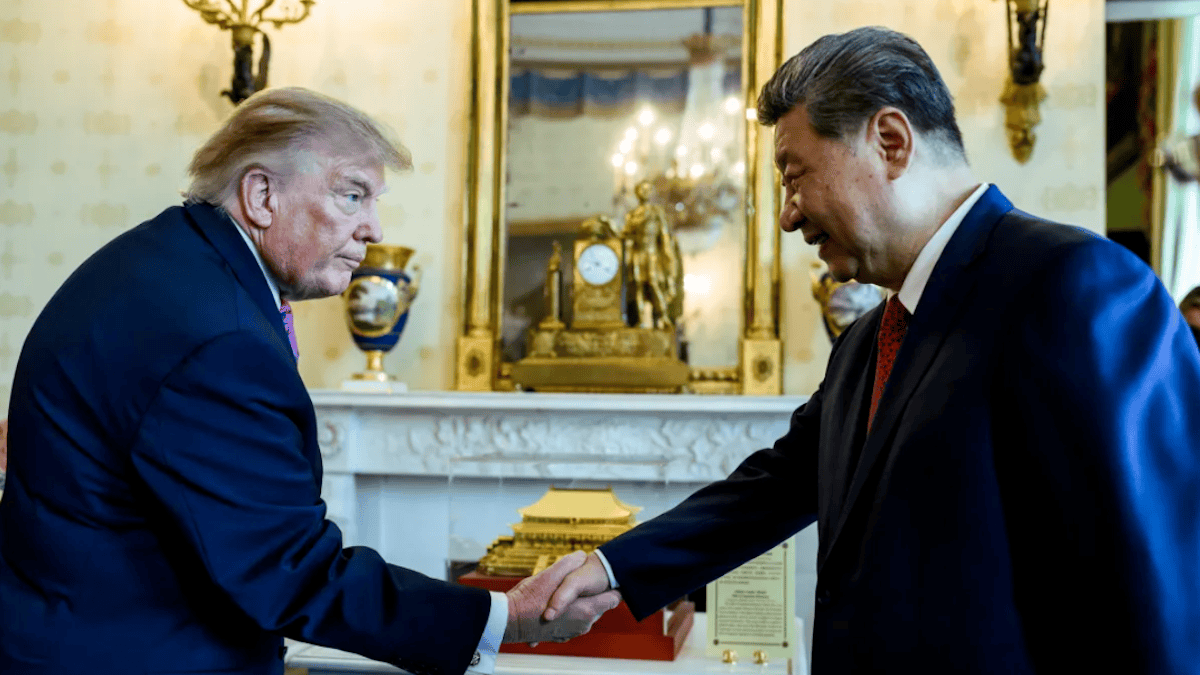
These moves have intensified despite a three-day summit between US President Donald Trump and Chinese President Xi Jinping in Washington last week. The two sides agreed to set up a communication channel for AI-related incidents and to hold a bilateral AI dialogue, with senior officials set to gather in Shenzhen in November during the Asia-Pacific Economic Cooperation (APEC) summit.
On August 26, Trump signed an executive order banning foreign-made transformers, high-voltage circuit breakers and other grid equipment linked to China and 23 other countries. The order took effect immediately, but no purchase is barred until the Department of Energy identifies risky equipment and publishes implementing rules, due by December 24.
Earlier this year, some global equipment suppliers prepared to run their data center supply chains regionally.
Legrand, a French electrical and digital building infrastructure group, bought Kratos Industries, a Colorado-based switchgear maker for data centers, in February to serve the US market. In April, it acquired TES Group, a Northern Ireland-based power distribution specialist serving Europe, and Keydak, a Guangzhou-based rack maker serving the Chinese market. Data centers accounted for 26% of Legrand’s revenue at the end of 2025.
Lucie Daudigny, a press officer at Legrand, told Asia Times that it was too early for the company to comment on Trump’s executive order, as many details of the measures had not yet been finalized.

“From a manufacturing point of view, the components we use are made by global companies such as ABB and Schneider,” James Peacock, chairman of TES Group, said in an interview in Northern Ireland. “I don’t perceive anything we put into our products that would stop us from delivering them to the US market.”
“The North American market is a great opportunity. The challenge for TES right now is that we’re so busy scaling in Europe. Have we got enough bandwidth to scale in North America at the same time?” he said.
He added that Legrand buys strategic businesses that fill gaps in its portfolio and lets them operate as standalone businesses in their own silos, though he would not rule out future collaboration.
On September 25, four US senators introduced a bill to bar federal agencies from buying for national security systems any Chinese optical transceivers, which move data across AI networks. Optical transceivers are modules that convert electrical signals into light pulses to move data between servers, and large AI data centers need millions of them.
The Coalition for a Prosperous America (CPA), a Washington-based lobbying group, pointed out that Chinese firms control roughly 70% of the global optical module market. It said Zhongji Innolight, the world’s largest manufacturer of high-speed optical transceiver modules, still has its hardware inside America’s data centers and national security systems, although it was added to the Department of Defense’s list of Chinese military companies in June.
Beyond the chip ban
Since 2022, Washington has used chip export controls to slow China’s AI progress. China has fought back with Southeast Asian data centers, smuggled Nvidia chips, homegrown Huawei processors and AI models partly distilled from US ones.
This year, Washington began allowing exports of more advanced chips such as Nvidia’s H200. Beijing approved some H200 purchases this summer and is reportedly now weighing imports of Nvidia’s RTX PRO 5500.
The US-China AI race is now being fought at the data center level.
On Tuesday, Trump hosted a White House lunch with 31 technology executives, including Elon Musk and Nvidia’s Jensen Huang. Recalling a meeting with Xi that Musk also attended, Trump said the Chinese leader was keen to attract AI data centers to China.
“He would love to have every single one because they’re smart. They want every data center. They want it because that’s great for China,” Trump told reporters after meeting dozens of technology executives on Tuesday.
He said he wanted global firms to build AI data centers in the US rather than in Nordic countries or China, as they would bring investment, jobs and tax revenue to America.
Attendees at Tuesday’s lunch signed a voluntary accord on “superintelligence” (the term that Trump prefers instead of artificial intelligence) that includes internal and external reviews of the technology. Trump said the self-policing agreement was morally binding but stopped short of backing new government guardrails. He ruled out working with Xi on governing AI.
“A lot of people say, let’s do it together with China, but then they’re going to be able to immediately gain access to things that we know that they don’t know,” he said. “We’re leading now over China and everyone else, and I want to keep it that way.”
Chinese commentators criticized Trump for sending mixed signals on global AI governance.
“Before the Xi-Trump summit, US Treasury Secretary Scott Bessent led the AI dialogue between the two sides, and media reports said they had reached some consensus on joint AI regulation,” Peter Qiu, the founder and president of the Hong Kong Center for Globalization (CGHK), says in an article. “Trump’s sudden opposition to working with China on AI regulation suggests that his team is willing to cooperate with Beijing, while he himself wants a strategic rivalry.”
“As long as Trump is opposed, it will be hard for China and the US to reach any substantive cooperation on joint AI regulation, a highly sensitive and dangerous field,” he says. “The US-China AI dialogue is in some ways comparable to the US-Soviet nuclear disarmament talks of the 1970s and 1980s.”
He adds that Beijing should make good use of whatever room for maneuver it has during the more than two years left in Trump’s term, a balancing act that will be a major challenge for China’s diplomacy and foreign strategy.
“The US intends to keep a firm grip on high-end chips, advanced algorithms, computing platforms and industry standards so that China stays in a catch-up position, turning [the American] technological edge into a bargaining chip,” says a Henan-based columnist using the pen name, Yimei Technology. “What makes the US think it can stay ahead forever by closing the door on cooperation?”
“For Trump, whether to cooperate depends first on how much the US can gain. If cooperation would help a rival catch up, he blocks it, and when the US needs overseas markets, supply chains or manufacturing capacity, cooperation is repackaged as an opportunity,” she says.
She says that China’s strengths in AI lie in the country’s complete industrial system, huge market and fast deployment and that US containment will only push China to speed up its own AI development.
“China’s innovation never seeks a monopoly. Chinese open-source AI models have been downloaded more than 10 billion times worldwide, helping to bridge the global intelligence divide,” Fu Cong, China’s permanent representative to the United Nations, said at a National Day reception in New York on Tuesday.
He said China had launched the World AI Cooperation Organization to help reform global governance and was willing to work with all countries to uphold multilateralism and share development opportunities.
Read: After Trump-Xi summit, Nvidia RTX PRO 5500 gains export prospects
Follow Jeff Pao on X at @jeffpao3






 race between the United States and China has accelerated in model protection, supply chains and talent controls)