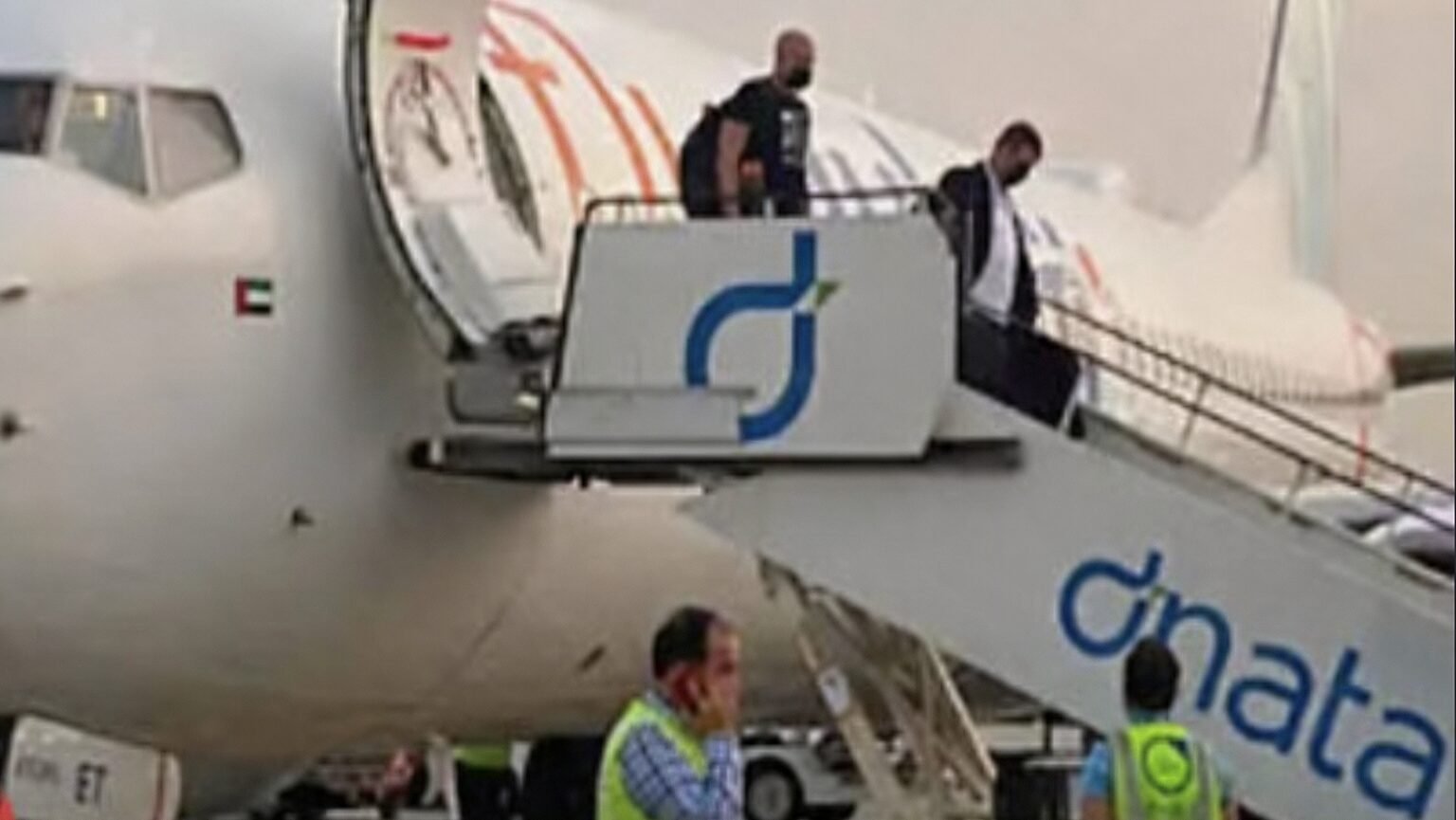
Images circulated after the landing appeared to show damage to the aircraft’s rudder, but no aviation authority had publicly established the cause of the apparent damage
Twenty-five years after the September 11 attacks, an Israel-bound passenger jet plunged more than 14,000 feet as a violent struggle unfolded inside its cockpit. Israeli officials say the co-pilot stabbed the captain and tried to crash Flydubai Flight FZ1073 before passengers subdued him and a reserve Flydubai crew traveling aboard took control of the aircraft and landed it safely in Saudi Arabia.
Saudi authorities are investigating the incident and have not publicly established a motive. Flydubai has confirmed an altercation on the flight deck but has cautioned against speculation while the investigation continues.
If the Israeli account is borne out, the episode would pose a different aviation-security problem from the September 11, 2001, attacks. The alleged attacker did not need to bypass cockpit security to access the controls. He was authorized to be there.
Flight FZ1073, a Boeing 737 MAX 8, was traveling Wednesday from Dubai to Tel Aviv with 172 passengers, 169 of them Israeli, according to Israel’s ambassador at its permanent mission in Geneva, Daniel Meron, who spoke to Reuters.
The flight diverted to Prince Sultan bin Abdulaziz International Airport in Tabuk, northwestern Saudi Arabia. The airport said air traffic control received the aircraft’s request for an emergency landing at 8:44 a.m. local time. It landed at 9:45 a.m.
Both the captain and co-pilot were injured and taken to a hospital. Prime Minister Benjamin Netanyahu said Saudi authorities arrested and interrogated the co-pilot.
Israeli officials have identified the alleged attacker as an Omani national and say they are treating the incident as a suspected terrorist attack. Defense Minister Israel Katz characterized it as an attempted jihadist attack. Saudi investigators have not publicly adopted that conclusion, and Flydubai says the reasons and motives remain unknown.
Flight-tracking data show how quickly the situation became dangerous. Flightradar24 data cited by Reuters showed the aircraft cruising at about 34,000 feet over Saudi Arabia before losing more than 14,000 feet in roughly 30 seconds. It briefly crossed into Jordanian airspace before returning to Saudi Arabia and heading toward Tabuk.
The aircraft transmitted squawk code 7700, the international signal for a general emergency, and several minutes later switched to 7500, which indicates unlawful interference. It subsequently returned to the general emergency code.
The flight data can establish what the aircraft did, but not why. Investigators will need cockpit voice and flight-data recordings, air traffic control communications and testimony from passengers and crew to reconstruct the order of the stabbing, rapid descent, emergency signals and intervention.
Netanyahu said the injured captain managed to release the cockpit door, allowing passengers to enter as the aircraft was descending. Doron Spielman, a spokesman for the Prime Minister’s Office, told Reuters that passengers found the wounded captain on the floor and the other pilot at the controls.
One passenger subdued the alleged attacker, according to Spielman. A reserve Flydubai crew traveling aboard then took control of the aircraft.
Flydubai has confirmed that account in part, saying an on-duty crew traveling on the flight secured the aircraft, diverted it and landed safely in Tabuk.
Video from the flight verified by Reuters showed two injured, bloodied men lying on the floor after the confrontation. Other images showed blood on passengers who had apparently been involved in the intervention.
The comparison with September 11 rests on the alleged objective, not on any established connection to those attacks or to al-Qaida.
On September 11, 2001, hijackers seized four US passenger aircraft. Three were deliberately flown into the World Trade Center towers and the Pentagon. Passengers and crew on United Airlines Flight 93 fought back after learning what had happened to the other aircraft; the plane crashed in Pennsylvania before reaching its suspected target in Washington.
The Flydubai case differs fundamentally: the person accused of trying to bring down the aircraft was himself a member of the flight crew.
That gives the incident another historical parallel. In 2015, Germanwings Flight 9525 crashed in the French Alps after co-pilot Andreas Lubitz locked the captain out of the cockpit and deliberately put the Airbus A320 into a descent, killing all 150 people aboard. Investigators did not conclude that the Germanwings crash was terrorism.
“It will change the way we do things,” Capt. Meidan Barr, former chairman of the Israeli Pilots Association, told The Media Line.
Barr, who had flown a Boeing 737 earlier Wednesday, said the safe landing should give investigators access to flight data and cockpit recordings that can be checked against accounts from passengers and crew. He urged investigators to complete that work before drawing conclusions about how a reported knife reached the cockpit or which safeguard may have failed.
Barr said a descent as rapid as the one recorded Wednesday can put substantial stress on an aircraft and make a subsequent landing more difficult. It can also make movement and communication aboard the aircraft harder as forces act on those inside.
Pilots train to carry out rapid emergency descents in circumstances such as a loss of cabin pressure, he said, but that does not explain what caused Wednesday’s descent.
Images circulated after the landing appeared to show damage to the aircraft’s rudder, but no aviation authority had publicly established the cause of the apparent damage.
The presence of reserve pilots aboard was crucial, Barr said, but did not make the situation routine. Airlines have procedures for dealing with an incapacitated pilot, and ground personnel can assist crews by radio. Taking control of an aircraft in the middle of an emergency without having prepared to operate that particular flight remains demanding even for a qualified pilot.
“It’s feasible, but it’s very difficult,” Barr said.
The incident is also turning attention toward what happens before a pilot ever enters a cockpit.
Barr expects investigators and aviation authorities to examine how crew members are recruited, trained, assessed and monitored. He would not prescribe a particular change while the facts remain unsettled.
Pilot vetting has already become part of the official response. Aviation-security specialists told Reuters that commercial pilots undergo background checks as well as continuing medical and psychological assessments. International Civil Aviation Organization standards provide the framework, but individual countries and airlines are responsible for implementing them.
The European Union Aviation Safety Agency told Reuters that Flydubai’s certification and safety oversight are the responsibility of the United Arab Emirates’ General Civil Aviation Authority, including requirements governing flight crews and their fitness to fly.
Dr. Uri Ben Yaakov, chief operating officer and senior researcher at the International Institute for Counter-Terrorism at Reichman University, also raised September 11 during his interview with The Media Line.
He said the comparison would depend on whether investigators establish that the co-pilot deliberately intended to use the passenger aircraft to kill those aboard. An attempted crash by itself does not establish terrorism, he said. Investigators will have to examine the co-pilot’s background, communications and recent behavior and determine whether he acted alone or had contact with an organization.
That inquiry may explain what happened more readily than it reveals how it could have been prevented.
Ben Yaakov said a person acting alone may exchange no instructions for an intelligence service to intercept. Investigators are likely to question people close to the suspect about changes in his behavior and examine his contacts and electronic material for indications of outside involvement.
He was cautious about predicting copycat attempts. Knife and vehicle attacks can be repeated by people with ordinary access to public spaces, he said. Very few people have authorized access to the controls of a commercial airliner.
Aviation security has also been repeatedly strengthened since the wave of airline hijackings in the late 1960s and 1970s and again after September 11.
We never have 100% security
Still, Ben Yaakov said, “we never have 100% security.”
Much of the physical evidence is now in Saudi Arabia, a country that does not have formal diplomatic relations with Israel. Saudi authorities received the aircraft, treated the injured pilots and detained the co-pilot. Israeli officials are seeking information about his background, possible contacts and whether anyone else was involved.
Ben Yaakov said law enforcement agencies can cooperate on investigations despite political differences between their governments, although sharing information about an airline employee may be more complicated than coordinating the physical security of an airport or aircraft.
The passengers, meanwhile, left Saudi Arabia aboard a replacement Flydubai aircraft at 5:40 p.m., according to Tabuk airport authorities. The flight landed at Ben Gurion Airport Wednesday evening.
Magen David Adom teams and airport medical personnel were waiting when they arrived. Most passengers required no medical treatment. A 51-year-old man with a minor upper-body injury was taken to a hospital in good condition.
The incident has already produced competing political responses in Israel.
Transportation Minister Miri Regev called for Flydubai flights to Israel to be suspended while the case is investigated and asked the Civil Aviation Authority to examine whether the United Arab Emirates complied with its aviation agreement with Israel.
Amir Hayek, Israel’s former ambassador to the UAE, urged officials not to rush to blame Flydubai. He pointed out that Flydubai and Etihad continued serving Israel during periods when many foreign airlines suspended operations.
Flydubai said the incident had not affected its wider scheduled operations, and no general suspension of its Israel service had been announced Wednesday evening.
Netanyahu, meanwhile, has ordered tighter security measures for pilots flying into Israel on both Israeli and foreign airlines.
Spielman told Reuters that authorities intend to know the identity of every pilot operating flights into Israel and subject them to security screening.
Who is flying my plane?
For Barr, that is where Wednesday’s incident is likely to leave its longest mark. Passengers have long been trained to think about who might try to get into a cockpit. The next set of questions may concern the people already inside it.
“Who is flying my plane?” Barr asked.