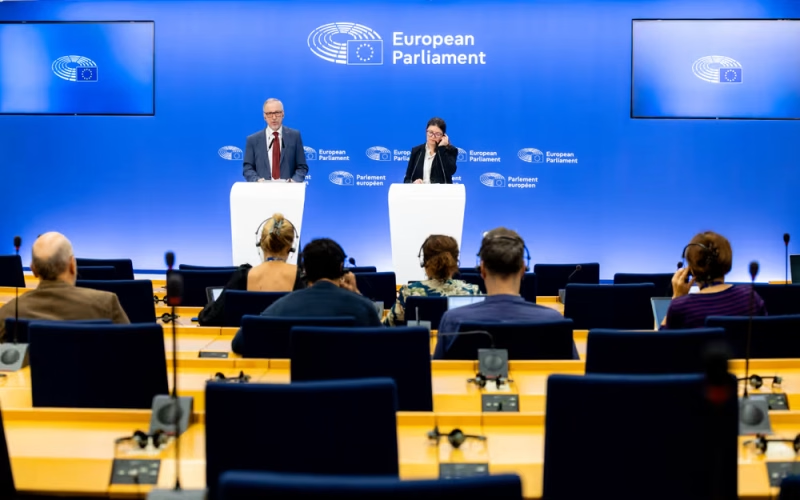
The European Parliament’s Committee on Culture and Education (CULT) voted Tuesday to amend the European Commission’s proposal for the 2028-2034 Erasmus+ programme.
Erasmus+ is the main EU funding instrument for mobility in education and training, youth and volunteering, and sport. It has had around 17 million participants since its creation in 1987, and its 40th anniversary falls in 2027.
The committee’s position was approved by 24 votes to one, with one abstention. It will go to a vote by the full Parliament at an upcoming plenary session. Once approved, negotiations can begin with the Council of the EU, which agreed its position in May 2026.
More funds and clearer distribution
Lawmakers called for raising the programme budget to €47.39 billion in current prices, compared with the €40.8 billion proposed by the Commission, to ensure the programme’s stated ambitions are adequately funded.
To simplify management and make the programme more predictable, they proposed a clear split of funds among policy fields: education and training would receive 74.6% of the total, youth and volunteering 15%, and sport 4.1%, with distribution also set within each field.
The committee also sought to strengthen conditions for combining Erasmus+ with other EU funds and initiatives. It backed a requirement that grants continue to respect the EU’s financial interests and the values set out in Article 2 of the Treaty on European Union.
Inclusion, teachers and athletes
Committee members said support for exchanges should reflect differences in living costs, housing prices, inflation and purchasing power among host countries, regions and cities. They want the new programme to be more inclusive, with at least 20% of participants being people with less access to career and educational opportunities.
They also said the programme should help implement the upcoming EU teachers and trainers agenda and lead to policy developments that improve teacher recruitment and retention. For the first time, they said, Erasmus+ should facilitate the mobility of athletes in grassroots sports, not only staff of sports clubs or organizations.
Lawmakers supported the Commission’s proposal to merge Erasmus+ with the European Solidarity Corps, including the European Voluntary Humanitarian Aid Corps. Best practices from the Solidarity Corps will be applied in the new programme.
“Erasmus+ is one of the EU’s most recognised programmes, creating opportunities for millions of Europeans to learn, teach, train, and gain international experience,” said rapporteur Bogdan Zdrojewski, a Polish member of the European People’s Party. “The decisions we make today will shape those opportunities for years to come.”
The Commission proposed the new Erasmus+ regulation on July 16, 2025, as part of the EU’s 2028-2034 long-term budget package. Parliament wants the budget to remain a strong investment tool that supports citizens, regions and businesses while delivering value beyond national budgets. Lawmakers propose increasing the size of the draft budget and insist on new revenue sources to fund it.
Find out more information