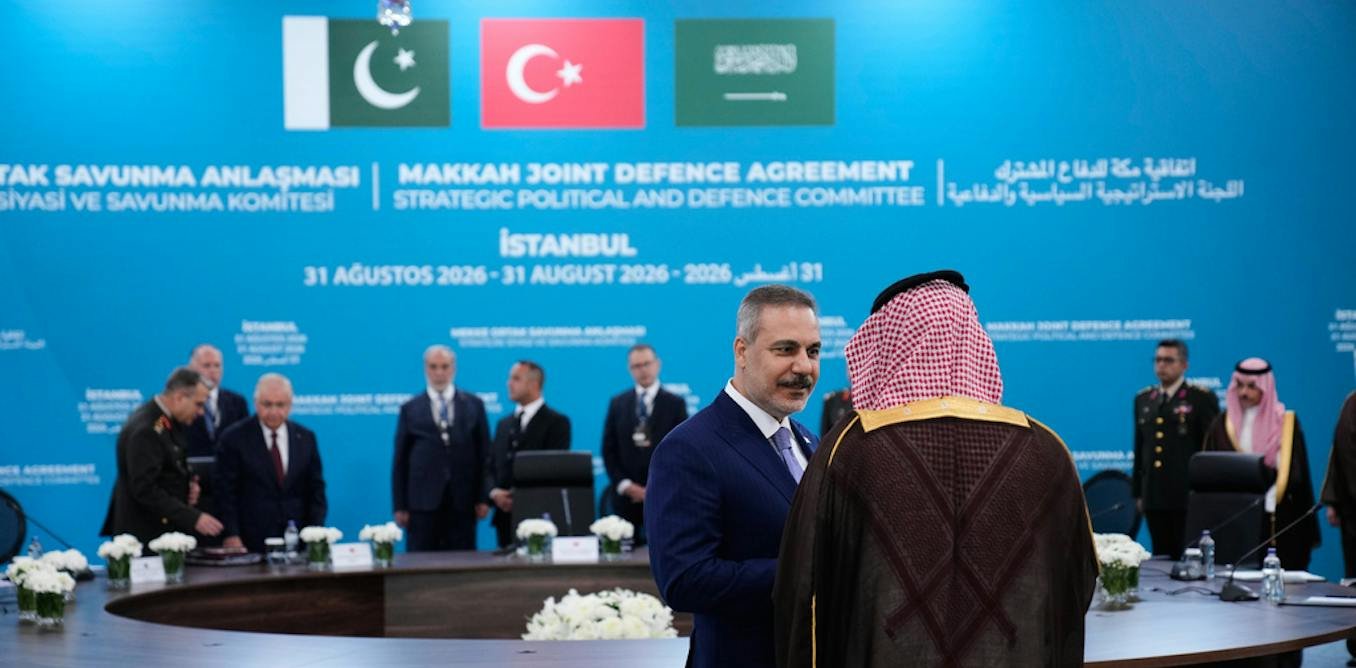
When Saudi Arabia, Turkey and Pakistan agreed to a mutual defense pact in August, it was principally seen as a political commitment. The “Mecca alliance,” as it was dubbed, stipulated that an armed attack on one would be treated as an attack on all three, accompanied by deeper military cooperation.
That pact is no longer simply a promise on paper. Within weeks, the three governments began building out the institutions and military mechanisms needed to give that commitment practical meaning.
With Houthi attacks continuing to threaten Saudi territory and Red Sea infrastructure, Turkey on Sept. 19 said it was prepared to meet Saudi Arabia’s military needs under the pact. Four days later, Pakistan appointed the first secretary-general to the three-country arrangement – officially called the Mecca Joint Defense Agreement.
Then on Sept. 25, the Saudi, Turkish and Pakistani foreign ministers convened on the sidelines of the U.N. General Assembly, reviewed progress toward institutionalizing the agreement, and called for an urgent meeting of their military chiefs. Those chiefs met in Riyadh that same day to discuss intelligence sharing, military coordination and the integration of capabilities.
Far from diplomatic and security humdrum, these developments make the Mecca pact about more than territorial defense in a region beset by myriad challenges and conflicts, from Iran to Yemen. For Saudi Arabia, which played the leading role in bringing the pact together, the arrangement responds to a pressing strategic need: strengthening the kingdom’s capacity to deter threats to its territory and the Red Sea corridor while reducing its reliance on external security guarantees. Indeed, protecting the kingdom increasingly means safeguarding not only its territory and airspace, but also the maritime corridors through which its economy reaches global markets.
From territorial defense to corridor security
The Mecca agreement emerged as Saudi Arabia and other Gulf states faced intensified missile and drone threats linked to the Iran conflict and Houthi attacks emanating from Yemen.
But defending Saudi Arabia’s territory is only part of the problem. During the current crisis with Iran, Saudi Arabia had to rely more heavily on its western coast and the Red Sea as an alternative outlet for energy exports after the Strait of Hormuz became severely constrained. The East-West pipeline carries Saudi crude across the kingdom to the port of Yanbu, allowing oil to reach the Red Sea without passing through Hormuz. Once that route becomes more important, however, the Bab el-Mandeb becomes a strategic vulnerability.
This is where two developments that might otherwise appear unrelated begin to fit together. On July 30, Saudi Arabia and 13 other countries announced a Multinational Maritime Defense Alliance to protect shipping through the Bab el-Mandeb, Red Sea and Gulf of Aden. Turkey and Pakistan, members of that maritime coalition, helped launch the Mecca pact just days later.
The two arrangements address different parts of the same strategic problem. The Mecca pact provides a framework for territorial and air defense; the maritime coalition seeks to protect the sea-lanes through which Saudi Arabia’s economy increasingly depends on for moving energy and goods. The distinction between the two becomes less meaningful when an attack on a Saudi pipeline, port or tanker can have consequences for the same national security interests as an attack on Saudi airspace.
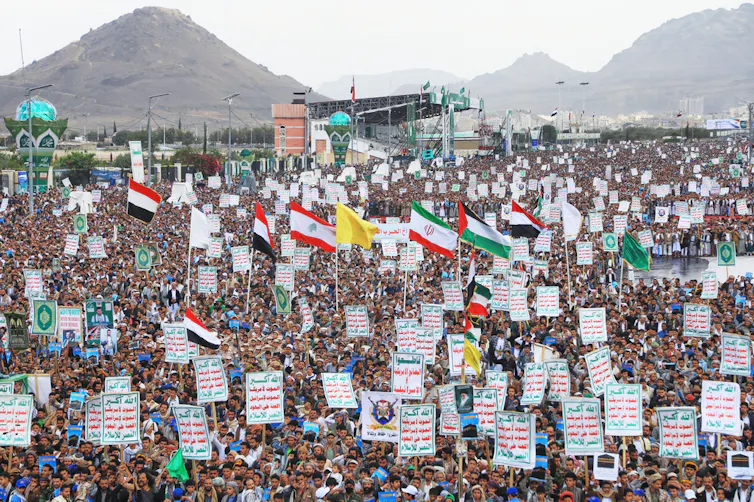
The Houthi campaign illustrates the problem. Attacks originating in Yemen have demonstrated that Saudi Arabia’s vulnerability cannot be confined to its borders. A missile or drone aimed at Saudi infrastructure and a maritime attack in the Red Sea may involve different weapons and operating environments, but both can disrupt the kingdom’s economic security.
The Sept. 25 trilateral meeting therefore took place as the distinction between Saudi Arabia’s territorial and maritime vulnerabilities was becoming harder to maintain.
Why Turkey is the connective tissue
Turkey sits at the intersection of these two security tracks.
Saudi Arabia brings geography, financial resources and a direct stake in securing the Arabian Peninsula and Red Sea corridor. Pakistan brings long-standing defense ties with Riyadh and substantial military capabilities.
But Turkey adds an increasingly sophisticated defense industry – including drones and other systems – alongside a diplomatic and strategic presence stretching from the eastern Mediterranean to the Red Sea and Horn of Africa.
That combination gives Ankara a potentially distinctive role. The Mecca pact needs countries with compatible capabilities, intelligence, coordination and equipment if its mutual-defense commitment is to be more than words. The maritime coalition faces a similar challenge in translating political support for freedom of navigation into a sustained security presence.
Turkey is positioned to contribute to both.
The two coalitions, however, remain distinct. Their memberships and mandates differ, and there is no indication of a joint command linking the Mecca pact to the broader maritime coalition. Nor does the September meeting of military chiefs establish that the three countries are preparing joint offensive operations against the Houthis.
The emphasis so far has been on coordination, intelligence and capability integration.
The significance therefore lies less in the emergence of a NATO-style regional alliance than in the possibility that separate defense initiatives are beginning to reinforce one another.
Regional backup plans
The developments also need to be understood in relation to the United States.
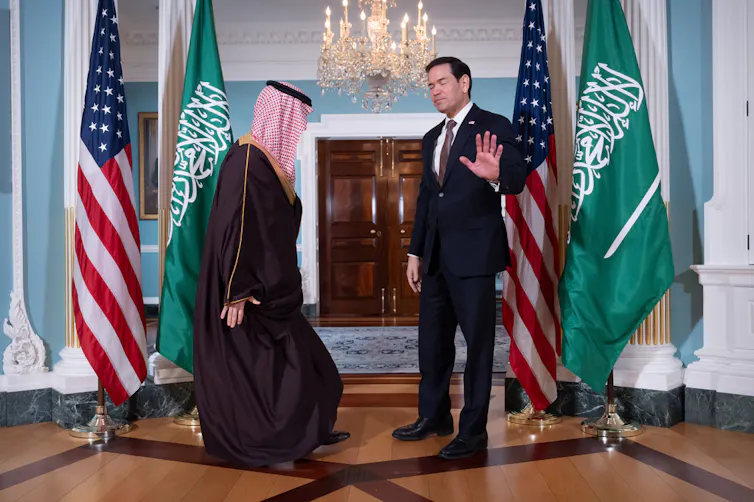
Saudi Arabia is not replacing its long-standing security relationship with Washington with an alliance involving Turkey and Pakistan. The Mecca pact does not require that outcome, and Saudi Arabia continues to rely heavily on American military capabilities, training, intelligence and security cooperation.
But repeated regional crises have put that reliance under growing strain, prompting Riyadh to hedge against the risks of depending so heavily on U.S. security guarantees.
What is changing is the number of actors involved in providing security around the kingdom and the extent to which Saudi Arabia is attempting to shape those arrangements. As such, the Mecca pact can be understood as an additional layer of regional security rather than a wholesale strategic realignment.
Regional states have long depended on outside powers while seeking greater strategic autonomy. The current situation in and around the Persian Gulf reinforces that tension because the threats facing Saudi Arabia are increasingly difficult to separate into discrete categories.
The same logic applies to the maritime coalition. A U.S. naval presence can protect shipping, but the creation of a regional coalition gives Saudi Arabia and its partners a mechanism through which they can assume more responsibility for the security of the waters on which their economies depend. It also gives Turkey and Pakistan a more institutionalized role in a security environment that extends beyond their immediate borders.
Whether these developments amount to a new regional security architecture remains uncertain. The institutions are young, military commitments are still being defined, and the maritime coalition’s broad membership does not necessarily translate into a willingness to deploy forces.
But the developments are significant because they point to a shift in how Saudi Arabia is addressing its security vulnerabilities. Missile defense, maritime security and energy infrastructure can no longer be treated as separate problems: Disruption in one part of the kingdom’s strategic geography can quickly affect the others.