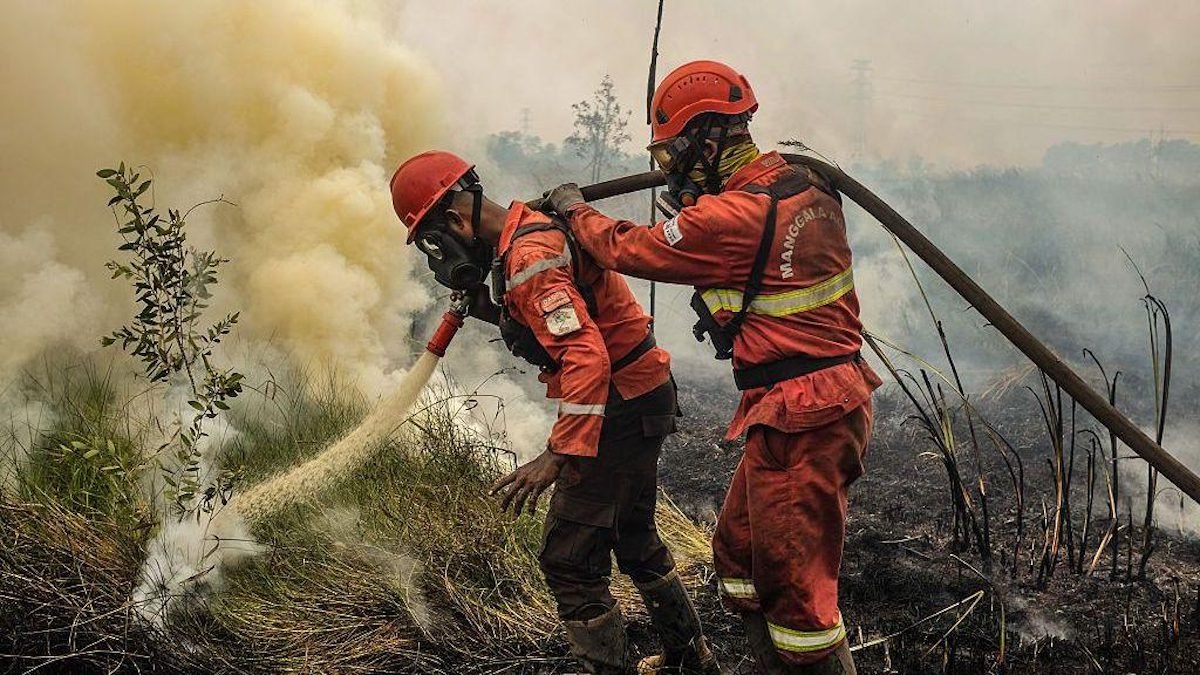
Two American charities recently announced a new fund to fight forest fires. They want to raise US$100 million to help countries find fires faster and put them out sooner. But the fund, announced at the UN General Assembly, is limited to South America, home to the Amazon rainforest.
Southeast Asia is left out, and so is Indonesia. Indonesia should not accept this quietly. The government in Jakarta should ask to join the fund and push for it to protect Indonesian forests, too.
The fund began in New York during a major annual climate meeting. Two nonprofit groups, Renaissance Philanthropy and Conservation X Labs, lead it. The Gordon and Betty Moore Foundation gave $30 million, and the David and Lucile Packard Foundation added $5 million.
The plan copies what already works, such as a camera network in Brazil that spots smoke early and a team of Indigenous firefighters in Bolivia that has worked for 15 years. Indonesia needs these ideas right now.
This year has been hard for Indonesia. Government data shows that fires burned more than 202,000 hectares of land from January to June, and almost 95,000 more hectares in July alone.
In half a year, the country lost an area nearly three times the size of Singapore. In West Kalimantan, smoke covered the city of Pontianak so thickly that it was almost invisible from the air. Schools closed, and flights were delayed. People in Malaysia, Singapore, Brunei and the Philippines breathed the smoke too.
The Center of Economic and Law Studies, a research group in Jakarta, estimates that fires from January to August cost Indonesia between 40 and 123 trillion rupiah in lost business and health care. In 2015, the World Bank calculated that fires cost the country $16 billion. That was more than twice the money needed to rebuild Aceh after the 2004 tsunami.
Why are Indonesia’s fires so hard to stop? A big part of the answer is peat. Peat is soft, wet soil made from dead plants that pile up over thousands of years. Indonesia holds about 36% of the world’s tropical peat.
When peat dries out, fire can spread underground, where water dropped from planes cannot reach it. This year, El Niño, a change in ocean temperature that brings long dry months to the region, has made the drought worse.
Some people will say the fund was made for the Amazon and Indonesia should solve its own problems. I disagree, for three reasons.
The first reason is money. In the same week, a United Nations report found that the world needs $66.8 billion more by 2030 to protect tropical forests. In 2023, only $14.6 billion was spent.
Almost 80% of the rainforest left on Earth is in three places: the Amazon, the Congo Basin in Africa, and Borneo, the island Indonesia shares with Malaysia and Brunei. If donors build a fire fund for only one of these places, the other two will keep waiting. Leaving out Southeast Asia was a big mistake.
The second reason is that Indonesia has something to offer. Indonesia has fought peat fires for about 30 years. Its Forestry Ministry tracks fire spots almost as they happen, using data from American satellites.
Brazil and Bolivia can learn from Indonesia’s mistakes, and Indonesia can learn from their cameras and their Indigenous fire teams. A fund that connects the Amazon and Borneo will be smarter than one that looks at only one region.
The third reason is harder to say, but it matters most. Most of Indonesia’s fires are started by people. Farmers and companies often burn land because it is the cheapest way to clear it for palm oil, other crops or mines.
If Indonesia joins an international fund, partners will ask difficult questions. The government should welcome these questions. Clear data and fair courts will bring in more support than excuses.
Bambang Hero Saharjo, who leads a fire management center for Southeast Asia, asked the world to help Indonesia put out its fires. But help rarely comes to a country that waits quietly for it.
So what should Jakarta do? The Forestry Ministry and the Foreign Ministry should contact the fund’s leaders before the end of this year. Indonesia can offer some of its own money, even a small amount, to show that it is serious. It can invite Malaysia and Brunei to join, because the fires on Borneo belong to all three countries.
The fires will come back next year and the year after that. El Niño comes and goes, but dry peat and cheap land clearing stay. A fund that already exists, with money already raised, is a good place to start. Indonesia should knock on its door now.
Bhima Yudhistira Adhinegara is the executive director of the Center of Economic and Law Studies (CELIOS), a Jakarta-based think tank. Muhammad Zulfikar Rakhmat is the director of the China-Indonesia and MENA-Indonesia desks at CELIOS.