Five leaders representing four electoral lists agree to coordinate their campaigns and prepare for a possible government while leaving leadership and coalition questions unresolved
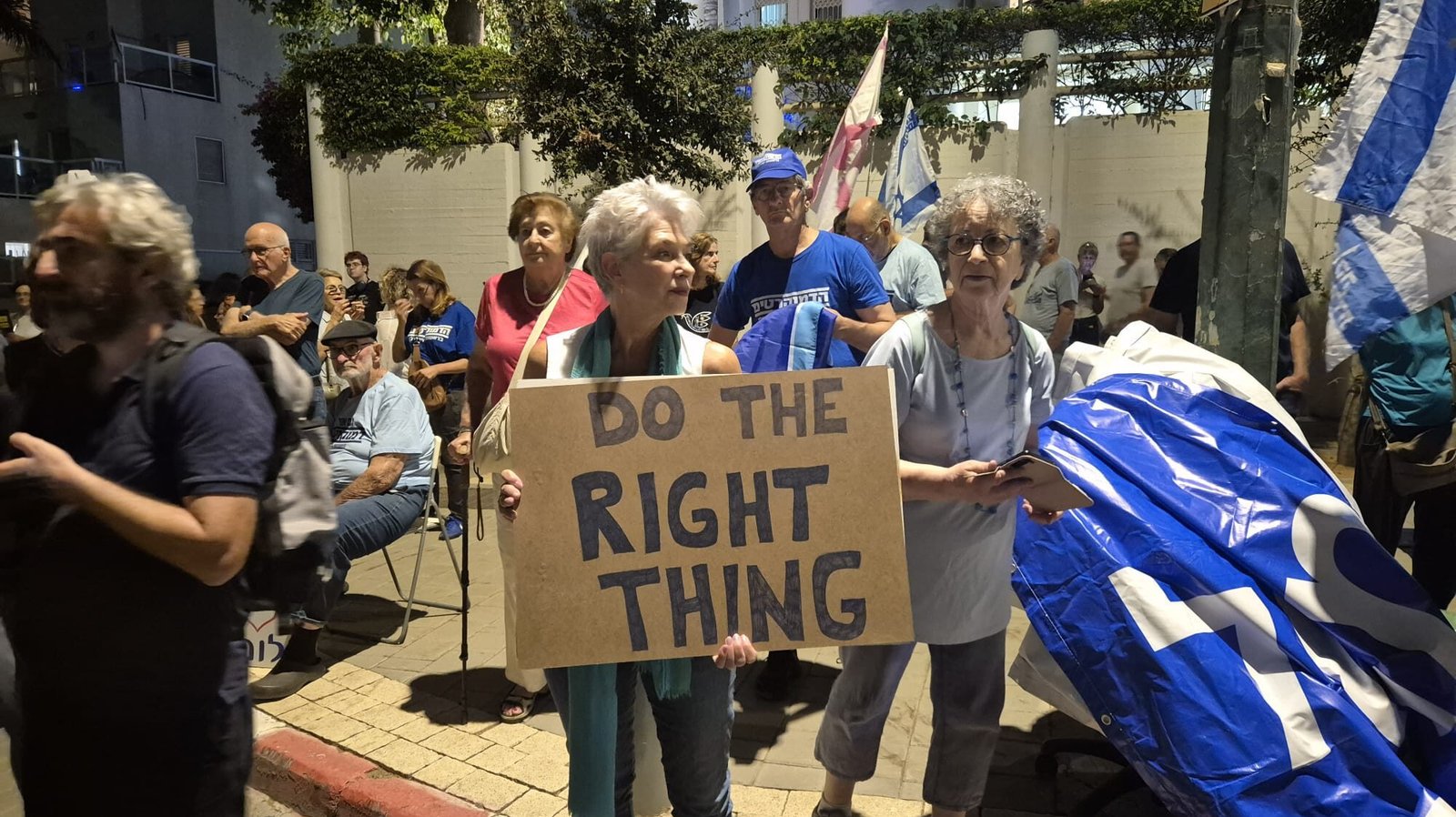
Outside Opposition Leader Yair Lapid’s Tel Aviv home on Saturday evening, supporters of several political parties and movements gathered as five opposition leaders met inside to coordinate their campaigns ahead of Israel’s Oct. 27 election.
Some wore T-shirts bearing the names of The Democrats or Gadi Eisenkot’s Yashar party, while others represented liberal and progressive movements promoting Jewish-Arab cooperation. Nearby, demonstrators in orange prison jumpsuits and masks depicting Prime Minister Benjamin Netanyahu and other government ministers posed alongside a man dressed as a Qatari sheikh handing out imitation dollar bills.
Yaron Gadot, wearing a T-shirt bearing the name of The Democrats, had a clear expectation for the meeting. Although he supported the party led by Yair Golan, his preferred candidate for prime minister was Eisenkot.
I expect them to decide that Eisenkot is the bloc’s candidate for prime minister
“I expect them to decide that Eisenkot is the bloc’s candidate for prime minister,” Gadot told The Media Line.
Gadot believed that agreeing on a single candidate would give supporters greater motivation to campaign together, even if some voters were unhappy with the choice.
The announcement that followed did not deliver the decision he had hoped for. Instead, Eisenkot, Naftali Bennett, Yair Lapid, Avigdor Liberman and Yair Golan signed a declaration committing themselves to cooperate during the final month of the campaign and work together to establish a government after the election.
The agreement brings together leaders representing four electoral lists: Bennett and Lapid’s joint B’Yachad list, Eisenkot’s Yashar, Liberman’s Yisrael Beitenu and Golan’s The Democrats. The five pledged to stop publicly attacking one another and to coordinate preparations for a possible future government, but they did not choose a common candidate for prime minister or resolve differences over potential coalition partners.
The document, titled the “Statement of Principles of the Leaders of the Repair and Hope Parties,” was signed Sept. 26 at Lapid’s home.
The language marks a departure from the familiar “Change Bloc” label associated with the Bennett-Lapid government that took office in 2021. The declaration describes the formation of a government dedicated to repair and rebuilding as the leaders’ shared objective while acknowledging ideological differences among them.
Its closing statement reads: “We are united and determined to bring repair and hope to the State of Israel.”
We are united and determined to bring repair and hope to the State of Israel
The agreement commits the leaders, as well as those acting on their behalf, to refrain from attacking the other participating parties or their leaders until a new government is established.
It also calls for the creation of three joint working groups within 48 hours. One will focus on voter turnout and election-day preparations, another will develop the foundations of a governing program, and a third will coordinate public messaging and efforts to counter misinformation and smear campaigns.
The proposed governing agenda includes equality in national service obligations, a state commission of inquiry into the Oct. 7, 2023, Hamas-led massacre, limits on the prime minister’s tenure, constitutional legislation and a plan for the next government’s first 100 days.
Supporters outside Lapid’s home were not necessarily in agreement about what should come next.
Party members and activists often stood with their own groups, while Women Wage Peace, known in Hebrew as Nashim Osot Shalom, and Standing Together, or Omdim Beyachad, called for the Joint Arab List to be included in the opposition’s plans. Neither organization is affiliated with the parties represented at the meeting.
Their demand went beyond the existing debate over cooperation with Ra’am, the Islamist Arab party that participated in the Bennett-Lapid governing coalition formed in 2021.
The five leaders have not reached a common position on what role Arab parties could play in forming the next government.
Among those outside Lapid’s home, the issue produced different answers.
Omer, who lives in nearby Ramat Aviv, told The Media Line that he wanted a broad Zionist coalition and would prefer not to depend heavily on Arab parties. Still, he said he would accept their participation if that was what it took to form a government.
He identified Liberman and Eisenkot as his preferred candidates to lead the opposition camp and said the parties should concentrate on attracting voters from different political backgrounds.
Omer also raised concerns about Israel’s security situation, the cost of living and judicial reform, arguing that a future government should seek broader agreement over changes to the judicial system.
For Dr. Amnon Cavari, a political scientist at Reichman University, the distinction between electoral cooperation and a unified political alliance is central to understanding what the meeting accomplished.
There is no unification here.
“There is no unification here,” Cavari told The Media Line.
While Netanyahu remains the established candidate of the governing camp, the opposition includes several parties whose leaders retain their own political ambitions. Under Israel’s parliamentary system, a prospective prime minister must assemble a coalition capable of commanding majority support in the 120-seat Knesset.
Eisenkot, Bennett and Liberman have all been associated with aspirations to lead the next government. Their parties also compete for voters within overlapping sections of the electorate.
Cavari said the question is whether that competition attracts new supporters or simply shifts existing opposition voters from one party to another without increasing their combined strength.
With one month remaining before election day, he said, the leaders needed to demonstrate that they could cooperate after weeks of public disagreements. Whether they had chosen the most effective moment for the announcement was harder to determine.
They had to show that they are united, that they are capable of working together
“They had to show that they are united, that they are capable of working together,” Cavari said.
For Eisenkot, cooperation with Golan carries an electoral consideration of its own.

Yair Golan, leader of The Democrats, arrives for the meeting at Opposition Leader Yair Lapid’s Tel Aviv home, Sept. 26, 2026. (Gabriel Colodro/The Media Line)
Cavari said the former military chief is seeking support from right-wing Israelis dissatisfied with Netanyahu who may nevertheless hesitate to vote for a party they associate with the left. Golan’s Democrats are part of Israel’s Zionist left, and Cavari said Likud was likely to use their cooperation to raise questions about what kind of government Eisenkot would seek to form.
That line of attack appeared almost immediately.
Following the meeting, Netanyahu posted an altered version of the opposition leaders’ group photograph on X, adding Arab political leaders Mansour Abbas and Ahmad Tibi. He claimed Eisenkot would seek to establish a government with the opposition leaders and Arab parties, presenting a large Likud vote as the way to prevent such a coalition.
Eisenkot, meanwhile, publicly ruled out including Abbas’ Ra’am party in a government he leads under current circumstances. He has said parties seeking to join his coalition would need to accept Israel as a Jewish and democratic state, support the Declaration of Independence and universal national service, and recognize Hamas as a terrorist organization that must be defeated.
Bennett was already looking beyond Saturday’s meeting.
Writing on X, he said the opposition could reach 63 seats in the Knesset and described the agreement as a commitment by the leaders to put personal interests aside.
A majority of at least 61 seats would be needed to form a government, provided the parties could agree on its composition and leadership.
Former Defense Minister Benny Gantz, whose Blue and White party did not participate in the meeting, was also making his position known. His party sent a mobile billboard to Lapid’s residence criticizing the division of Israeli politics into competing blocs.
Cavari said the present campaign differs substantially from Israel’s previous national election in 2022 because of the Oct. 7 attack, the wars that followed and the dispute over the government’s judicial overhaul.
His research, he said, indicates that supporters of both the governing coalition and the opposition report high levels of willingness to vote, with the figures higher among opposition voters. Participation intentions have also been rising among supporters of the governing coalition, he said.
Actual turnout will not be known until election day.
The parties now face their first deadline under the agreement: establishing the three working groups responsible for coordinating election preparations, developing a governing program and managing public communications.
No comparable timetable has been announced for choosing a candidate for prime minister or settling the more difficult question of which parties would be included in the government the opposition leaders hope to form.