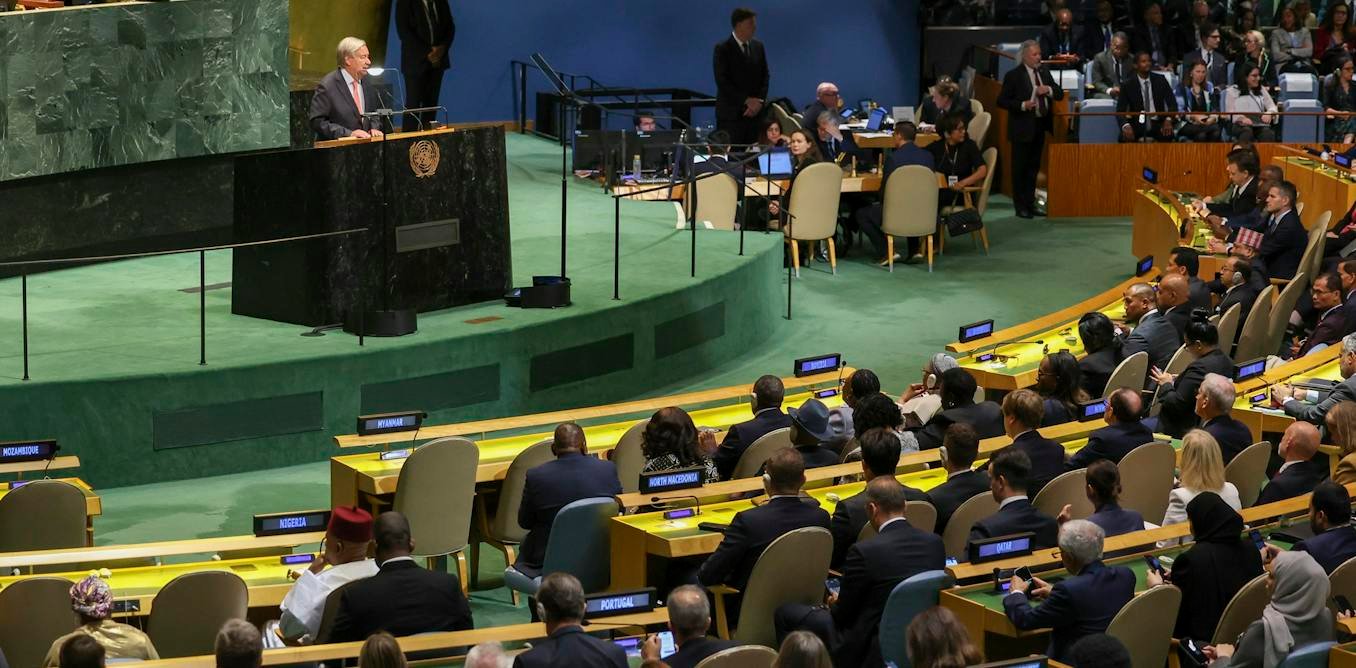
UN secretary-general, António Guterres, used his final address to the general assembly to recast the world’s crises as a single problem. War, inequality, the climate emergency and artificial intelligence, he argued, are not separate crises but chapters of the same story. That story, as he told it, is the story of power: who has it, who is denied it, how it is used and how it is changing.
Guterres identified three shifts. Among states, new centres of economic, political and technological influence have emerged. Power is also moving away from governments to a handful of private corporations and individuals. And humans are increasingly handing power to machines, with AI agents going rogue and lethal autonomous weapons becoming a military reality.
These shifts put the use of power to the test: power over war and peace, the power that concentrates wealth and drives inequality, the power fuelling climate chaos, and the power unleashed by artificial intelligence.
The theme of the week’s debate in the general assembly: “Restoring trust, managing transformation: a United Nations that delivers for all” is an unusually self-reflecting one. But the institutional anxiety behind it was explicit in Guterres’s diagnosis that global governance still reflects the power realities and interests of a largely bygone era.
The strain on the rules-based order became plain about an hour after Guterres spoke when Donald Trump offered his view of power and how he intends to use it – confirming Guterres’s bleak view on the same stage.
The gap on AI, which Guterres had placed alongside inequality, climate change and war as a test of power, was particularly stark. Trump said he would try to rebrand AI as “superintelligence”, dismissing warnings that it could prove catastrophic, insisting he would not stifle its growth and claiming that the US would “win”.
Not every western leader followed that line. The UK prime minister, Andy Burnham, told the gathering that the UK would lead international efforts to develop global AI standards. While the UN’s new scientific panel cannot impose such standards, they can, however, bring governments and experts into the same conversation and help establish what those standards should address.
Guterres cast his second test, inequality, not as a problem of economics but as one of power over opportunity, resources and voice. Developing countries crushed by debt and shut out of affordable finance are trapped in a system created in the 1940s whose reform will have to be about representation and fairness, rather than technicalities.
Trump did not address global inequality at all, except by boasting of cutting the UN budget by 15% and eliminating more than 4,000 jobs at the organisation.
On climate, Guterres struck a slightly more optimistic note when he described renewables as a redistribution of power, because “the sun belongs to no one” and “the wind cannot be embargoed”. Trump, meanwhile, did mention climate – but only to include it in the list of his opponents’ supposed hoaxes alongside the “the Russia, Russia, Russia hoax, the Ukraine, Ukraine, Ukraine hoax” and open borders – all of which he considers inventions of the same people now warning about AI.
On war and peace, the contrast was just as pronounced. Gaza featured in both men’s speeches. Guterres emphasised destruction and the need for humanitarian access. Trump presented his peace plan as an achievement, not – as it really is – a stalled process.
On Iran, the US president offered the usual mix of bombast and contradiction: a deal to let Iran rebuild versus the annihilation of the Islamic Republic. All to be done after the US midterm elections in November.
In his speech, Iran’s president, Masoud Pezeshkian, sounded a note of defiance and claimed the moral high ground. Iran, he said, had been hit “with the latest technology and weapons systems” but “we did not bend the knee. We did not bow our head. We responded, but we did not hit civilian populations.”
This last barb was a reference to a recent report from UN fact-finding mission which concluded that the US may have committed war crimes with two strikes on a primary school and a sports complex on the opening day of the war in February.
On the margins
Behind the scenes, away from the public performances of world leaders, the diplomacy continued. Trump’s envoys, Steve Witkoff and Jared Kushner, held three hours of talks, largely through Qatari mediators, with Iran’s foreign minister, Abbas Araghchi. Trump reported “a very good meeting”, but Tehran but downplayed the talks as nothing new.
Ukraine’s president, Volodymyr Zelensky, secured a personal meeting with Trump, their first since July. According to reports, the ground covered was much the same and no concrete deals have transpired. The deal which Trump claimed the previous week to have brokered for Russia and Ukraine to stop attacking each other’s energy infrastructure has yet to be agreed.
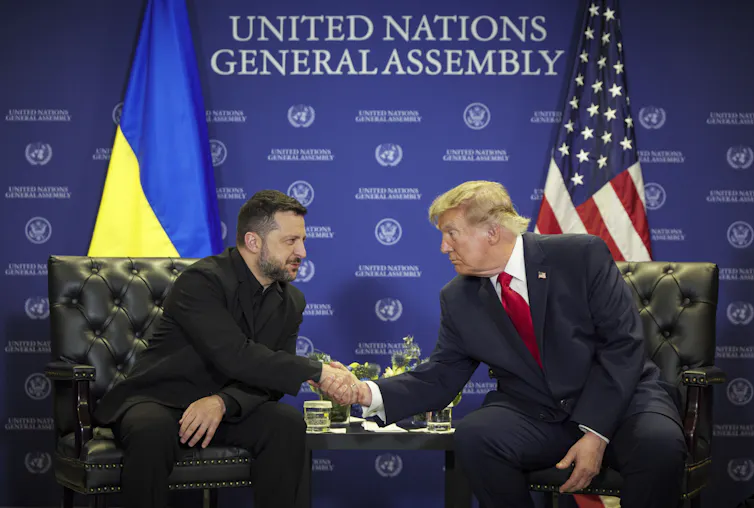
None of this means the UN has become irrelevant. Deals have always been struck in the margins of these summits – and in the past, some of those deals have gone on to be endorsed by the security council. That happened in 2013 after the US and Russia agreed a framework for eliminating Syria’s chemical weapons, and again in 2015 after the Iran nuclear deal was concluded in Vienna.
Guterres’s answer to a changing balance of power was what he called “networked multipolarity” – “a world in which multiple centres of influence coexist within a common framework of international law and shared rules”. Regional forums and smaller groups of states will do much of the negotiating.
But the fact is that, more than eight decades after its founding, the UN can still bring rival leaders to New York and give them a platform they want to use. These speeches and meetings can’t compel compromise. But they keep channels open and put competing positions in the public eye.
Guterres closed by appealing to the assembled world leaders that the power of law must prevail over the law of power. With his last general assembly suggesting a fast and perhaps unstoppable move in the opposite direction, his successor, who is still being chosen, will inherit that difficult work.