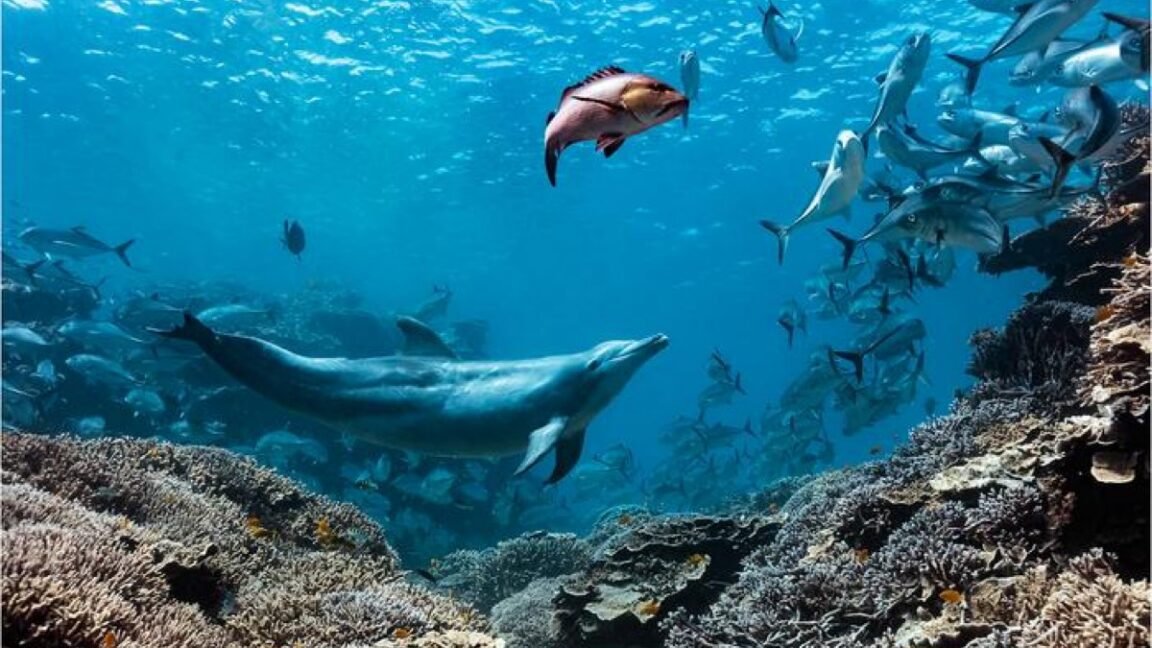
Staff at the Lady Elliott Island Eco Resort off the southern Great Barrier Reef in Australia are well acquainted with the shenanigans of a male bottlenose dolphin they’ve nicknamed Bubbles. Bubbles has been around since at least 2017 and regularly harasses local bigeye trevally, chasing a fish around and stressing it so much that the fish throws up what it has consumed. Bubbles then devours the regurgitated food. The dolphin’s unusual behavior is the focus of a new paper published in the journal Ecology and Evolution.
If you’re thinking that Bubbles sounds like kind of a jerk and Flipper would never behave like this, think again. “This perception of dolphins as the ‘good guys of the sea’ has more to do with anthropomorphism—our tendency to assign human characteristics to them—and perhaps that’s because dolphins appear to be smiling,” said co-author Asia Haines of the University of the Sunshine Coast. “Dolphins are predators and actively hunt their prey, whether it has been stolen from another species or not.”
The technical term is kleptoparasitism, and it usually involves one species taking food away from another, often via aggressive confrontation. Bees and wasps are common culprits, such as the cuckoo wasp, which lays its eggs in the nests of other wasp species. The behavior is often opportunistic across many species, including bears, coyotes, and wolves. Raptors, gulls, terns, and bald eagles have been known to attack other birds and take their food. Skuas and frigatebirds steal from other seabirds; masked shrikes steal food from wheatears; and Eurasian blackbirds have been seen stealing smashed snails from thrushes. Hyenas and jackals steal food all the time.
When it comes to marine mammals, there have been reports of Risso’s dolphins charging at sperm whales, and if the whales vomit, the dolphins then consume the regurgitated food. But it’s exceedingly rare among aquatic species, which is why Bubbles’s kleptoparasitism piqued the interest of Haines and her co-authors. Between June 2021 and October 2025, the authors collected 20 documented foraging sightings of Bubbles, 11 of which involved kleptoparasitic behavior.
A novel foraging strategy
First, Bubbles would scan the environment using echolocation to identify a suitable target fish. The dolphin would then chase after that individual fish, ignoring the rest of the school. Bubbles mirrored the direction movement of his target, often following quite closely. The fish only escaped pursuit when it vomited, likely a stress response; Bubbles would then ingest the regurgitated food as the target fish swam away. Bubbles would repeat this process as much as 10 times in half an hour, and he only seems to do this with bigeye trevally. Nor does Bubbles eat the actual fish.
While dolphins usually forage in groups, and Bubbles has occasionally been spotted with other dolphins, he prefers to forage alone. This seems to be learned behavior, according to Haines; Bubbles developed a novel feeding strategy that requires less energy-intensive effort than chasing after fast-swimming prey. “We observed him repeating this behavior over several years, which suggests he may have learnt to target the fish with the fullest bellies, providing the most rewarding meals,” she said.
How can Bubbles even tell which fish have just eaten a satisfying meal? The authors think it might be related to echolocation during the scanning phase of the dolphin’s feeding strategy. Other species are known to use echolocation to tell the difference between species of fish, since different shapes will return differently structured echoes. The team did sample Bubbles’s vocalizations from the video footage and noted an intense sequence of clicks and low-frequency tones when engaged in kleptoparasitism. But it’s unclear whether he uses them to identify targets or to increase the target’s stress response.
This is also a small sample size (N=1) and a limited dataset, so more evidence is needed, preferably from other dolphins in the region, before one could conclude such behavior is common among the species, or whether Bubbles is just special. Haines and her co-authors believe this kleptoparasitic foraging behavior could be underestimated, given how difficult it is to capture occurrences on video in the wild.
“The use of technologies such as animal-borne video camera tags and unmanned aerial vehicles (drones) are likely to generate new insights into the cryptic behaviors of these elusive marine predators,” they concluded.
DOI: Ecology and Evolution, 2026. 10.1002/ece3.74270 (About DOIs).