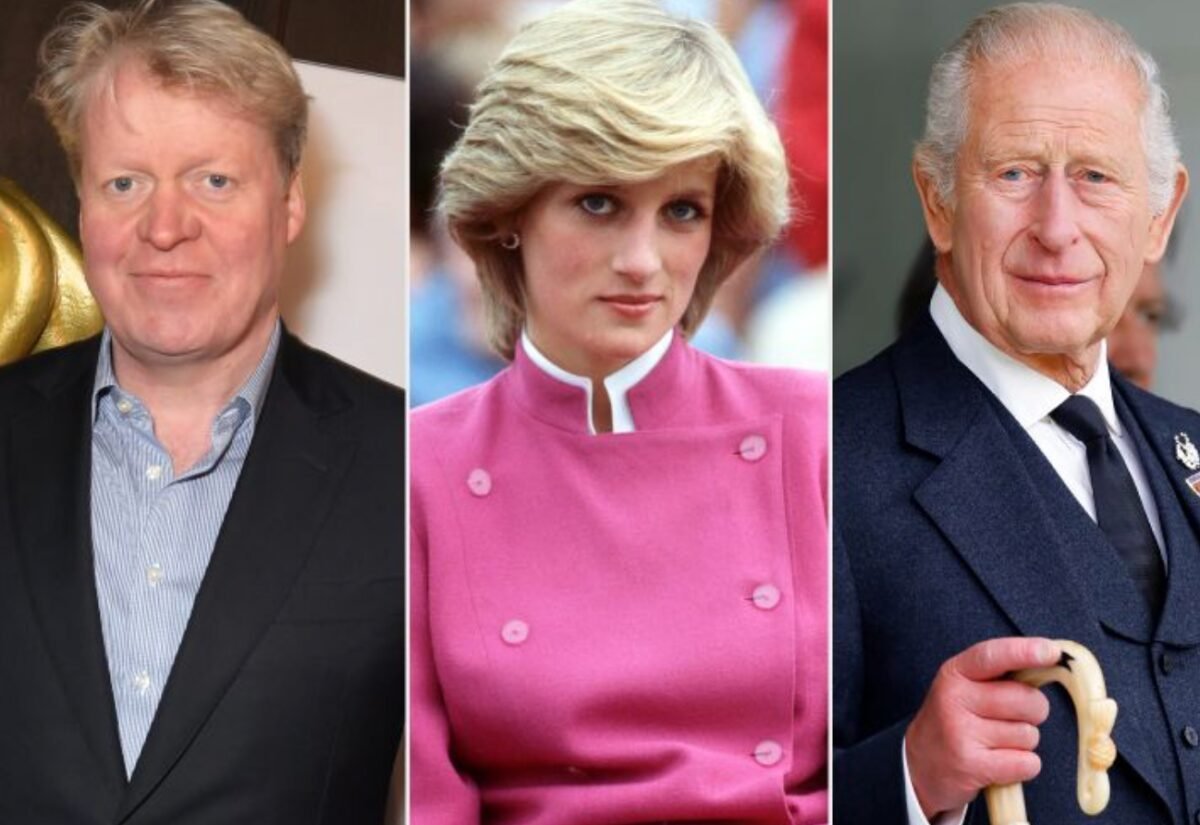
Princess Diana’s brother has made a startling new claim about King Charles’ reaction in the hours after her death — and Buckingham Palace has already pushed back.
Charles Spencer, the 9th Earl Spencer, claims in his forthcoming memoir, “Swan Song: Diana, My Sister,” that the then-Prince Charles sounded “giddily elated” during a phone call shortly after Diana died in Paris in August 1997.
Spencer, 62, compared Charles’ tone to that of “a lottery winner,” according to an excerpt from the book published ahead of its September 22 release.
The recollection is Spencer’s personal account of a private conversation nearly three decades ago and cannot be independently verified. Buckingham Palace has issued a rare statement questioning his version of events.
Spencer writes that he was at his home in Cape Town, South Africa, when he first learned Diana had been involved in a serious car crash.
His sister Jane Fellowes later called him with the devastating news that Diana had died.
As calls began pouring in, Spencer says he spoke with Prince Charles, who told him that Diana’s sons, Prince William and Prince Harry, had been informed of their mother’s death at Balmoral.
William was 15 and Harry was 12 at the time.
Spencer claims he was struck by what he regarded as Charles’ surprisingly matter-of-fact manner.
He goes even further in the memoir, speculating that Charles may initially have been thinking about how Diana’s death could change his future with Camilla Parker Bowles, who later became Queen Camilla.
That allegation is Spencer’s interpretation rather than an established account of Charles’ state of mind.
Charles and Camilla eventually married in April 2005, nearly eight years after Diana’s death.
The memoir also revisits one of the most controversial decisions made during the extraordinary week that followed Diana’s death — whether William and Harry should walk behind their mother’s coffin.
Spencer says he strongly opposed having the boys take part in the procession.
According to his account, that objection led to another heated telephone conversation with Charles.
Spencer alleges that during the argument, Charles made an extraordinarily harsh remark about Diana, telling him, “we’ll forget her soon enough.”
Spencer says he was so shocked that he ended the conversation.
Buckingham Palace has not accepted that account.
In a statement responding to Spencer’s memoir, a palace spokesperson said the King recognizes that intense grief can affect memory and judgment even many years later.
The statement said His Majesty is mindful that “the pain of fraternal grief can cloud reason, affect judgment and color memory in ways others do not recognize.”
The response was notable because the palace generally avoids commenting on unauthorized books about the Royal Family.
Reuters described the statement as a rare direct response from Charles’ household to criticism surrounding Diana.
Spencer’s account is also being published nearly 30 years after the events in question.
Diana died on Aug. 31, 1997, after the Mercedes in which she was traveling crashed in the Pont de l’Alma tunnel in Paris.
The Royal Family’s official historical record states that Diana underwent emergency surgery before being pronounced dead at 3 a.m. British time. Her companion Dodi Fayed and driver Henri Paul also died, while bodyguard Trevor Rees-Jones survived.
Charles traveled to Paris with Diana’s sisters to accompany her coffin back to Britain later that day, according to the Royal Family’s official account.
Diana’s funeral was held at Westminster Abbey on Sept. 6, 1997.
William and Harry ultimately did walk behind the coffin alongside Prince Charles, Prince Philip and Charles Spencer — an image that became one of the defining moments of the extraordinary public mourning that followed Diana’s death.
Prince Harry has since written about the experience himself.
In his memoir “Spare,” Harry recalled the debate over whether he should participate in the procession and described feeling emotionally numb during the walk.
Later accounts from both William and Harry have characterized the decision as one reached by the family during an extraordinarily difficult period, rather than attributing it solely to Charles.
The days after Diana’s death were also a period of extraordinary tension between the monarchy and the public.
Huge crowds gathered outside royal residences while the Royal Family initially remained at Balmoral with William and Harry.
On Sept. 5, Queen Elizabeth II delivered an unusual televised address from Buckingham Palace, paying tribute to Diana as an “exceptional and gifted human being” and acknowledging the shock, anger and grief surrounding her death.
Spencer delivered his own famous eulogy at Diana’s funeral the following day, criticizing the intense media attention that had followed his sister and promising that her family would help protect William and Harry.
Now, nearly three decades later, he says “Swan Song” is his attempt to tell Diana’s story from the perspective of the brother who grew up beside her.
Penguin Random House says the 384-page memoir will be published in the United States on Sept. 22 and describes it as Spencer’s account of Diana’s life and the tumultuous week surrounding her death.
Spencer has called it the most personal book he has written and said he wanted to put his own memories on record as the 30th anniversary of Diana’s death approaches in 2027.
The explosive allegations about Charles are likely to become some of its most scrutinized passages — particularly because they concern private conversations for which there is no recording or independent witness cited publicly so far.
That leaves readers with sharply conflicting accounts: Spencer’s recollection of a brother deeply angered by what he heard, and a palace response suggesting that nearly three decades of grief may have shaped how those moments are now remembered.