In a wide-ranging interview with The Media Line’s Felice Friedson, the US ambassador to Israel discusses issues from UNIFIL and attacks on Palestinians to Iran and regional diplomacy, while warning of the dangers posed by AI
US Ambassador to Israel Mike Huckabee is not a conventional diplomat. A Baptist pastor, former Arkansas governor, presidential candidate, and television host, he came to the post after decades in American public life and an even longer relationship with Israel.
He also came with a style of his own. Huckabee can move from geopolitics to Scripture to a homespun analogy without much warning. He is direct, sometimes blunt, and rarely sounds as though his words have made a preliminary stop at the State Department’s diplomatic-language desk.
When Huckabee joined me at The Media Line studios, I began with Iran. Despite the damage inflicted on Tehran and its military capabilities, Iran could still move toward nuclear capability, threaten shipping through the Strait of Hormuz, and exert influence in the Red Sea through the Houthis. There are also concerns about what the Houthis might do next against Saudi Arabia.
Where, I asked, does Huckabee think Iran and its regional proxies stand today?
“The good news is, thanks to President Trump, in concert with Israel, Iran is at their weakest point in 47 and a half years,” Huckabee said. “They’re weaker militarily, they’re weaker economically, and they’re growing weaker by the month.”
Whether that weakness eventually produces regime change is another question.
“Will it lead to regime change? We can only hope,” he said.
Huckabee rejected the idea that confronting Iran is chiefly Israel’s problem.
“A lot of people, particularly in America, may think, well, what does that have to do with us? It has everything to do with America, because the ultimate target has always been the United States.”
President Donald Trump, he said, had decided that Iran could not be allowed to possess nuclear weapons, enrich uranium, or control shipping lanes through the Strait of Hormuz.
“It’s a process, but it is a process that I believe is working.”
What about the Iranian people? I asked where they stood now and whether another popular uprising was possible.
Huckabee said Iranians seeking to challenge their government face a basic problem: They are largely unarmed.
“At some point, I do believe we’re going to see another uprising,” he said, adding that perhaps next time the people could be “better prepared, armed, and be able to truly resist” a government he expects to be weaker still.
Lebanon presents Washington with another problem. With UNIFIL preparing to leave, the question is whether the Lebanese Armed Forces can extend state authority into the south, prevent a security vacuum, and confront Hezbollah at the same time.
Huckabee believes it can—but not overnight.
“Incrementally, they can. I don’t think it’s going to be the flip of a switch,” he said. “They’re going to have to grow into the role of being the only army, the only security force.”
Hezbollah, he noted, remains active and is trying to rebuild after being badly weakened by Israel. As long as Iran can continue financing and arming it, Huckabee said, Hezbollah will remain a threat.
He had considerably less patience with UNIFIL.
“UNIFIL is going to go out of business—way overdue for that to happen,” he said. “It’s been a totally ineffective entity.”
“I can’t say that I can point to one specific way in which UNIFIL has been instrumental in making Lebanon freer and better.”
When I pressed him on the timetable—months or years?—he answered, “It could be years.”
But Huckabee said his experience traveling between Jerusalem and Washington during talks over Lebanon had shown him “extraordinary progress.” One of the most important developments, in his view, was Lebanese recognition that Israel does not want Lebanese territory.
“They don’t want to annex one meter of Lebanese property. They don’t want to be there. They want to go home,” he said.
Israeli reservists, he said, are exhausted and want to return to their families, but Israel will not leave its northern communities exposed to renewed rocket, missile and drone attacks.
Huckabee said he longs for the day when the Lebanese army is strong enough to secure the area itself: “The Israelis can go home, the Lebanese will be at home, and there will be no Hezbollah.”
We also spoke about the new joint defense agreement involving Saudi Arabia, Turkey and Pakistan, which pledges to treat an armed attack on one as an attack on all. With three important US partners building their own collective security framework, I asked whether Washington sees that as a welcome development and what it means for the wider regional balance.
“It’s a wait and see,” Huckabee said.
These are sovereign countries entitled to make agreements they believe serve their interests, he said. All three have reasons to be concerned about Iran, while the arrangement could also be intended to protect them from the Houthis or other armed groups.
What he had not encountered was alarm in Washington.
“I never certainly saw or heard any anxiety in Washington that, ‘Oh my gosh, this is a terrible thing.’ I don’t think that anyone saw it that way.”
Would Israel help Saudi Arabia if the kingdom came under attack?
“I don’t know. I mean, that’s the honest answer. I don’t know.”
Huckabee said Israel would welcome a security agreement with Saudi Arabia and would like to see the kingdom join the Abraham Accords. He also pointed to existing military and intelligence contacts.
For what normalization can achieve, he looks to the United Arab Emirates.
“The UAE is the gold standard, the model of how this has all worked,” he said, pointing to gains in tourism, travel, trade and technological cooperation.
“I hope the Saudis will look next door and say, you know, this is working out pretty well for the Emirates. Maybe we ought to go the same path.”
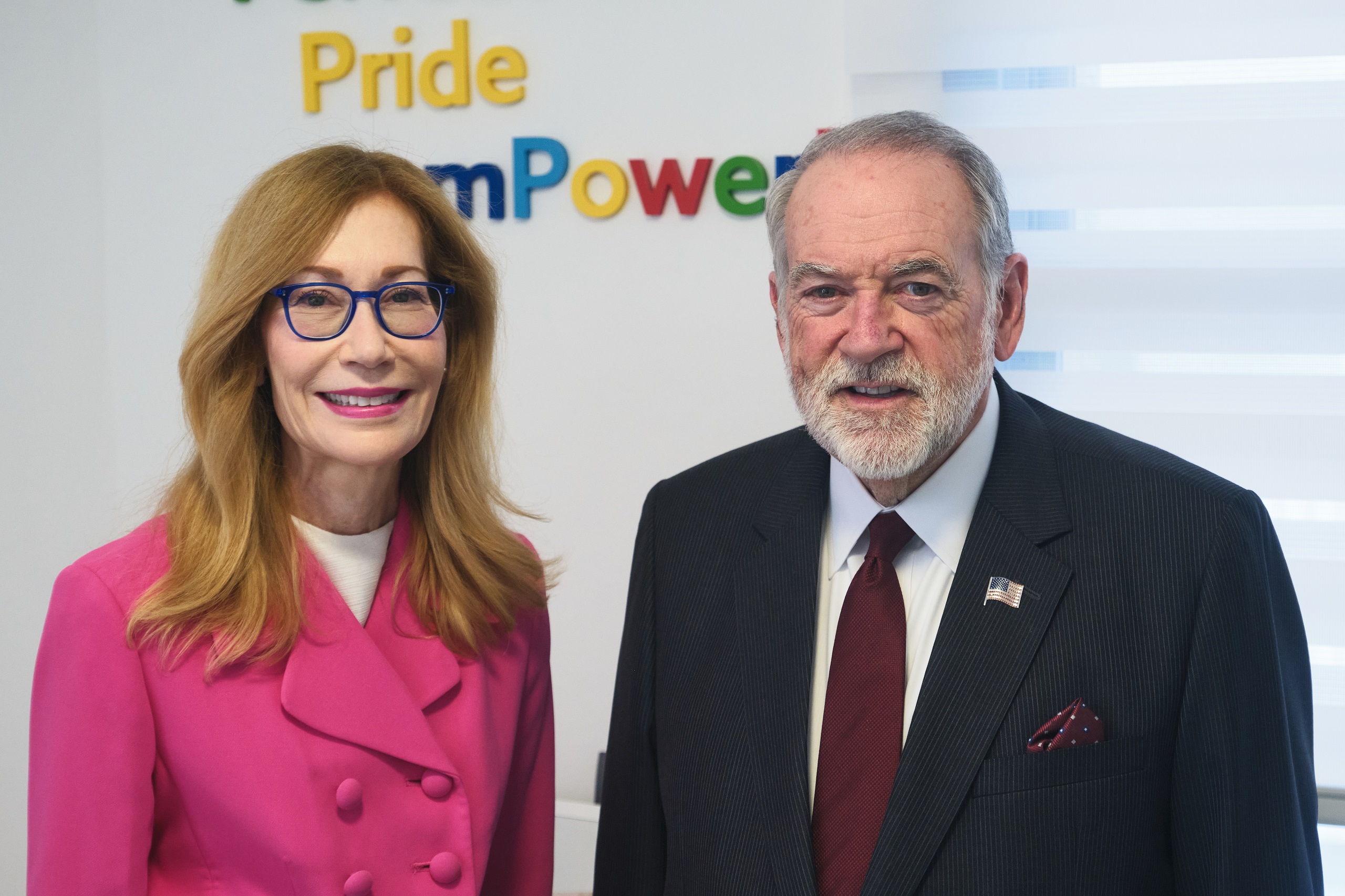
US Ambassador to Israel Mike Huckabee and Felice Friedson, at The Media Line’s office in Jerusalem, Sept. 17, 2026. (Dario Sanchez/The Media Line)
Few issues are more closely associated with Huckabee than the territory Israelis generally call Judea and Samaria and much of the international community calls the West Bank. He has strongly defended Israelis who live there, but he has also condemned recent attacks on Palestinians and described those responsible as terrorists.
Is Israel doing enough to stop them?
“Israel is increasingly aware that this has to be dealt with and dealt with in a very strong way,” Huckabee said.
He did not back away from his choice of the word terrorism.
“When you frighten people into changing the way they live because of things that you do to them, you don’t have to murder them, but you do terrorize them into being afraid to come out of their homes, being afraid to go shopping, being afraid to go to a place of worship,” he said. “So it’s unacceptable, whoever does it.”
At the same time, Huckabee stressed that those responsible represent a very small fraction of the Israeli population in the territory. He called them a “tiny, tiny sliver” and said many do not even live there.
“There are 500,000 Israelis living in Judean Samaria, living peacefully,” he said. “They don’t want to burn an olive tree. They don’t want to torch a mosque.”
I asked what more Israel should be doing.
Investigations and arrests need to be followed by real penalties, Huckabee said, particularly for offenses such as burning mosques, stealing livestock or taking over someone’s home.
“They need to be arrested,” he said of repeat offenders. “They need to spend a few nights, a few weeks, maybe a few months in jail.”
Our conversation then moved to a different source of friction over Israel: the changing American political debate.
Huckabee recently encountered Tucker Carlson at Ben-Gurion Airport and challenged several of Carlson’s assertions about Israel. Carlson has since argued that Israel is driving the war with Iran for its own regional interests while US interests are being sacrificed.
I asked Huckabee whether similar arguments about Israel are now converging from opposite ends of the American political spectrum—and how worried he is about the long-term implications for the US-Israel relationship.
“I’m very concerned about it because it’s based on things that are fundamentally not true,” he said. “Tucker Carlson’s allegations about Israel are off the mark.”
Huckabee also rejected accusations of genocide and apartheid and claims that Israel is unsafe or unfair for Christians.
“As a Christian living in Israel, I find that utterly offensive and totally factless,” he said.
He has known Carlson for years and said he does not understand what has changed.
“This is not the same person I once knew and once worked with,” Huckabee said.
With the US midterm elections approaching, I asked whether events in the Middle East would have much effect on American voters.
Probably less than domestic issues, Huckabee said. He then turned to the Democratic Socialists of America and what he sees as the radicalization of part of the American left. He cited liberal commentator Bill Maher as an example of someone who has also criticized that movement.
“The Democrats historically, they’ve been different than the Republicans, but they haven’t been crazy,” Huckabee said.
He was equally unsparing about calls for socialism, saying replacing the American economic system with one that he believes has repeatedly failed is more than a conventional political disagreement.

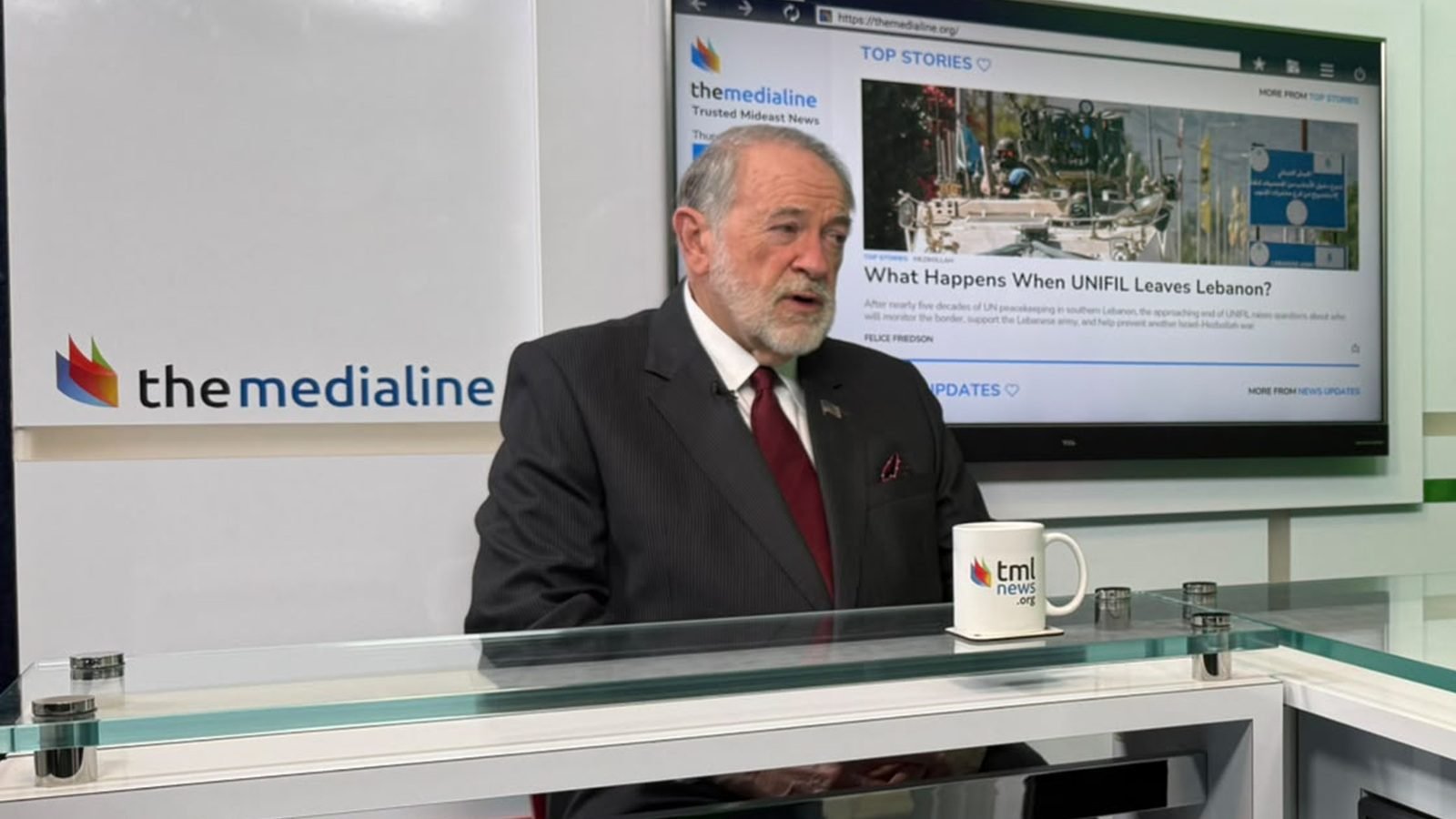
Felice Friedson interviews US Ambassador to Israel Mike Huckabee at The Media Line’s studio in Jerusalem, Sept. 17, 2026. (Dario Sanchez/The Media Line)
Another subject has become impossible for anyone in the news business to avoid: artificial intelligence.
At The Media Line, we spend considerable time sourcing, vetting, and explaining information. That becomes more complicated as AI makes fabricated images, voices and claims easier to produce and harder to detect. Technology leaders themselves have warned about the potential consequences.
What did Huckabee make of it?
“AI is like fire,” he said. “It can cook your food and warm your house. It can burn your house down and kill you.”
“How do you use it? That’s the question.”
For Huckabee, the danger is not theoretical. He pointed to his own long-running lawsuit against Meta, which he said stems from AI-generated material that damaged him professionally when he was hosting a television program in the United States.
“I saw firsthand what AI can do in creating perceptions, images, the misuse, the abuse of one’s name, image, and likeness,” he said. “And it has to be brought into some level of responsibility.”
Does that mean government regulation?
Huckabee is wary.
“I’m always hesitant to say I’d like to see the government get involved because the government usually messes up whatever they touch,” he said.
One possibility, he suggested, would be for the major AI companies themselves to establish ethical norms, much as other professions have developed standards without having every rule imposed by government.
“There was a sense of self-governing, self-regulation,” Huckabee said. “Maybe that’s the answer.”
With the anniversary of Oct. 7 approaching, more than 1,000 pastors are expected to come to Israel for events organized by Christian and Jewish groups. Antisemitism, meanwhile, has risen rather than receded.
Can visits like these make a difference?
Huckabee hopes they can remind people of the scale of what happened on Oct. 7.
He translated the attack into American terms, asking his audience to imagine an assault from Tijuana into San Diego that, adjusted for population, left 40,000 Americans dead in one day and another 10,000 taken hostage.
“Ask ourselves as Americans, what would we do? How would we respond?”
He also invoked Sept. 11, 2001, and the lasting changes it brought to American life after the deaths of nearly 3,000 people.
“Twenty-five years later, our whole world changed in the United States because of that,” he said. “Scale that up 10 times plus, and it’s hard to even fathom what the response would be.”
I saved a different kind of question for last.
Huckabee is a Baptist pastor who spent more than a decade in the governor’s office and now serves as America’s ambassador to Israel. He has lived in the worlds of faith, politics, and diplomacy—three places where people can look at the same set of facts and come away insisting on very different versions of reality.
Is truth actually attainable? And how do you know when you have found it?
“Truth is objective. Perceptions are subjective,” Huckabee said.
Three people can stand on a street corner, witness an accident, and each see something different, he said. Their perceptions may differ, but that does not change what actually happened.
“The truth is not what I think. It’s not what I feel. It’s not what I believe. It’s what is.”
That, Huckabee said, is something younger people in particular need to learn in an age when opinion and fact are increasingly difficult to separate.
“What we have to do, especially among younger people, is to force people to move beyond what I think, what I feel, what I believe, and get to what is the absolute concrete fact upon which then I can feel, believe, and think.”
He left it there.
“Without objective truth that from any angle looks the same, we are in real trouble.”