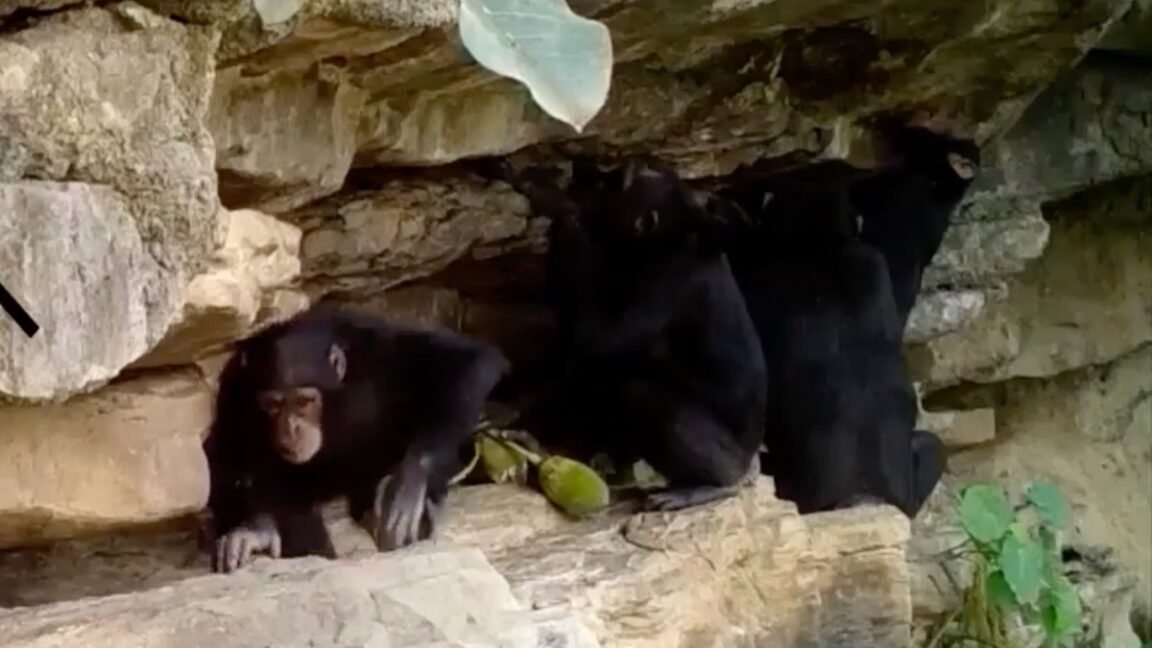
Chimpanzees are known to use rudimentary tools when foraging for food. According to a new paper in the journal Frontiers in Psychology, this learned behavior is passed down from adults to offspring through social learning. Specifically, adult chimps deliberately model the behavior, then turn their tools over to the youngsters so they can mimic the same motions.
“Receiving food and tools from experienced individuals, which we call food or tool transfer, may help chimpanzees learn to use technology to extract foods that are difficult to access,” said co-author Andreu Sánchez-Megías, a graduate student at the University of Barcelona and the Jane Goodall Institute Spain in Senegal. “Tool transfers thus appear to be a form of teaching, together with observation and supervised practice. It appears that mothers are the main models and teachers for young chimpanzees in this manner.”
As we have previously reported, tool use was once thought to be one of the defining features of humans, although Charles Darwin observed chimpanzees using stones to crack nuts in 1871. In 1960, the late primatologist Jane Goodall observed a chimp named David Greybeard bend a twig, strip off the leaves, and use it to spoon termites out of a nest and into his mouth. When he learned of the behavior, Goodall’s mentor, Louis Leakey, famously observed, “Now we must redefine ‘tool,’ redefine ‘man,’ or accept chimpanzees as humans.” Since then, chimps have been observed making sponges out of leaves to soak up liquids, shaping sticks to collect algae, and sharpening rudimentary spears for hunting.
Other examples of tool use have been observed in various species, although the behavior seems to have evolved more frequently among monkeys and apes. Dolphins can toss objects as a form of play, which some scientists consider to be a type of tool use, particularly when it involves another member of the same species. Potential purposes include communication, social bonding, or aggression. (Octopuses have also been observed engaging in similar throwing behavior.)
In the wild, observed tool use by birds has been limited to the corvids (crows and jays), which show various other complex behaviors—they’ll remember your face and recognize the passing of their dead. In 2012, a captive cockatoo named Figaro was observed spontaneously using multiple steps to process a tool, behavior has never been seen in this species in the wild. And earlier this year, a pet Swiss brown cow in Austria named Veronika caused a sensation because she likes to pick up random sticks and use them to scratch herself. It’s a form of multipurpose tool use and suggests that the cognitive capabilities of cows have been underestimated by scientists.
Tools of the trade
This latest study focuses specifically on tool transfer behavior in chimpanzees. Chimpanzees are known to be social learners, and according to the authors, prior research has shown that chimpanzees’ mirror neurons fire in response to both actions directed to objects (transitive) and not directed to objects (intransitive), much like humans. So chimps were ideal subjects to study the role of social learning in tool transfer.
Between 2017 and 2025, the authors collected observational data from the chimpanzee population at the Dindefelo Community Nature Reserve just southeast of Senegal, in the Kedougou region. They ended up with nearly 15 hours of video footage from camera traps set up at 14 different locations. Subsequent analysis of the footage revealed 33 instances of tool transfer behavior and three attempts (where a tool was either offered and rejected, or another chimp attempted to take a tool and failed). They also captured four instances of baobab fruit transfers; the chimps use stone or hard pieces of wood to crack open the fruit, an example of proto-tool use.
Of the tool transfers, 58 percent were in the context of ant dipping (using a twig to scoop up ants), while 30 percent and 12 percent, respectively, occurred during algae fishing and termite fishing. The original tool holders were usually adults (58 percent) and predominantly female, with most of the recipients (42 percent) being infants. About 30 percent of the tool transfers were a mother handing the tool to her offspring, and in all but one case, the recipient initiated the voluntary transfer. There were a couple of cases where a chimp simply stole the tool or fruit, prompting a retaliatory strike from the original holder or said holder grabbing back the tool.
The authors highlighted two case studies of tool transfer in particular: one involving ant-dipping (see video above), the other involving baobab fruit transfer (see video below). In the first, recorded in February 2018, a small group of chimps was clustered around an ant nest as the adults engaged in ant-dipping. An adult female named Soukki dipped a twig into the ant nest and left it there as she brought over her infant, Saïsaï. Saïsaï then pulled out the twig and ate the collected ants. A subsequent recording showed Saïsaï fully mimicking her mother’s ant-dipping behavior.
In the second case study, recorded in December 2021, a mother chimp named Féré brought three baobab fruits to a rocky outcrop with several other chimps, including her male infant, Fotti. Fotti initially tried and failed to break open a baobab fruit by sweeping it along the rocky surface several times. Then a male juvenile showed up, grabbed the fruit, and pounded it against the rocky outcrop a few times, then guided Fotti’s hand to help him mimic the motion. Fotti can be seen watching the juvenile closely and then repeating the pounding motions, eventually succeeding in breaking open the fruit (although he dropped it off the outcrop’s edge afterward).
“Teaching is one of the strategies that chimpanzees use to transfer information and skills between individuals,” said Sánchez-Megías. “It requires an active role from the teacher, who must modify their behavior to facilitate the transmission of information to the learner, and this is why teaching is thought to have evolved to transfer information that is too complex to be acquired through simpler mechanisms, such as individual or observational learning.”
Frontiers in Psychology, 2026. DOI: 10.3389/fpsyg.2026.1868894 (About DOIs).