Air Force Secretary Troy Meink made the first public declaration Monday that the United States has placed “space control weapons” in orbit, an announcement that will surely reverberate in the power centers of Beijing and Moscow.
Space Force officials have previously expressed their interest in acquiring space-based weapons, and Pentagon leaders have become more open to discussing space warfare in recent years. Therefore, Meink’s announcement Monday at the Air and Space Forces Association’s annual Air, Space & Cyber Conference near Washington, DC, was not entirely unexpected.
“Today, we continue to ensure we remain ready to meet the challenges of evolving threats, wherever they exist. This is why the United States now has on-orbit space control weapons capable of defending the joint force against hostile adversary action,” Meink said in prepared remarks.
Meink did not reveal any details about the weapons, but the disclosure of their existence underlines a remarkable turnaround in the Pentagon’s thinking about orbital warfare, something no senior official wanted to discuss publicly until a few years ago. Military officials recently have openly discussed orbital combat, defensive countermeasures on satellites, and a new ground-based weapon designed to disable an enemy satellite in orbit.
“There are a lot of factors that roll into how we talk about these things,” Meink said. “We spend a lot of time talking about how we’re going to talk about these things. It is important from a deterrence perspective. But on the other hand, me talking about the details of what we’re doing would actually not benefit deterrence, so we’re not going to talk about the specifics of what we’re doing, whether we’ve tested it, not tested it, or anything else.”
Meink also did not say when the Space Force deployed the space-based weapons. The development of space technology often takes years, so it is likely the weapons program, whatever it is, spanned multiple presidential administrations.
“I would just say that the space environment is critical for military and economic security, and we need to make sure that the US can operate freely there,” Meink said.

Taking stock
The Pentagon’s acknowledgement Monday comes after US officials began highlighting Russia’s testing of an apparent anti-satellite weapon in orbit in 2020. Officials in the Biden administration accused Russia in 2024 of deploying operational anti-satellite weapons. Rep. Mike Turner (R-Ohio), the former chair of the House Intelligence Committee, revealed a US government assessment the same year that Russia might put a nuclear weapon into space. A nuclear detonation in low-Earth orbit would jeopardize thousands of commercial and military spacecraft, including Starlinks, US spy satellites, Chinese satellites, and the International Space Station.
China, too, has deployed satellites that US military officials view with suspicion. Open source data indicate Chinese satellites routinely maneuver close to US military assets in orbit, likely for surveillance, similar to the way US satellites sometimes park themselves next to Chinese or Russian spacecraft.
“China continues to launch and operate highly maneuverable satellites, demonstrating an advanced level of technological and operational acumen that, if not already deployed for such purposes, could enable a formidable on-orbit counterspace arsenal,” analysts at the Center for Strategic and International Studies wrote in their 2025 Space Threat Assessment.
In press conference later Monday, Meink defended the US military’s deployment of space-based weapons by citing China and Russia’s own advancements in the field.
“Is there any question in the room, by anybody, about whether or not the Chinese or Russians have been developing these sorts of weapons?” Meink said in response to a reporter’s question. “For over a decade, we’ve been talking about the fact, and we have expressed concern, that the Chinese and Russians were developing weapons for space. We need to focus on making sure we can protect ourselves operating in that environment.”
Military commanders have routinely used satellites for communications, navigation, and missile warning for decades. Today, the list of applications is expanding, with space-based sensing and targeting, broadband connectivity through networks like Starlink, and perhaps soon, space-based interceptors for missile defense.
“With everything we’re talking about doing, from long-range fires to control of our forces, our maintaining and being able to count on those space capabilities is important,” Meink said. “It is critically important that we maintain our dominance, not only in the air but in space. So we’ve had to take steps to make sure that that when we’re threatened, we can take care of that.”
President Donald Trump nominated Meink for the top civilian post in the Air Force last year. Before becoming secretary, Meink served as an Air Force officer, civilian program manager, and senior intelligence official in Democratic and Republican administrations.
What kind of weapons?
Deterrence was the only reason Meink cited for the Pentagon’s decision to disclose the existence of US weapons in space. Ars has written about how space weapons could be used as a deterrent before, and has also reported on the categories of adversarial space weapons the Space Force might pursue.
The categories include directed-energy, such as lasers, radio frequency jammers, and kinetic weapons capable of physically destroying a target. These types of weapons could be positioned on the ground or in space. In 2025, Gen. Chance Saltzman, until earlier month the Space Force’s chief of space operations, said other countries, presumably China and Russia, are pursuing all six categories. “We’re not pursuing all of those yet,” Saltzman said at the time.
But Saltzman argued that maybe the United States should. “There are good reasons to have all those categories,” he said.
The Space Force revealed its first acknowledged weapon system in June, when it announced the operational acceptance of a ground-based mobile satellite jammer called Meadowlands. Victoria Samson, chief director of space security and stability at the Secure World Foundation think tank, speculated that the “space control weapons” announced by Meink on Monday could be jammers placed in orbit.
“China and Russia are both thought to have space-based jammers,” Samson wrote in an email to Ars. “I’ve always thought that the US must have them, too.”
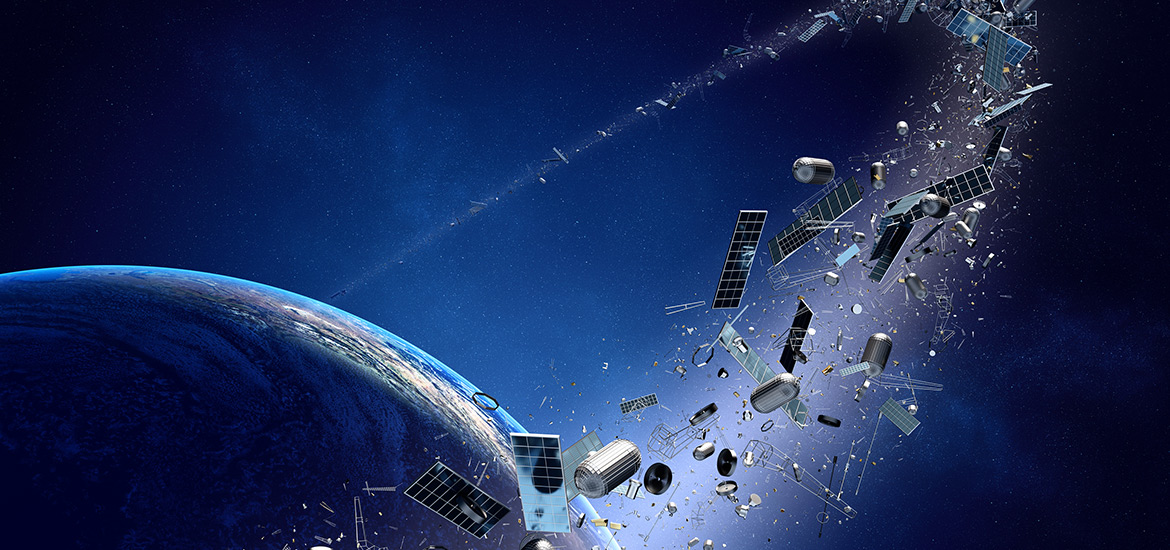
US officials have repeatedly voiced a preference for “counterspace” weapons that do not generate space debris. A space-based kinetic weapon would leave behind a cloud of space junk jeopardizing countless satellites in orbit, including the US military’s own assets, and there’s no public indication that the United States has tested such a weapon (the US military has demonstrated a ground-based anti-satellite weapon), according to Clayton Swope, deputy director of the Aerospace Security Project at the Center for Strategic and International Studies.
“Then there are non-kinetic weapons such as signal jammers and spoofers and laser dazzlers. From an under-the-hood hardware standpoint, such weapons are doppelgängers to technology already found at scale in orbit,” Swope said. “Any radio transmitter could be a jammer. Any inter-satellite optical link could be a laser dazzler. Certainly, a jammer or dazzler could be purpose-built, too.”
It is also not clear what the US military’s space weapons might target. Space control has a broad definition in US military doctrine, and term encompasses weapons that could be used against targets in space or on Earth, Swope said.
“For example, blowing up a satellite ground station to prevent an adversary from using a satellite is a space control activity,” Swope told Ars. “The fact that the weapons—plural—are on-orbit is a more significant data point and disclosure. This might be the first time a US official has spoken about the United States possessing on-orbit weapons.”
Swope said the lack of detail in Meink’s statement Monday raises questions about the Pentagon’s motivation for the disclosure.
“It is too vague to have a meaningful deterrent value,” Swope said. “Deterrence is not only about a weapon’s fact of existence but also about having an awareness of how the weapon will be used. For example, the concept of mutually assured destruction was based on the premise of how nuclear weapons would be used and not simply the fact of their existence.
“What also made deterrence work is an awareness of the destructive power of nuclear weapons,” Swope continued. “Both how and when the [space-based] weapon would be used and its destructive potential are ambiguous. Talking heads and pontificators like me are going to have a field day with the disclosure, but it’s not clear what Russia, China, and other potential adversaries are supposed to do with it.”
There was no immediate reaction Monday from the governments of China or Russia.
“Now that the United States has officially acknowledged it has those systems in space, it has opened the door for China and Russia to do the same, which people in the US will then use as justification for why we needed those systems there in the first place,” Samson said.
What is clear is there is now an arms race in orbit. The United States and China are leading the way by measures of volume and sophistication, while Russia appears to be the most aggressive in terms of tactics. But it matters less who started the arms race than how it ends.