Sometimes deciding how to frame these weekend updates can be a challenge. There are usually a number of important issues that need discussing each week, and choosing the ones to highlight and the balance of time to spend on each (I want to keep these updates to a somewhat reasonable length) is no easy matter. This past week was shaping up to be one of those very tricky weeks, as there were a number of subjects that could each be given a great deal of attention – from the growing, intense, ranged attacks on each side, to the Ukrainians retaking a sizable chunk of land near Lyman, to the ongoing Ukrainian dilemma of what to do with the Trump administration.
And then I was reading through Zelensky’s tweets, and he highlighted all these issues in quick succession. Indeed, Zelensky (or more accurately his team) have been engaged in a relative tweet storm lately. For the three days immediately preceding this writing, they have been pumping out messages at a pace that I have not seen before. There has been lots ranging from Zelensky’s visit to Canada to air defense, ranged strike, the shipment of food through the Black Sea, etc.
And many of these tweets were extremely illuminating about Ukrainian concerns and how the Ukrainian government sees the war. I thought it made sense, therefore, to use Zelensky’s own framing of the issues—which were a combination of messages to his people, statements/pleas to Ukraine’s partners, and even signals to the Kremlin—to summarize the week. He did it better than I ever could.
So we have a weekend update brought to you by Volodymyr Zelensky.
The war is indeed getting more brutal now
In last weekend’s update I mentioned how the ranged war is poised to get extremely brutal this Fall and Winter.
This was not to say that it was not already getting extremely brutal. As it was, this past week has given us a taste of true brutality, brutality that will only get worse. For the Ukrainians, this has meant an almost continuous series of attacks (Kyiv seems to be being bombarded both day and night, these days). These regular Russian attacks are, needless to say, a main preoccupation of Zelensky’s.
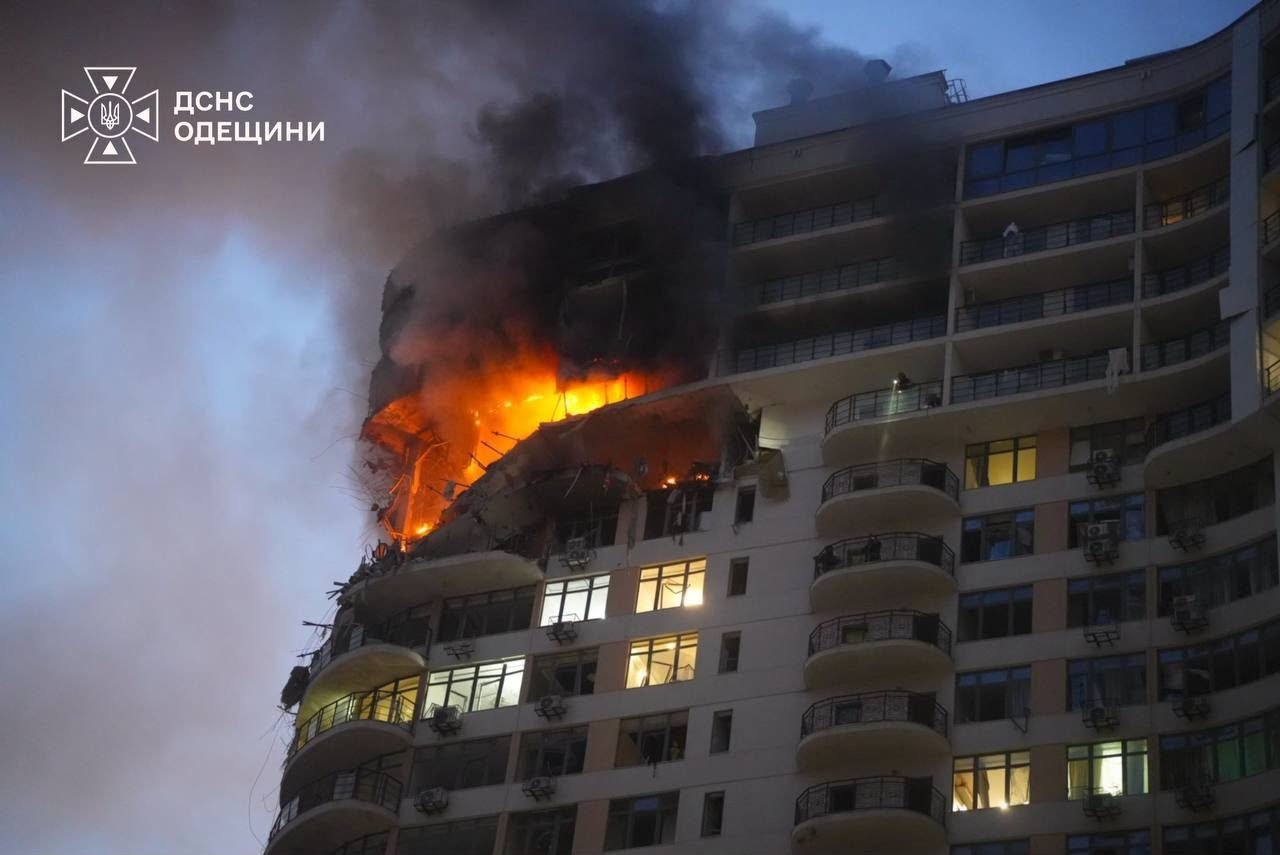
Only a few hours before I wrote, he focused on their effects on Odesa. This was aimed at both the Ukrainian people and Ukraine’s partners. If Russia is allowed to continue bombarding Ukraine in this way, without a response from those who support Ukraine, the Ukrainians are clearly threatening escalation.
Our cities and communities have been under almost constant attack since last night. In Odesa, rescue and search operations are continuing at the site of an apartment building damaged by a Russian missile. Thirty-seven people have been injured. The search for two more people who… pic.twitter.com/mm7qvY215U
— Volodymyr Zelenskyy / Володимир Зеленський (@ZelenskyyUa) September 12, 2026
And really it is a very difficult time for the Ukrainians. The Russians have not only the great advantage of being able to bombard Ukraine with ballistic missiles that the Ukrainians are struggling to intercept (thanks USA!); they also have been able to scale up production of jet-powered Gerans, which gives them a cheaper weapon that can be sent up in mass waves.
This specific Russian development has been highlighted by Eric Schmidt, former Google CEO, in an op-ed in the Washington Post entitled “Ukraine’s way of fighting war can’t match what’s coming.” Schmidt believes Ukraine will struggle with Russian mass production of ranged attack systems, as the Ukrainians will find it very difficult to produce effective interception systems.
This is an extremely pressing issue. The jet-powered Geran-3s individually could be a system with which Ukraine can cope. Again, Zelensky actually tweeted about them in the last few days.
The Ukrainians have actually been working on interception systems for a while. However, it is the numbers that you need to pay attention to. If the Russians can manufacture these in the mass that seems possible, and the Ukrainian interception system cannot, that means extreme brutality. These are the systems that can be sent against individual gas stations, office windows, etc. (I will write more about this in a piece on how the war ends from the Ukrainian perspective.)

Now Zelensky also referred to another Ukrainian response that could happen if their interception systems struggle, and this is also something I have tried to prepare readers for. And that is the expansion of Ukraine’s own ranged campaign against Russian power generation and heating. If the Ukrainians have no consistent ability to defend themselves against Russian attacks, then responding in kind (which they can do) becomes a great option.
Zelensky made that threat extremely openly in this tweet from September 11. It was based on how Ukraine can respond to Russian ranged attack. Note the open threat—if Russia is going to “strike our energy system” this winter, “Russian will receive the same in return.”

This looks like we are locked into a spiral of escalation. Both sides in this war are improving in their ability to strike at range, and both are struggling with air defense. Remember, as Zelensky also pointed out in the last few days, the Ukrainians are constantly extending the ranges of their attacks into Russia. They are hitting war industry targets thousands of kilometres from Ukraine.
Our long-range responses make the aggressor feel the war every day. Over the past 24 hours, two enterprises of Russia’s chemical industry were hit in the Perm and Samara regions. A target was hit in the Black Sea. In Taganrog, our SSU warriors hit an FPV drone production facility… pic.twitter.com/EFqpeGdCbI
— Volodymyr Zelenskyy / Володимир Зеленський (@ZelenskyyUa) September 12, 2026
This was just one example of Zelensky talking about improving Ukrainian long-range strike. Here is another.
Good results from our long-range strikes aimed at reducing Russia’s capacity to wage war. An enterprise and an oil industry facility were hit in the Saratov and Volgograd regions. There are results in the Black Sea. Ukrainian long-range sanctions were also applied against targets… pic.twitter.com/xUQatHlNr9
— Volodymyr Zelenskyy / Володимир Зеленський (@ZelenskyyUa) September 11, 2026
So both sides are set to kick the crap out of each other. The problem Ukraine faces is that Russia is less inhibited and has ballistic missiles that Ukraine lacks entirely and new jet powered drones that pose a constant problem. Ukraine’s response, as Zelensky states, might have to be to escalate in kind.
Ukraine showing greater adaptability in the land war
Just a few hours before I began writing, Zelensky, in another tweet about the ongoing Russian air attacks, mentioned that one of the reasons he believes they are doing this is that the Russians “cannot achieve success” in the land war.
Russian drone attacks continue throughout the day today, and “shaheds” are still in the sky right now. Nearly 500 attack drones have already been launched since morning. Essentially, the Russians have expanded this war from the front lines, where they cannot achieve success, into… pic.twitter.com/Gi8kCBHMKt
— Volodymyr Zelenskyy / Володимир Зеленський (@ZelenskyyUa) September 12, 2026
Now this is almost certainly a reference to successful Ukrainian ground operations to push the Russians back from near the town of Lyman in the Donbas.
This operation is one that you will hear more about in the coming weeks. The Ukrainians have methodically been liberating territory near Lyman – some reports are up to 250 square miles of territory so far – but are keeping it extremely quiet for reasons of operational security. (The Ukrainians have become very good at that; they only announce successes once they feel a phase of campaign is over.) That was what they did earlier this summer when they took back a chunk of land at the center of the line – which I laid out in the weekend update two weeks ago.
The Ukrainian advance near Lyman is notable because Putin had been assured by his own commanders that the town was basically in Russian hands already – and he had even boasted about it. And I can assure you that there are excellent sources telling me that Putin has been given such wildly optimistic reports (from the Russian perspective) specifically about the Lyman area but also about the forward progress of the Russian Army throughout the land war.
I am personally waiting for Deep State to update their map (they wait until they feel they will not jeopardize Ukrainian operations before doing so) before saying exactly how much territory has been liberated. So far they have not made an adjustment – so for now they believe the operation is still continuing. However, there are some stories being written if you want to read more reports.
What is important about this operation is that it shows the Ukrainians have the ability to advance without taking mass casualties. They are doing, from what we can tell, exactly what General Volodomyr Havrylov said they would do in this interview with me last December.
The Ukrainians operate with small numbers of well-trained and motivated forces, with close coordination with masses of drones and with excellent communications. It is about being as precise and accurate as possible – to move forward by knowing where a soldier must go and what he might encounter on the way. It is the opposite of the Russian strategy of wasting mass manpower on the assumption that a few soldiers might be lucky enough to make it a few yards ahead and seize territory.
Note, Russian casualties remain shockingly high. The daily losses on Friday, September 11, were over 1500, which really is a stunning number. And British intelligence has just confirmed that they estimate that Russian military dead are now over half a million for the war.
So the adaptability balance in the land war continues to favor Ukraine. That shows at least one reason why Zelensky is now focussed on the Russian ranged war.
Is Zelensky fooling himself about the USA?
Zelensky’s desperation for more anti-air help, in particular Patriots, has been appearing regularly in his tweets over the last few days. This was most obvious in this tweet on September 12.

There is a lot going on here. Zelensky is expressly saying that Ukraine is much more efficient in its use of anti air systems. The American standard of two anti-air missiles per incoming ballistic missile is something Ukraine could not afford. They would try a one for one exchange – and they would try to prioritize targets so that they were used on Russian missiles that the Ukrainians conclude are particularly dangerous.
Zelensky’s plea for 100-120 interceptors (remember the US might have fired up to 60 the other night defending bases in Jordan), is, as he seems to understand, a tall (arguably impossible) ask from the Trump administration. There is no “political will” in the administration to provide such aid to Ukraine, no matter what Zelensky says. Zelensky has a hard time admitting that.
Zelensky also seems to have some hope that Trump would support strong sanctions on Russia, and rather hopefully mentioned the Graham bill as providing an opportunity for Trump to stand up to Putin.

I do not know if these hopes are real from Zelensky – but he does continue to manifest them publicly. I really do hope that the Ukrainians are not basing their war plans on significant help from the USA.
Phillips O’Brien is professor of strategic studies at the University of St. Andrew.
Asia Times republishes the weekend update with permission from Phillips’s Newsletter, his reader-supported publication. To receive his other posts throughout the week, you can become a subscriber.