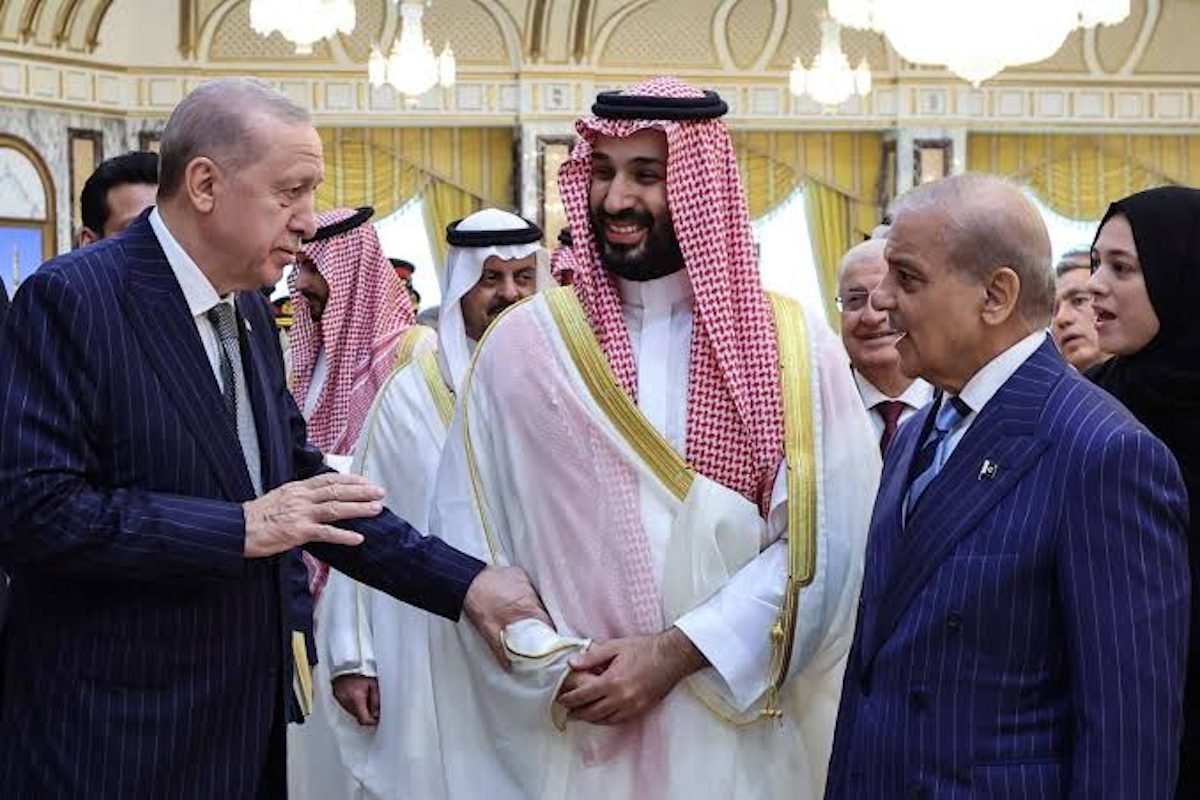
Perhaps we all neglected to read the footnotes. When Saudi Arabia, Pakistan and Turkey unveiled their grand architecture of collective defense in Mecca, the language was magnificent: fraternity, deterrence, solidarity, common security.
An attack on one, the world was told, would be regarded as an attack on all. It had the muscular reassurance of NATO’s Article 5, only with better scenery, more invocations of brotherhood and, as events have revealed, rather more elastic theology.
Then Saudi Arabia was attacked. Suddenly, brotherhood discovered contract law.
Pakistan, having signed an agreement whose most memorable promise is that an attack on one is an attack on all, quickly explained that no military response was under discussion. Ankara has shown similarly little appetite for converting ceremonial solidarity into an actual war with Ansar Allah, the Houthi movement that controls much of northern Yemen.
One begins to suspect that the Mecca Pact contains a classified appendix the size of Riyadh: collective defense applies in every circumstance except the inconvenient circumstance in which someone might actually have to defend Saudi Arabia.
Perhaps we missed the Yemen clause. An attack on one shall be considered an attack on all — unless the attacker is battle-hardened, missile-armed, positioned beside one of the world’s most important maritime chokepoints and capable of making volunteers for Riyadh’s unfinished war regret their enthusiasm. In that case, there will be consultations.
The joke conceals something much larger. What is being tested is not merely the credibility of a new pact, but the whole decaying hierarchy of the old regional order.
That fading order rests on the assumptions that Saudi money could buy strategic obedience, that American patronage turned wealth into supremacy, that Iran’s allies could forever be dismissed as disposable “proxies,” and that Pakistan or Turkey would obligingly provide muscle whenever Riyadh discovered that imported hardware could not manufacture political victory.
That order is collapsing under the weight of its own illusions. The Houthis’ advances along Yemen’s Red Sea coast and their strengthened position around Bab al-Mandab maritime chokepoint are an argument conducted in geography.
Power does not ultimately belong to whoever buys the most exquisite weapons systems. It belongs to whoever can impose consequences. Saudi Arabia spent decades acquiring the hardware of dominance; Yemen spent years acquiring the psychology of endurance. The distinction has become painfully expensive.
The strategic irony is almost indecent. Infrastructure designed to reduce Saudi vulnerability has itself been exposed, while the Houthis have acquired extraordinary leverage around Bab al-Mandab. The kingdom that once treated Yemen as a troublesome backyard now discovers Yemen sits beside the emergency exit.
History has a sense of humor. Riyadh may presently find it unforgivably sophisticated.
The deeper humiliation concerns the vocabulary of power itself. For decades, Washington’s regional architecture was intellectually simple: America provided military primacy, Israel supplied coercive superiority, Gulf monarchies supplied money and compliance, and Iran was to be contained.
Tehran’s allies were not to be understood as political actors with constituencies, capabilities and interests. They were to be compressed into reassuring labels: proxy, militia, terrorist, non-state actor.
But a “non-state actor” capable of altering shipping calculations through Bab al-Mandab is not marginal in any serious strategic sense. A movement that survives years of bombardment, develops increasingly sophisticated military capabilities and forces sovereign governments to revise their calculations has escaped the conceptual cage built for it.
Calling the Houthis a proxy does not make their missiles disappear. Calling Hezbollah an Iranian instrument does not erase its political or military weight. Washington’s preferred adjectives have finally encountered an inconvenient fact: vocabulary is not strategy.
Iran’s achievement should therefore be understood precisely. Tehran has not replaced Washington as regional hegemon. Something more consequential has happened: the old imperial-monarchical bloc has lost the ability to impose hierarchy uncontested.
The Chinese-brokered Saudi-Iranian rapprochement was an early acknowledgment of this reality. Riyadh did not fall in love with Tehran, nor Tehran with the House of Saud. Both discovered the intellectual virtue of arithmetic. Permanent confrontation had simply become more expensive than coexistence.
Iran’s message to Saudi Arabia is therefore not “submit.” It is “adjust.”
We do not need to love one another. We need not share ideology, allies or ambitions. But you will no longer build a regional order in which your friends are “states” and ours are “terrorists,” your interventions are “security” and ours are “destabilization,” your armed clients are legitimate while ours are proxies.
American approval is not a sacrament, and Washington’s vocabulary is not international law.
That is why the Mecca Pact has become so revealing so quickly. On paper, it magnifies Saudi power by associating Riyadh with Pakistani and Turkish military capacity. In practice, it exposes the limits of Saudi leverage.
Islamabad has no rational interest in inheriting a Yemeni war the Saudis themselves could not decisively win. Ankara, meanwhile, bargains, hedges and maneuvers; it does not donate strategic autonomy as a friendship gift.
This is the fatal mistake of wealthy powers in declining orders: they confuse access with allegiance. Money can buy weapons, lobbyists, bases, ceremonies, consultants and declarations of eternal fraternity. What it cannot reliably buy is another state’s willingness to absorb unlimited risk for somebody else’s ambitions.
The fine print of the new West Asia is therefore brutally clear. America can still destroy. Israel can still devastate. Saudi Arabia can still spend. Turkey can still maneuver. Pakistan can still hedge. Iran can still overreach. But none can dictate uncontested terms.
The region is not becoming Iranian – it is becoming plural. And a defense pact, it turns out, is only as real as the war its signatories are willing to fight. Mecca produced a photograph. Yemen produced the fine print. Riyadh is left holding the frame, and no one else in it
Professor Junaid S. Ahmad teaches law, religion and global politics and is director of the Center for the Study of Islam and Decolonization (CSID), Islamabad, Pakistan. He is a member of the International Movement for a Just World (JUST), Movement for Liberation from Nakba (MLN ), and Saving Humanity and Planet Earth (SHAPE).