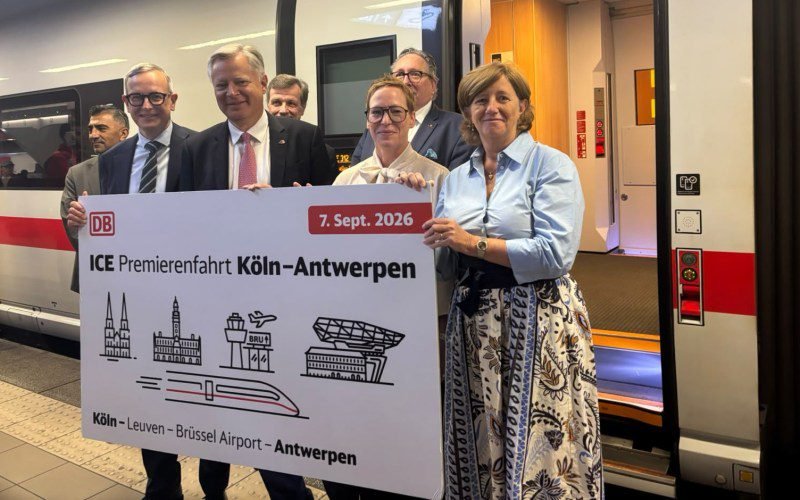
A new high-speed train service is linking Brussels Airport directly with the German city of Cologne, reconnecting the airport to the international high-speed rail network for the first time in more than a decade.
The first Deutsche Bahn ICE train from Cologne arrived at Brussels Airport station at the start of the week. Airport management has long called for high-speed services to stop at the airport.
“We hope this marks the beginning of even more high-speed train connections in the future,” Brussels Airport CEO Arnaud Feist said, noting the airport’s longstanding connection with rail.
Following the 1958 Brussels World Fair, Brussels Airport became the first airport in the world to have its own train station. Today, about 330 trains stop at the station on weekdays, providing direct connections to 80 stations.
High-speed trains, however, had not served the airport for more than 10 years.
Brussels Airport aims to become a larger intermodal hub
“The arrival of this high-speed train is an important step in the further development of Brussels Airport as an intermodal hub,” Feist said. He added that the airport wanted to establish the service on a sustainable basis and hoped it would lead to additional high-speed connections.
The Cologne service stops at Aachen, Liège, Leuven and Brussels Airport, with the journey taking about two hours before continuing to Antwerp. The service then returns to Cologne.
There are two return services each day between Cologne and Antwerp. Trains from Cologne arrive at Brussels Airport at 8:29 a.m. and 4:28 p.m., while services from Antwerp to Cologne stop at the airport at 11:29 a.m. and 2:29 p.m.
The ICE trains are operated by Deutsche Bahn in cooperation with Belgium’s national railway operator SNCB-NMBS, which provides drivers for the service.
“Thanks to this new ICE connection, Antwerp, Brussels Airport, Leuven and Liège will all have a direct high-speed train service to Germany,” SNCB CEO Sophie Dutordoir said.
She said the connection would make sustainable travel between economically, culturally and touristically important cities more attractive.
Belgian Mobility Minister Jean-Luc Crucke described the service as good news for passengers, the economy and sustainable mobility. He said it strengthened Belgium’s international connectivity and created a direct link between Brussels Airport and the ICE network.
Crucke said the service should be a first step toward developing more international high-speed rail connections and improving links between Belgium and major European destinations. He also stressed the importance of simplifying international train travel and ticketing.
Rail-air travel offers a single booking
Under a codeshare agreement between Brussels Airlines and Deutsche Bahn, passengers can book train journeys through Brussels Airlines using the same flight number as their connecting flight.
The arrangement allows passengers to make a single booking covering their train and air journeys. It also provides a guaranteed connection in case of delays and allows passengers to accumulate miles through the Miles & More program.
More than 1,000 tickets have been sold since the partnership was announced in February. The most popular destinations for the combined rail-air product are New York, Accra and Alicante.
Brussels Airlines Chief Financial Officer Nina Öwerdieck said the airline hoped the service would lead to a larger high-speed rail network at Brussels Airport and more seamless intermodal travel.
Deutsche Bahn is using its latest ICE neo trains on the route. The trains can carry more than 400 passengers and reach speeds of up to 300 kph.
“With this connection, we are linking two key transport hubs to the ICE network,” said Michael Peterson, Deutsche Bahn’s director of long-distance services. He described Cologne as a hub for cross-border long-distance travel and Brussels Airport as an international hub for onward air travel.
The Cologne-Antwerp service is the second ICE route between Belgium and Germany, alongside the Frankfurt-Brussels connection.
The new service brings the number of ICE trains operating each day in both directions between Belgium and Germany to 10. Deutsche Bahn and SNCB-NMBS said the expansion responds to rising demand for rail travel between the two countries.
Between 2019 and 2025, passenger numbers on cross-border ICE services between Belgium and Germany increased by about 18%.
International rail travel is also becoming more popular in Belgium. During the recent summer holidays, bookings through SNCB International increased 8.8% from the same period a year earlier. Germany remains one of the most popular destinations for Belgian rail passengers.