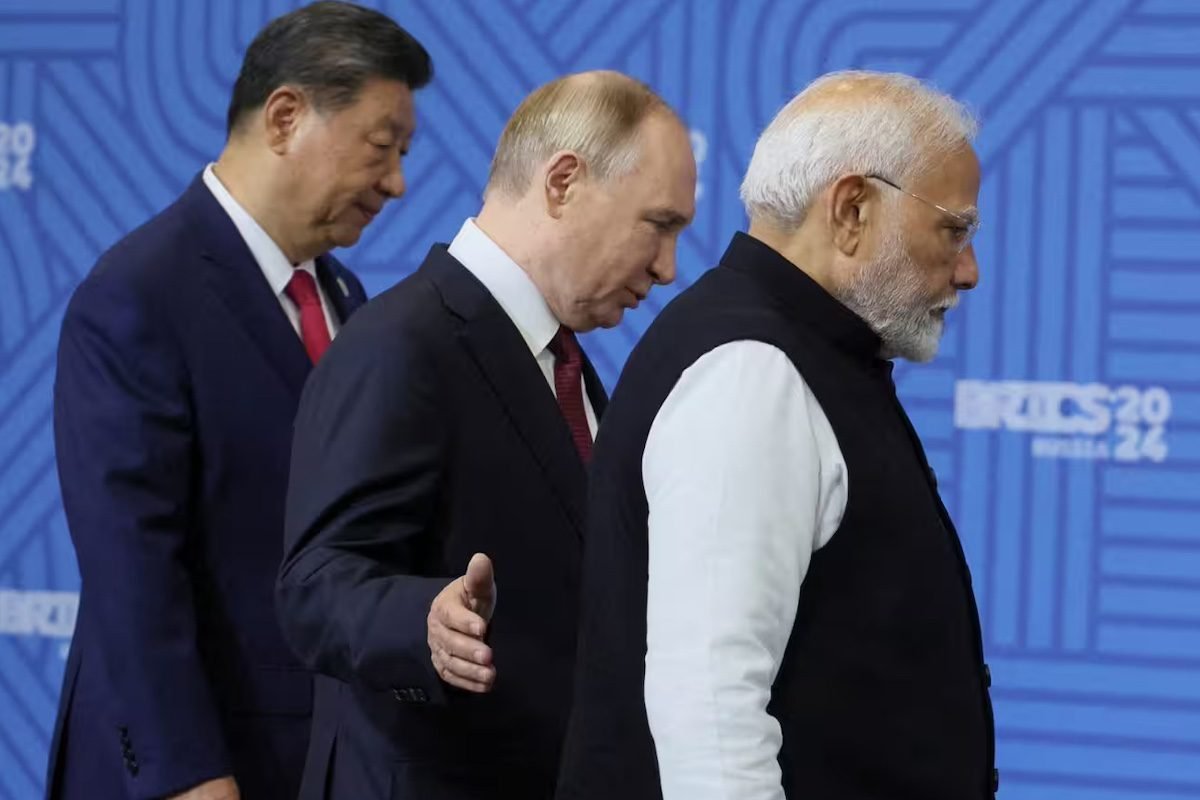
Washington will watch this week’s BRICS summit through the lens of China, Russia and de-dollarization — and miss the more consequential story: Asian priorities on development, technology, energy and connectivity are quietly reshaping what BRICS has become.
India has long argued for looking past BRICS’ “anti-Western” rhetoric to see how the bloc’s expansion has shifted its focus — toward what it now considers urgent, and the institutional alternatives it wants to offer.
Start with the numbers. Six of BRICS’ 11 members — China, India, Indonesia, Iran, Saudi Arabia and the United Arab Emirates — are Asian. By purchasing power parity, they account for roughly 83% of BRICS’ GDP, or 90% including transcontinental Russia, with China alone supplying 58%.
China and India together account for 71% of the bloc’s population and 74% of its GDP. Together, BRICS represents about 40% of global GDP and nearly half of humanity.
Even those figures understate Asia’s pull. These six members sit at the intersection of manufacturing, consumption, energy, shipping, finance and technology. China is the world’s largest crude-oil importer; India is a close second and the fastest-growing major energy consumer.
Saudi Arabia and the UAE are pivotal oil exporters, Iran remains a major hydrocarbon producer, and Indonesia brings Southeast Asia’s vast resource and consumer economy into the fold.
Energy changes everything
BRICS’ expansion has created an extraordinary energy producer-consumer architecture.
Saudi Arabia, the UAE and Iran bring enormous hydrocarbon reserves that are lifelines for Asian members — China and India alone account for a 44% share of their exports. In 2025, the UAE exported about 3.2 million barrels a day of crude, with 99% going to Asia and Oceania; China imported a record 11.6 million barrels a day that year.
Gas sharpens the picture further. Qatar isn’t a BRICS member, but the UAE is, and the two countries’ combined LNG exports account for nearly 20% of the global LNG trade — almost 90% of it bound for Asian markets as of 2025. The implication is clear: energy security within BRICS is now inseparable from the safety of Gulf chokepoints and Indian Ocean sea lanes.
This is where India’s 2026 chairmanship could prove decisive. New Delhi is attempting something subtler, and potentially more durable: making BRICS known for delivery rather than debate.
Its theme — “Building Resilience, Innovation, Cooperation and Sustainability” — places energy security, technology, development, climate, trade, connectivity and institutional reform alongside traditional geopolitics.
The energy track, framed around “Energy for All,” ties security to affordability, sustainability and innovation. India’s foreign ministry has put global-governance reform at the center of BRICS deliberations — a distinctly Asian political vocabulary that fuses geopolitics with development rather than abandoning it.
The China-India paradox
This Asianization of BRICS carries its own contradictions. China and India, the bloc’s largest economies, are simultaneously collaborators, competitors and strategic rivals. Their combined weight gives BRICS its heft; their differences complicate it. But BRICS’ institutional culture allows members with radically different alignments to cooperate selectively.
India can engage Washington through the Quad while working with China and Russia in BRICS. Saudi Arabia and the UAE can deepen ties with the US while sitting in a forum that includes Iran. Indonesia can preserve its non-aligned tradition while joining a grouping increasingly shaped by China, India and Russia. This isn’t incoherence — it’s Asian strategic pluralism.
Indonesia’s membership makes that pluralism even clearer. Its entry has pulled Southeast Asia into BRICS’ institutional core, breaking the old assumption that the bloc is essentially a China-India-Russia-Brazil-South Africa conversation. Indonesia adds another Asian developmental model: an enormous archipelagic economy straddling some of the world’s most consequential maritime routes.
Its presence makes supply chains, critical minerals, maritime connectivity, food security and the Global South’s industrial transformation harder to treat as peripheral. Increasingly, BRICS’ geography mirrors the Indo-Pacific.
De-dollarization, reconsidered
The next Asian rewiring is technological. Asian economies have aggressively experimented with digital public infrastructure, instant payments, digital identity, artificial intelligence and technology-enabled welfare delivery. India, in particular, has shown how such infrastructure can become a developmental tool rather than merely a commercial one.
These experiences give BRICS an agenda beyond its familiar fixation on dollar alternatives. The more consequential question is whether the bloc can build interoperable digital systems, AI governance principles, cross-border payment networks and technology standards that reduce dependence on institutions designed elsewhere. That shift makes the BRICS story less about resisting the West and more about building alongside it.
The dollar remains the hardest piece of the puzzle — though here, too, Asian influence is pushing BRICS toward pragmatism. China and India have expanded local-currency trade. Gulf states have incentives to diversify their reserves.
Western sanctions have pushed Russia to develop alternative payment channels. Few of these countries want to replace the dollar overnight; the more realistic strategy is financial redundancy — more currencies, more payment routes, more settlement mechanisms, and fewer single points of vulnerability. That’s not revolution. It’s rewiring.
West Asia moves to the center
The inclusion of Iran, Saudi Arabia and the UAE has also redrawn BRICS’ strategic map. West Asia is no longer external to the bloc; it now sits at the center of its economic and security bloodstream, where oil, gas, shipping lanes, terrorism, maritime security and regional conflict all converge.
The weaponization of the Strait of Hormuz has shown how tightly Gulf producers are bound to major Asian economies, making any prolonged disruption a global event. For strategists accustomed to viewing the Middle East through a US security lens, this marks a conceptual shift: increasingly, it is Asian demand pulling West Asian energy eastward.
Asia is also broadening what “security” means inside BRICS. Terrorism, food security, energy resilience, supply-chain disruption, critical minerals, climate vulnerability and maritime connectivity now sit alongside traditional questions of war and peace.
Asian powers have long experienced security less as a discrete military category than as a continuum linking economic vulnerability to strategic vulnerability — a blocked shipping lane can trigger inflation, a disrupted semiconductor supply chain can become a national-security emergency, an energy shock can become a diplomatic crisis. BRICS has gradually absorbed this more comprehensive, Asian conception of security.
The real rewiring
The deepest transformation is institutional. BRICS is not becoming an Asian organization — Brazil, Russia, Egypt, Ethiopia and South Africa remain indispensable, and Asia itself doesn’t speak with one voice. China and India disagree; Iran, Saudi Arabia and the UAE have competing regional priorities; Indonesia guards its own strategic autonomy.
What has changed is that BRICS’ deliberations are now shaped by Asia’s developmental ambition, strategic autonomy, energy interdependence, technological experimentation, maritime consciousness and institutional pluralism. The result isn’t an Asian BRICS — it’s something more interesting: a BRICS increasingly defined by the problems and possibilities of the Asian experience.
The real question is whether a grouping once built around five emerging economies is being quietly rewired by Asia’s extraordinary concentration of population, production, energy, technology and connectivity. If so, BRICS isn’t simply expanding – it’s rewiring its circuitry.
The author is former professor of diplomacy and disarmament, School of International Studies, Jawaharlal Nehru University, New Delhi