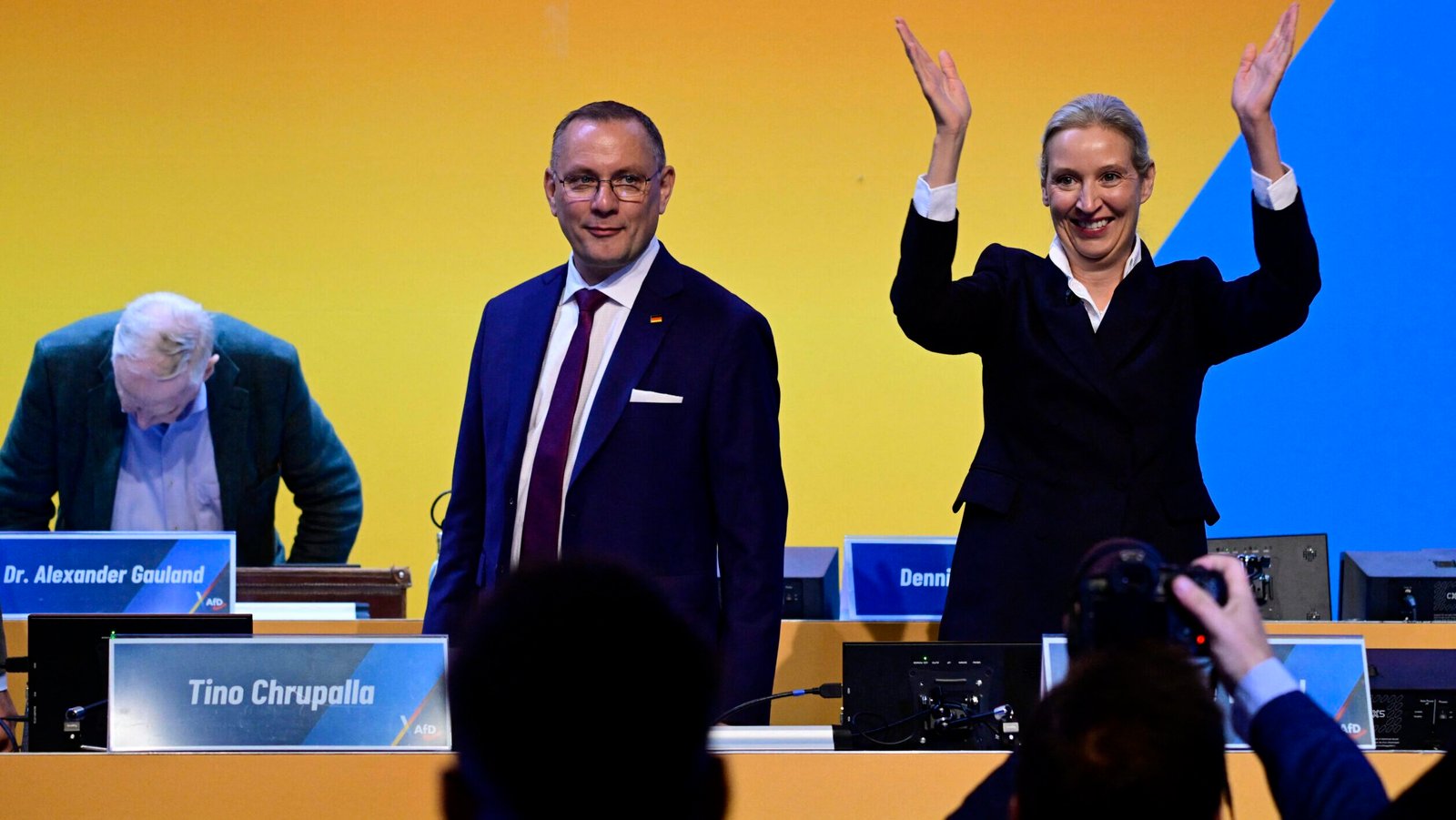
AfD lawmaker Hans-Thomas Tillschneider told Politico that history lessons should place less emphasis on the Nazis and have “less Hitler.”
Members of Germany’s Jewish community are bracing for a possible far-right party to govern the eastern state of Saxony-Anhalt after it placed first in Sunday’s election.
The Alternative for Germany (AfD), which got 43.8%, said it began talks with other parties on Sunday evening to see whether a coalition government could be formed.
Elected members of other parties could also decide to cross over to the AfD to give it enough seats to govern. The party’s current size means it cannot form a government on its own in Saxony-Anhalt, which is home to about 1,300 members of the Jewish community.
Remko Leemhuis, the director of the Berlin office of the American Jewish Committee (AJC), told The Media Line that Sunday’s election could set a precedent for other elections and increase the chances of mainstream parties cooperating with the AfD.
“I think it would prove that they could win,” he said. “We have seen a bigger willingness over the past years, at least in theory, to be open to work with the AfD.”
We have seen a bigger willingness over the past years, at least in theory, to be open to work with the AfD
The center-right Christian Democratic Union (CDU), which leads Germany’s federal government and received 17.2% of the vote, has committed to a “firewall” against the AfD. In 2018, it stated it would not enter coalitions “and similar forms of cooperation” with the party.
Leemhuis said that if the AfD can govern, it will increase the pressure on other parties to cooperate with it: “Once there is an example, then I think the whole concept of a firewall has ended,” he said.
After the 2025 federal election, the AfD became the largest opposition party in Germany’s parliament, the Bundestag, with nearly 21 percent of the vote.
Leemhuis said one of his concerns if the AfD was able to form government was that security funding provided to the Jewish community, such as guards at synagogues, is determined at the state level. The AfD could also lead the local branch of the domestic intelligence agency, which monitors extremism.
The party has proposed establishing “voluntary citizen patrols,” with a population that has dropped by nearly a third since the reunification of Germany in 1990 to 2.1 million. The AfD has also criticized Germany’s remembrance culture and its continued acknowledgment and reckoning with the crimes of the Nazis.
A party lawmaker in the state, Hans-Thomas Tillschneider, told Politico that the AfD would “shift the emphasis” on school lessons on the Nazis. At one point, he suggested having “less Hitler” in history classes.
In 2019, a far-right gunman in the city of Halle, located in Saxony-Anhalt, tried but failed to enter a synagogue, which had over 50 people for Yom Kippur, and then killed a passerby and a person at a kebab shop.
Max Privorozki, the chairperson of the Jewish Community of Halle, told The Media Line that there is cause for concern regardless of Sunday’s election results.
“This party has been around for years, quite apart from the upcoming elections. One cannot ignore past election results: this party constitutes the largest opposition group in both the Bundestag and our state parliament,” he stated.
This party constitutes the largest opposition group in both the Bundestag and our state parliament
“I think the far more important question is how it came about that the AfD has become so popular.”
The party was founded in 2013 on a eurosceptic platform but has since shifted to the far right. Some of its regional branches, including in Saxony-Anhalt, have been classified as right-wing extremist organizations by Germany’s domestic intelligence agency.
One of its most high-profile politicians, Bjoern Hocke, was convicted twice for using a Nazi slogan. In 2017, the party’s co-leader, Alexander Gauland, said the Nazis were “just” bird droppings among Germany’s more than 1,000 years of history.
In a report released last month, the AJC stated that high-level AfD officials have used coded language to make antisemitic allusions, such as claiming that parts of the German government and the EU are controlled by the “perverse spirit of George Soros.”
While the AfD forming a coalition with other parties will be difficult because most parties refuse to cooperate, recent events have called that commitment into question.
Weeks before the 2025 federal election, Chancellor Frederich Merz and his party were in opposition and proceeded with a vote on a proposed non-binding motion on immigration, which passed with support from the AfD.
Former Chancellor Angela Merkel, a fellow member of the Christian Democratic Union, issued a rare statement criticizing her party for allowing a majority to be formed with the far-right party.
However, the most likely way for the AfD to enter government would be through some kind of agreement with the far-left Sahra Wagenknecht Alliance (BSW) or with elected individuals from it.
On Sunday, Greenpeace organized a rally against the far-right movement in the central square of Magdeburg, the capital of Saxony-Anhalt, writing a sign on the ground that read “We remain colorful.” That same square saw a demonstration the day before the election, with thousands gathering in a “march for democracy.”