NEW YORK – America’s trade deficit just widened to US$88.6 billion, its largest since March 2025 — and the political reflex in Washington is almost certain to be more, not fewer, tariffs and trade restrictions.
The irony is that the number doesn’t mean what US President Donald Trump will likely claim. July’s spike reflects a surge in AI‑related tech and semiconductor imports, not a collapse in American competitiveness.
A booming domestic appetite for chips and computing hardware is pulling in more foreign goods than exports can offset. That’s not a losing trade war — it’s an economy investing aggressively in the next technology cycle.
But nuance rarely survives contact with tariff politics. Washington is poised to treat the widening gap as proof that tougher measures are needed, setting up yet another round of retaliatory duties and non‑tariff barriers just as businesses were adjusting to the last one.
The Supreme Court tried to rein this in. Its February ruling blocked Trump from using the 1977 International Emergency Economic Powers Act to impose sweeping tariffs.
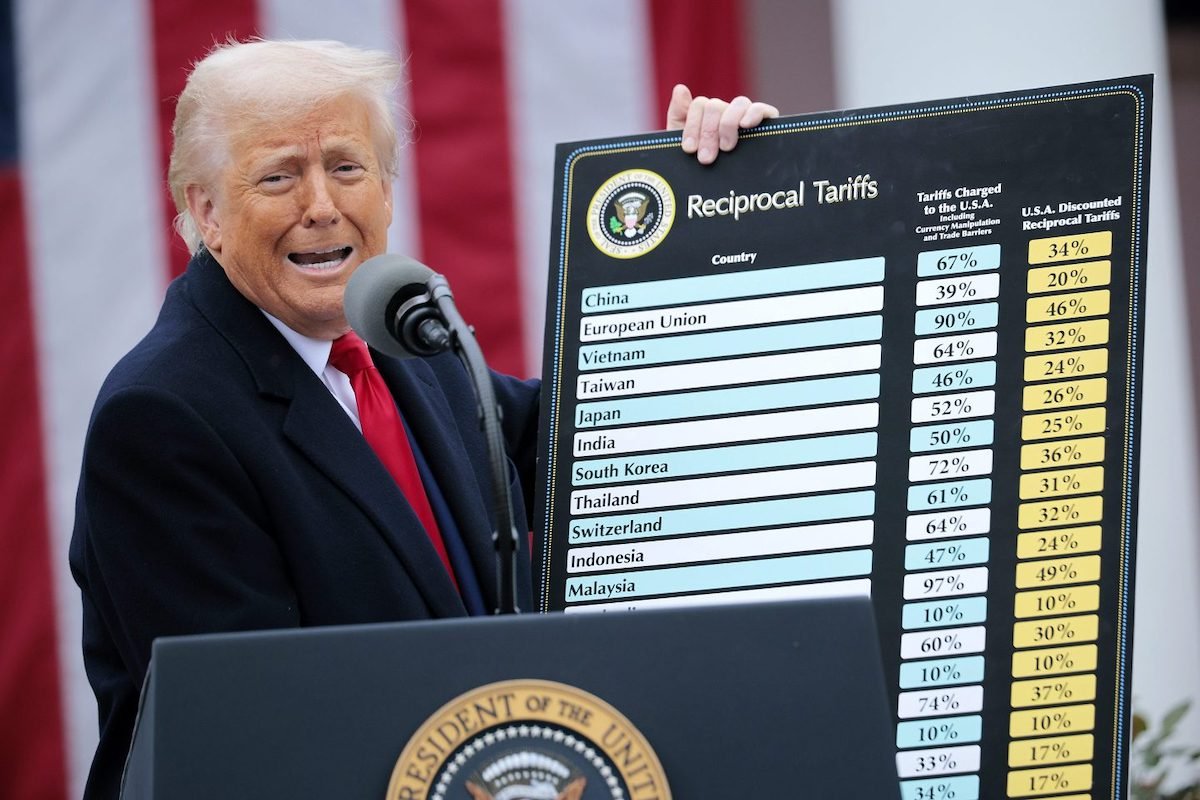
He immediately pivoted to Section 122 of the 1974 Trade Act. When that authority expired in late July, he pivoted again — this time to Section 301, slapping 10%–12.5% tariffs on more than 60 countries.
That’s three legal-system workarounds in under a year. As Deutsche Bank strategist Jim Reid notes, tariffs are becoming a permanent fixture of US economic policy — and the striking part is how little the underlying economics change each time.
The data tell the story. The trade gap jumped 24.4% in July. Imports rose 2.8% to $399.3 billion, goods shipments climbed 3.7% to $320.6 billion, and capital‑goods imports hit a record $140.3 billion, driven by computers, components and semiconductors feeding the AI buildout.
Now the rising political fallout from Trump’s poor trade track record even has Canada in harm’s way. “Americans have zero interest in picking a fight with Canada,” says Eurasia Group’s Ian Bremmer — which hasn’t stopped the administration from aiming at it anyway.
Raymond James analyst Edward Mills expects this to open “the next chapter” in Trump’s effort to rebuild the tariff regime the Supreme Court ruling dismantled, noting that despite midterm anxieties and inflation fatigue, “the US has not yet reached peak tariff.”
The consequences are already apparent: rising inflation pressure, 30‑year Treasury yields at 20‑year highs, and a Federal Reserve now weighing a rate hike as soon as this month. Higher borrowing costs threaten growth and confidence — undercutting the very economic legacy tariffs were meant to protect.
The deeper problem isn’t any single tariff; it’s the worldview behind them. Trump entered office thinking like it’s 1985, and that mindset keeps misfiring in a global economy that no longer operates on those gears.
Beijing, meanwhile, has little reason to complain. Xi Jinping’s Communist Party is likely pleased to see Washington roiling markets, straining alliances and eroding the soft power the US spent decades building. Watching Trump’s inner circle disrupt institutions and mishandle sensitive data only deepens mistrust at home and abroad.
Trump has blinked so many times on his big trade war that it’s become easy to dismiss. Though he imposed 30%‑range tariffs on China, that’s a fraction of the 100%‑plus levies he threatened. For all the bluster, many on Wall Street are betting he will ultimately back down.
Fears of tanking the stock market, pushback from the oligarch‑adjacent figures orbiting Trump 2.0, or advisers warning that threatening a massive trade war is one thing. Detonating the global economy, and Wall Street with it, is another.
Trump’s not alone in using tariffs. Biden quadrupled tariffs on Chinese EVs to 100% in 2024 and raised duties on batteries, solar cells, cranes, medical equipment, aluminum, and steel — borrowing the same playbook despite promising a more competitive American economy.
Japan has spent 14 years trying to revive Reagan‑era trickle‑down economics through Abenomics, with little to show in real wage growth. South Korea has flirted with similar strategies, with similarly thin results.
If the 1985 model still worked, Russia’s economy would be thriving. It isn’t.
Xi, by contrast, is playing a different game — pouring money into renewable energy, automation and high‑value industries to position China for 2030 and beyond. Trump’s approach, by contrast, is trying to drag America back to an industrial model globalization retired decades ago.
The mental template is the 1985 Plaza Accord, negotiated at Trump’s former Plaza Hotel, where Washington pressured Japan and Europe into currency moves that suited US interests. Trump wants that leverage again, aimed at China.
But China in 2026 isn’t Japan in 1985. The US and Chinese economies are too intertwined to separate cleanly, and Beijing has ample leverage to dump Treasuries, tax US exports, devalue the yuan, cancel Boeing orders, choke off soybean purchases, or restrict imports from pharmaceuticals to beef.
Even a “successful” currency squeeze wouldn’t fix what actually ails the US economy: crumbling infrastructure, unstable health care, an opioid crisis, or a workforce unprepared for automation and AI — forces likely to eliminate more American jobs than China ever will. It wouldn’t lift productivity, narrow inequality or push corporations to raise wages or innovate faster.
Instead, the fixation on tariffs distracts from the challenges that matter — from the shift to solar and wind to automation timelines Treasury officials still dismiss as “50 or 100 more years” away.
Even the administration’s flagship “wins” reflect outdated logic. In 2017, the Trump 1.0 White House offered Taiwan’s Foxconn roughly $3 billion to build a Wisconsin plant projected to create 13,000 jobs — about $15,000 in public subsidy per job, per year, for a company whose profits depend on mainland Chinese labor.
It was a small but telling example of 1985‑style industrial thinking applied to a 2026 economy that no longer runs on those terms — and a reminder of how tangled the US–China relationship really is. It’s highly unclear whether Trump 2.0 has learned from any of its former mistakes.
America’s edge has always come from looking forward. Pulling policy back to 1985 risks losing exactly that. And as Trump focuses on tripping up rivals rather than strengthening the US economy, China has every incentive to maintain its trade surplus as long as possible, argues economist Michael Pettis of the Carnegie Endowment.
Writing in Foreign Affairs, Pettis notes that protectionism is usually a symptom of long‑standing imbalances, not their cause — and removing it doesn’t make the eventual adjustment less painful. Today’s global imbalances are unusually large, and the coming correction is likely to be difficult.
China, too, looks vulnerable: its debt burden is among the world’s highest, much of it tied to investments with diminishing or negative returns — excess housing, underused infrastructure and manufacturing capacity that far outstrips demand.
Given those pressures — a massive property crisis, near‑record youth unemployment, weak local‑government finances, and soft consumer demand — Xi has every incentive to keep China’s export engine running hot and heavy.
And to thank his lucky stars that he’s facing off against an American leader whose 40-year-old toolkit is failing in real time.
Follow William Pesek on X at @WilliamPesek