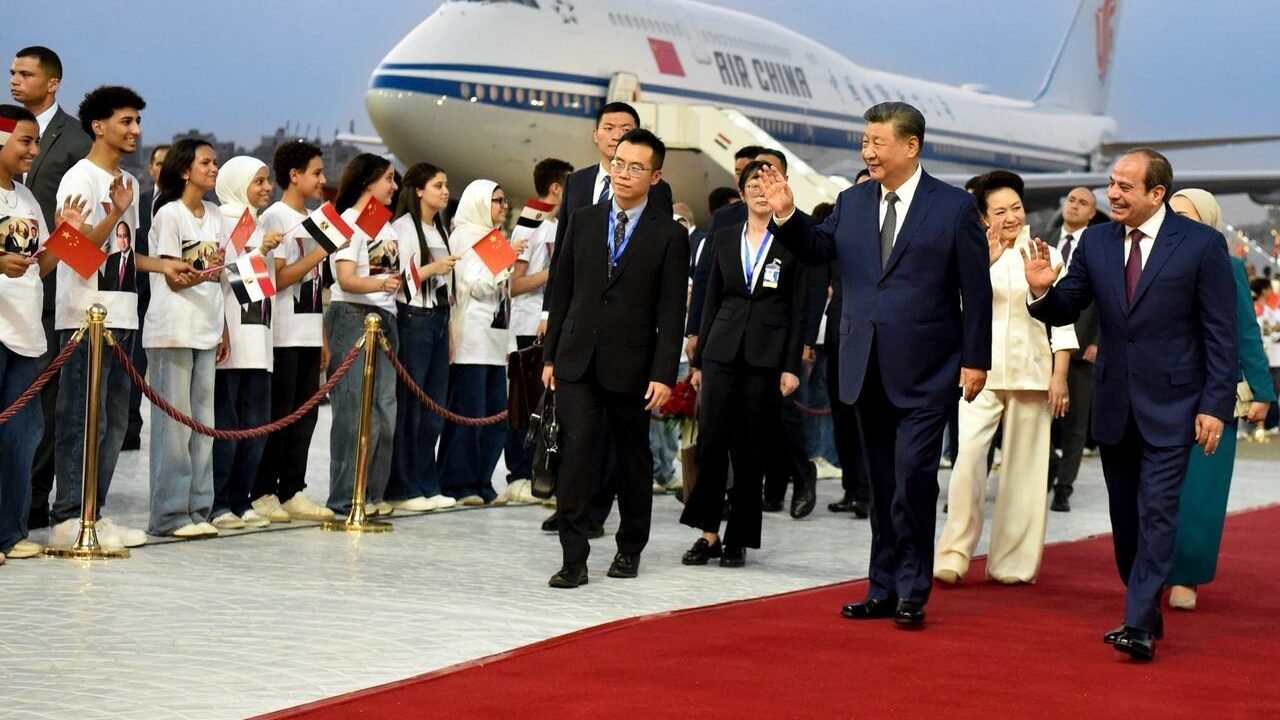
Chinese President Xi Jinping arrived in Cairo this week for a state visit with President Abdel Fattah el-Sisi, using a rare Middle East trip to press for a regional security framework and deepen China’s economic, military and diplomatic ties with one of Washington’s closest Arab partners.
The visit, Xi’s first to Egypt in a decade and his first Middle East trip in four years, unfolded as the US-Iran conflict disrupted shipping, raised energy fears and forced regional capitals to reassess their partnerships. At Cairo’s Ittihadiya Palace, the two leaders held expanded talks, signed agreements and memoranda of understanding, and marked 70 years of diplomatic relations.
Xi called for regional countries to reject outside interference and take a greater role in managing their own security. The message was aimed at a Middle East rattled by fighting around the Strait of Hormuz, with China positioning itself as a power that can offer trade, infrastructure and diplomacy without demanding that states choose a single camp.
Egypt is an especially valuable partner. It sits beside the Suez Canal, a vital route for trade between Asia and Europe, and remains a major recipient of US military aid. Yet Cairo has steadily broadened its ties with Beijing, Moscow and European capitals, pursuing what Egyptian officials describe as strategic balance rather than a break with Washington.
China has invested heavily in Egypt’s Suez Canal Economic Zone, industrial projects, transport and green energy. The two countries also agreed to expand cooperation in security, counterterrorism, semiconductors, critical minerals and the use of national currencies in trade. Their military relationship has gained visibility through the recent Eagles of Civilization joint exercises, which included Chinese J-16 fighter jets and Egyptian Rafale aircraft.
The two leaders discussed the Gaza war, Iran, Red Sea shipping and wider regional stability. Both countries back a two-state solution to the Israeli-Palestinian conflict, and Beijing has sought to present itself as a diplomatic counterweight after helping broker the 2023 restoration of ties between Iran and Saudi Arabia.
The timing also carries a financial edge. Washington has warned it could widen Iran-related sanctions affecting Chinese and Egyptian entities, including the UAE operations of Egypt’s Banque Misr. China remains a major purchaser of Iranian oil and has strong incentives to protect trade routes and limit the war’s economic fallout.
For Egypt, Xi’s visit offered investment and leverage. For China, it delivered something equally valuable: a prominent seat in the region’s next strategic conversation.