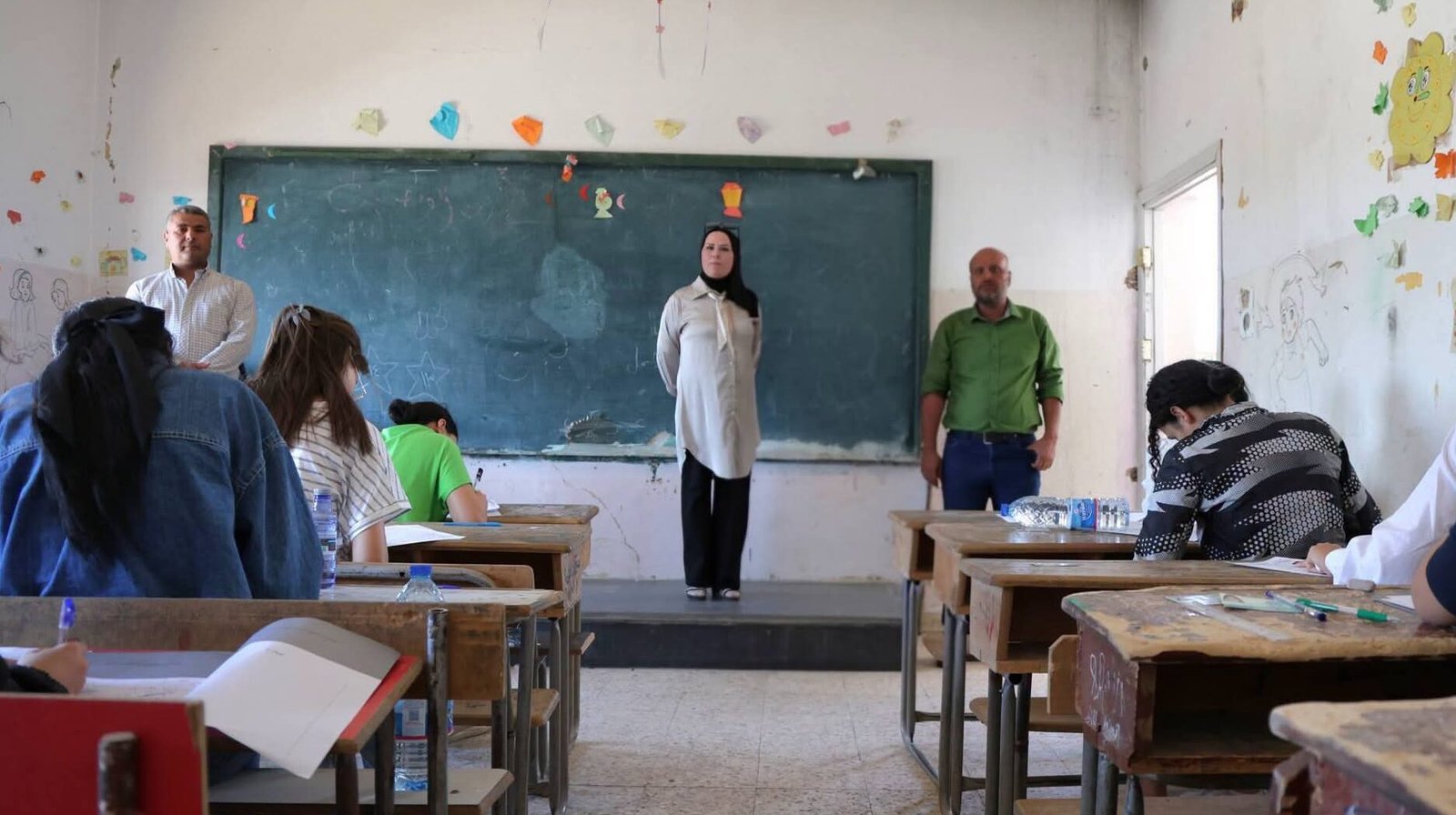
In Syria’s southern As-Suwayda province, the route to an examination hall has become a political fault line. As Rizik Alabi reports, thousands of students who spent months preparing for national exams have found that their future now depends less on what they learned than on who controls the road ahead.
One student, identified as Sally for security reasons, left her home before the tests began and stayed with relatives in a government-controlled part of the province. She feared she would otherwise be unable to reach the official examination center. Her calculation was grim but simple: move early, or risk losing an academic year.
She was among more than 13,000 students registered for basic and secondary certificate examinations in As-Suwayda. Only about 2,000 reached the first round of testing. Damascus then arranged a special session beginning August 29, but only around 150 students made it to designated centers in northern rural parts of the province. The exams are scheduled to run through September 10; thousands remain shut out.
At issue is more than transport. Syria’s Education Ministry insists that official examinations must be managed at state-approved centers. Local forces aligned with Druze spiritual leader Sheik Hikmat al-Hijri have demanded locations nearer to students’ homes and cited security risks in traveling into government-held territory.
The National Guard has denied blocking students, describing the disruption as a response by families unwilling to send their children through contested areas. Yet an earlier statement by the National Guard-affiliated Shahba Operations Room said it would close roads to vehicles carrying students to ministry-designated sites and impound vehicles that defied the order.
Damascus says armed groups are preventing access to a service it organized to protect students’ rights. Its critics ask why, given the province’s tense conditions, the government did not establish centers closer to the affected communities. Each side charges the other with weaponizing education. The children, as usual, are left holding the short end of the timetable.
The dispute grows out of unresolved authority in As-Suwayda after deadly fighting in July 2025. Local armed groups retain control over As-Suwayda city and other areas, while Damascus seeks to restore state institutions across Syria.
Political activist Muhannad Sharrouf warns that the consequences will outlast the present confrontation. “They are not merely depriving them of an exam; they are threatening their future and pushing another generation toward further loss, chaos and collapse.”
Alabi’s full report captures how a dispute over exam centers has become a measure of Syria’s wider failure to keep public life separate from political conflict. Read it for the human cost behind the numbers.