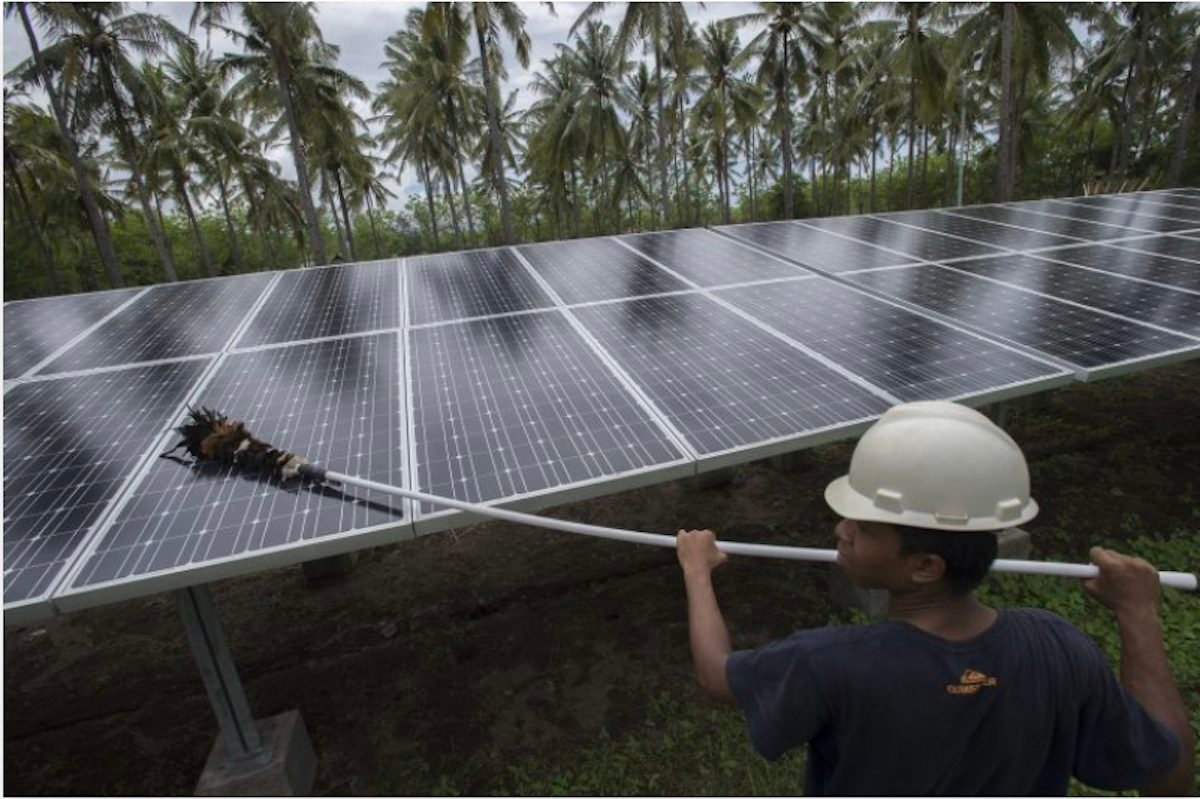
Indonesia wants China’s help building enough solar power to electrify 100 mid-sized cities without actually owning the capacity.
On July 17 in Shanghai, Indonesia’s economy minister, Airlangga Hartarto, asked China’s trade minister, Wang Wentao, to invest in developing 100 gigawatts of new solar capacity by 2029 — a new energy buildout so ambitious it would rival the power output of a major industrialized nation.
Indonesia has already launched 14 projects at different stages totaling 5.3 gigawatts, including 1 gigawatt with battery storage in Bali. The government now says the full plan will require US$73 billion.
Airlangga used the word “invest” while making his pitch in Shanghai, but the better word for what China can bring to the table is “build.”
An investor puts in money and shares the risk. A builder, on the other hand, gets paid a fee and walks away. China fits the builder role far better in President Prabowo Subianto’s massive solar ambition.
In 2025, trade between the two countries hit $154.6 billion while Chinese companies poured in $8.1 billion, marking 13% of all foreign investment in the country. Even with such buoyant trade and investment flows, China’s appetite for Indonesia’s $73 billion solar plan isn’t a given.
From Jakarta’s perspective, Cirata offers a hopeful precedent: the largest floating solar plant in Southeast Asia, situated on a lake in West Java. The $140 million, 145-megawatt plant was developed through a joint venture between PLN Nusantara Power, part of Indonesia’s state power utility, and Masdar, a UAE renewable energy firm.
China’s state-owned PowerChina served as the project’s EPC contractor, while the Indonesian-UAE project joint venture retained ownership. Cirata illustrates a model PowerChina can use elsewhere: acting as an EPC contractor without taking an ownership stake in the generating asset.
The arrangement is broadly consistent with Xi Jinping’s post-2021 emphasis on a “small and beautiful” Belt and Road Initiative, which placed greater weight on more targeted projects alongside the large infrastructure deals that had characterized the BRI’s earlier years.
At the same time, Chinese sovereign lending to developing countries has fallen sharply. New Chinese sovereign loan commitments reported in the World Bank’s debtor system have been about $7 billion a year since 2023, while net flows turned negative by $34 billion in 2024.
Indonesia doesn’t necessarily need Chinese capital to bankroll its solar plan. In 2025, Indonesia introduced a government-guarantee framework for renewable-energy projects, including guarantees against certain payment risks involving PLN and other state-owned entities. Such guarantees can make projects more bankable for lenders.
Danantara, Indonesia’s new state investment fund, has already said it will help fund the scheme. On August 26, Pahala Mansury, the fund’s managing director for global relations and governance, said Danantara can act as an equity investor in projects like this one, backed by new multi-source bonds.
Jakarta has also eased a longstanding rule that once scared off foreign investors by requiring too many locally made components in local projects. Together, these moves open the project to lenders and investors well beyond China.
This setup would seem to suit China. Chinese factories can now produce about 1,200 gigawatts of solar panels a year, far exceeding global annual demand.
That excess capacity has crushed prices and profits: revenue from Chinese solar exports fell from $42.3 billion in 2022 to $23.7 billion in 2025, even as shipment volumes rose.
Panel prices fell from 25 US cents a watt in 2022 to about 7 cents in 2025, and several of China’s major solar manufacturers are now losing money, meaning they need new buyers.
Indonesia fits that bill amid estimates that its solar capacity is projected to grow from 2.15 gigawatts in 2025 to almost 15 gigawatts by 2031. Simply put, Chinese companies arguably need Indonesia’s market more than Indonesia needs any single Chinese supplier.
At the same time, Indonesia isn’t picking China over the West so much as taking what’s on offer. The US canceled its own $7 billion solar program for low-income households while recently cutting foreign aid for clean energy.
The EU’s Team Europe package for Indonesia’s energy transition totals 3.4 billion euros — significant, but small relative to the roughly $73 billion investment requirement for the 100-GW solar program.
On July 30, Indonesia’s environment minister, Moh Jumhur Hidayat, met China’s climate envoy, Liu Zhenmin, to discuss deeper cooperation on clean energy, marking a real and welcome step.
China is well suited to help build Indonesia’s solar dream. That could mean supplying equipment and construction expertise, paid through capital Indonesia raises internally, including through partners like Danantara.
For Jakarta, that is the opportunity: use China’s extraordinary manufacturing scale and construction expertise without handing Beijing a stake in Indonesia’s power system. China can supply the panels, batteries and engineering; Indonesia can raise the capital and retain the assets.
The smartest deal, in other words, may be one in which China helps build Indonesia’s solar future—but Indonesia owns it.
Muhammad Zulfikar Rakhmat is director of the China-Indonesia Desk at the Jakarta-based Center of Economic and Law Studies (CELIOS) independent research institute. Yeta Purnama is a researcher at CELIOS.