
Fashionistas of a certain age no doubt remember the late designer Stephen Sprouse, who gave Blondie’s Debbie Harry her distinctive Bowery punk style. Sprouse’s first collections in the mid-1980s made a major splash, melding graffiti prints, a playful ’60s aesthetic, and bright Day-Glo colors that won admirers such as Andy Warhol.
Several examples of Sprouse’s work are preserved in the textiles collection of the Indianapolis Museum of Art at Newfields, where conservationists are trying to learn more about the phosphorescent and fluorescent pigments the designer used in his creations in order to keep the colors from dulling over time. They described recent advances in that research at a meeting of the American Chemical Society (ACS) held this week in Chicago.
Scientists began describing minerals that glowed in the dark as phosphors in the Middle Ages. Typically, such materials take on a charge when exposed to light, storing the absorbed energy and releasing it gradually as re-emitted light. Henri Becquerel discovered radioactive decay in 1896 because of his work with phosphorescent uranium salts: He left the salts in a closed drawer with photographic plates, which fogged up even without a light source. DayGlo paints and similar materials exploit the related phenomenon of fluorescence. DayGlo pigments fluoresce in daylight by essentially converting UV light into visible light to produce brighter, more vibrant colors.
Sprouse is not the only one to find inspiration in DayGlo and similar phosphorescent and fluorescent materials. All glow-in-the-dark toys, stickers, paint, coatings in fluorescent lamps, cathode-ray tube TVs, and some clock dials rely on phosphorescence. (By contrast, glow sticks rely on a chemiluminescent process.) They’re also commonly used for traffic signage and on safety gear.
DayGlo pigments were used extensively during World War II to make fluorescent fabric panels for US ground troops, while DayGlo’s black light paints were used on Navy aircraft carriers to enable planes to land at night. Artists have used both phosphorescent and fluorescence materials extensively from the mid-20th century on, most notably for psychedelic art and Sprouse’s designs.
A question of preservation




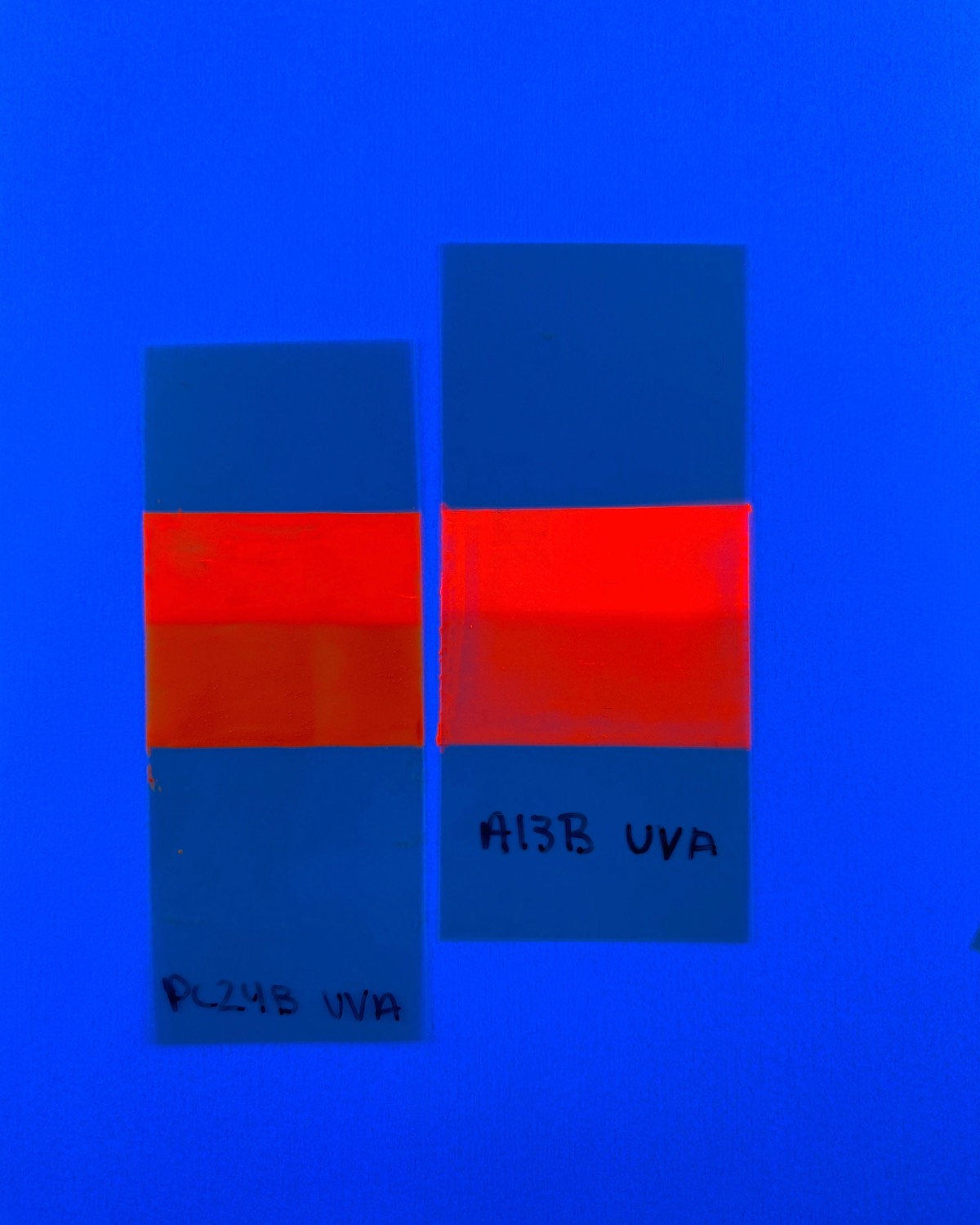
“For artists, the effect isn’t simply cosmetic, because they intentionally use these colors for their visual impact,” said Sarah Schmidtke Sobeck, a photochemist at The College of Wooster who spoke at the ACS meeting.
Sobeck and Gregory Smith, a conservation scientist at the Indianapolis Museum of Art, have been collaborating on researching such materials for the last decade after meeting at a cultural heritage science conference. Their partnership has already produced a two-part study on the composition, spectral properties, and light stability of daylight fluorescence artists’ pigments.
That earlier work showed that the optical brightener compounds that give fluorescent pigments their brightness degrade more quickly than the pigment dyes. Thus, even when there is no degradation in the pigments, the colors can appear to darken. That poses a unique challenge for conservationists responsible for long-term restoration of these works. Not only must they match colors under both visible and UV light, but the pigments will also change subtly over time. Gaining a better understanding of the unique photochemistry of such materials is critical for this purpose.
During her talk, Sobeck reported on the group’s most recent work, extending their research to glow-in-the-dark phosphorescence pigments, with particular focus on the museum’s Sprouse collection. Among the early findings: Such materials have a markedly different composition from fluorescent colorants, which typically use organic dyes. The phosphorescent materials contain mineral-based pigments and inorganic compounds.
Also, humidity turns out to be a significant factor in the breakdown of phosphorescent pigments—as much if not more so than prolonged exposure to light, which will help the museum improve its storage and exhibition practices for such artworks. The next step in this ongoing project will focus on the white pigment powder lithopone, testing how long phosphorescent materials containing that pigment will glow after each charge.