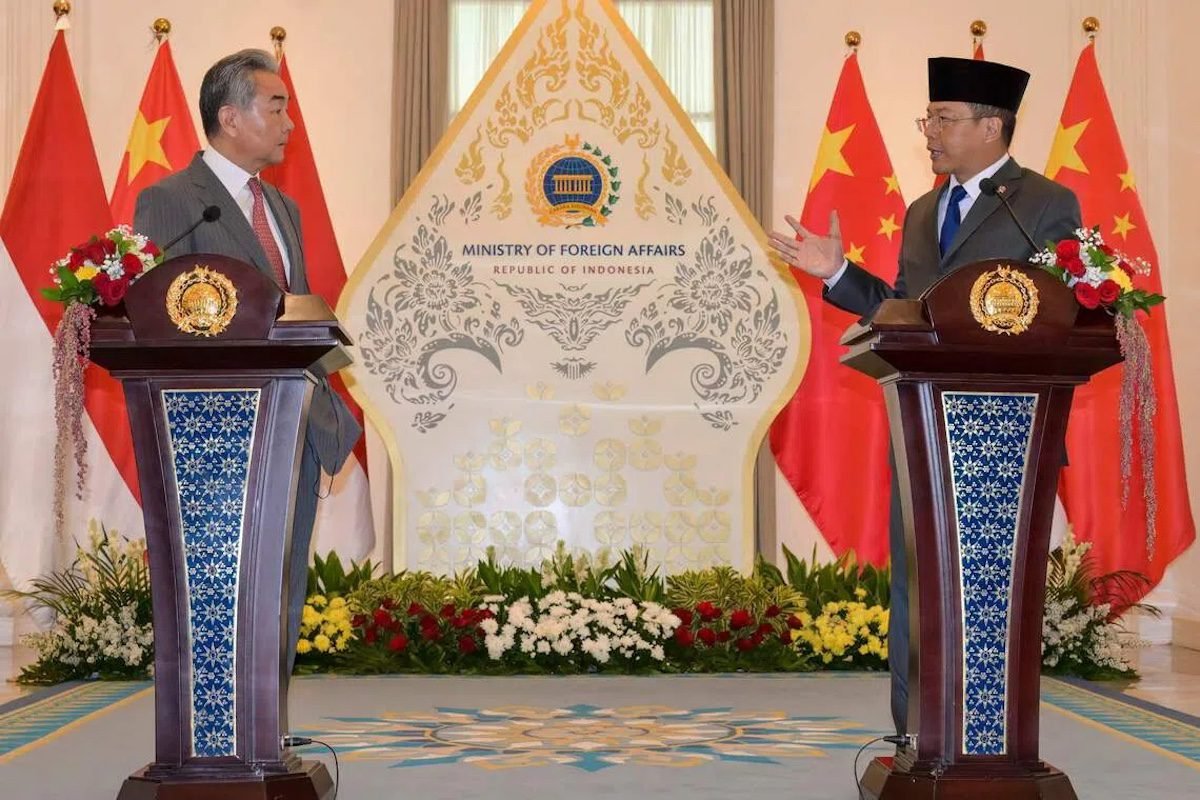
Chinese Foreign Minister Wang Yi was in Jakarta from August 20 to 22, where he launched a new Comprehensive Strategic Dialogue, initiated a second round of the 2+2 dialogue between foreign and defense ministers, and held a separate meeting with Indonesia’s top economic official, Luhut Binsar Pandjaitan.
News coverage of the diplomatic whirlwind was mostly celebratory. However, set against what transpired bilaterally in the weeks before his trip, the outcomes look more complicated.
On August 12, an Indonesian frigate carried out an unprecedented joint naval drill with a Chinese warship east of Taiwan, the first time China has held such an exercise there with any foreign navy.
Jakarta called it a routine “passing exercise”; Taiwan called it a “military provocation” and demanded an explanation. The drill happened the same day Indonesia’s defense minister met a senior US defense official in Jakarta, a coincidence that captures how far Indonesia is leaning into military cooperation with Beijing while still trying to keep Washington close.
In May, Chinese firms operating in Indonesia sent an unusually blunt open letter to Prabowo through the China Chamber of Commerce, warning that sudden regulatory changes, nickel mining quota cuts, new foreign exchange rules and what it bluntly called corruption and extortion by local officials were squeezing Chinese-invested firms.
That complaint explains what otherwise reads as a throwaway line from this week: Wang’s direct request that Jakarta guarantee a friendlier business climate for Chinese companies.
Bundling politics, trade, maritime affairs and security into one closed-door dialogue may help translate presidential goodwill into programs. It also means the public and parliament have less visibility into what is being traded for what. A concession in one area can be offset by a gain in another without either being announced separately.
The most concrete outcome came in the realm of defense. Sjafrie Sjamsoeddin announced the two countries will jointly build a factory to produce ammunition, missiles and rockets, with China transferring the technology to build it domestically by 2027.
Many basic questions remain unanswered, however, including which Chinese company will participate, who owns what and how much technology will genuinely be transferred so that weapons are not merely assembled locally from imported Chinese parts and components.
Sjafrie also said there had been no talks about buying Chinese J-10 jets, an idea he had floated in 2025 before backing away, and insisted the meeting did not touch a separate American request to allow its military planes to fly freely over Indonesian territory. Set against the Taiwan-area drill 12 days earlier, that denial is worth watching rather than simply accepting.
On the South China Sea, both sides repeated their support for finishing a long-delayed regional code of conduct, language that has been under negotiation since 2002. Wang also urged Indonesia to jointly resist “bullying” by other powers, spelled the US, and back several Chinese-led global initiatives, a call from a country that is locked in a dispute with Jakarta over the Natuna Sea.
That dispute, which has seen Chinese coast guard vessels operating in waters Indonesia claims as its exclusive economic zone, again went unaddressed by name while Wang was in Jakarta.
On economics, the two countries reaffirmed plans to keep financing the Jakarta-Bandung high-speed rail line, whose debt problems remain unresolved despite repeated assurances that talks are “going smoothly,” and to deepen cooperation on food, energy, minerals and artificial intelligence.
Indonesia had already joined a new China-led global AI governance body a month earlier, alongside Russia and Pakistan but no G7 country, with little public debate. Jakarta’s AI pledges made during Wang’s visit thus build on an alignment already made.
In his meeting with Luhut, Wang asked Jakarta to guarantee a “safe, stable and good” business environment for Chinese companies, effectively echoing Chinese firms’ scolding letter about regulatory whiplash in May at the highest diplomatic level.
Luhut said cooperation “cannot stop at grand projects on paper” and must deliver real jobs, technology and the right standard – though no one has explained how it will be measured. His comments did not seemingly resolve the tension that has boiled over into the open between Jakarta’s resource nationalism and Chinese investors’ call for greater regulatory certainty.
None of this happened in a vacuum. Days after President Prabowo Subianto’s inauguration in October 2024, a Chinese coast guard vessel obstructed state oil firm Pertamina’s seismic survey near Natuna, sparking an early test of his then-new government. Fast forward to the present, and a case could be made that the president is bowing to Beijing pressure tactics.
In February 2026, Indonesia signed a trade deal with Washington cutting US tariffs from 32% to 19% in exchange for terms that could constrain its economic dealings with China.
It’s still unclear to what extent Prabowo has yielded to US demands for overflight rights in Indonesia that analysts suggest would have strategic implications for maritime chokepoints, not least the Malacca Strait, where well over 70% of China’s energy imports transit.
Taken together, Jakarta’s “free and active” foreign policy doctrine looks less and less like an even balance and more like a set of overlapping, closed-door bargains whose real terms outsiders can only partly see, with unknown implications for national sovereignty and well-being.
Muhammad Zulfikar Rakhmat is the director of the China-Indonesia Desk at the Jakarta-based Center of Economic and Law Studies (CELIOS), an independent research institute. Yeta Purnama is a researcher at CELIOS.