Israeli security doctrine measures threats by their effect on freedom of aerial movement rather than by their political or legal character
One question captures the whole Syrian scene: Why does Israel respond to a Turkish presence that differs in kind—not degree—from the Iranian presence with exactly the same military tools?
The difference between the two models is fundamental. Iran’s positioning rested on penetration by militias, irregular supply lines, and an attempt to redraw the demographic map—a project that ran through the Syrian state and ultimately superseded it. Turkey’s positioning is based on a state-to-state partnership: air cover, training for the new Syrian army, and the rehabilitation of bases and airfields. The first deliberately weakened the state; the second requires the state to exist so that Turkey can work through it.
Yet Israel’s response remains the same. Here lies the key to understanding it: Israeli security doctrine classifies a threat not by its legitimacy but by its effect on freedom of aerial movement. A conventional radar operated by a North Atlantic Treaty Organization member restricts Israeli aircraft more than a shoulder-fired missile in the hands of a member of an armed group. By that standard, legitimate partnership and illegitimate infiltration become equivalent—and resurfacing a runway becomes grounds for bombing it.
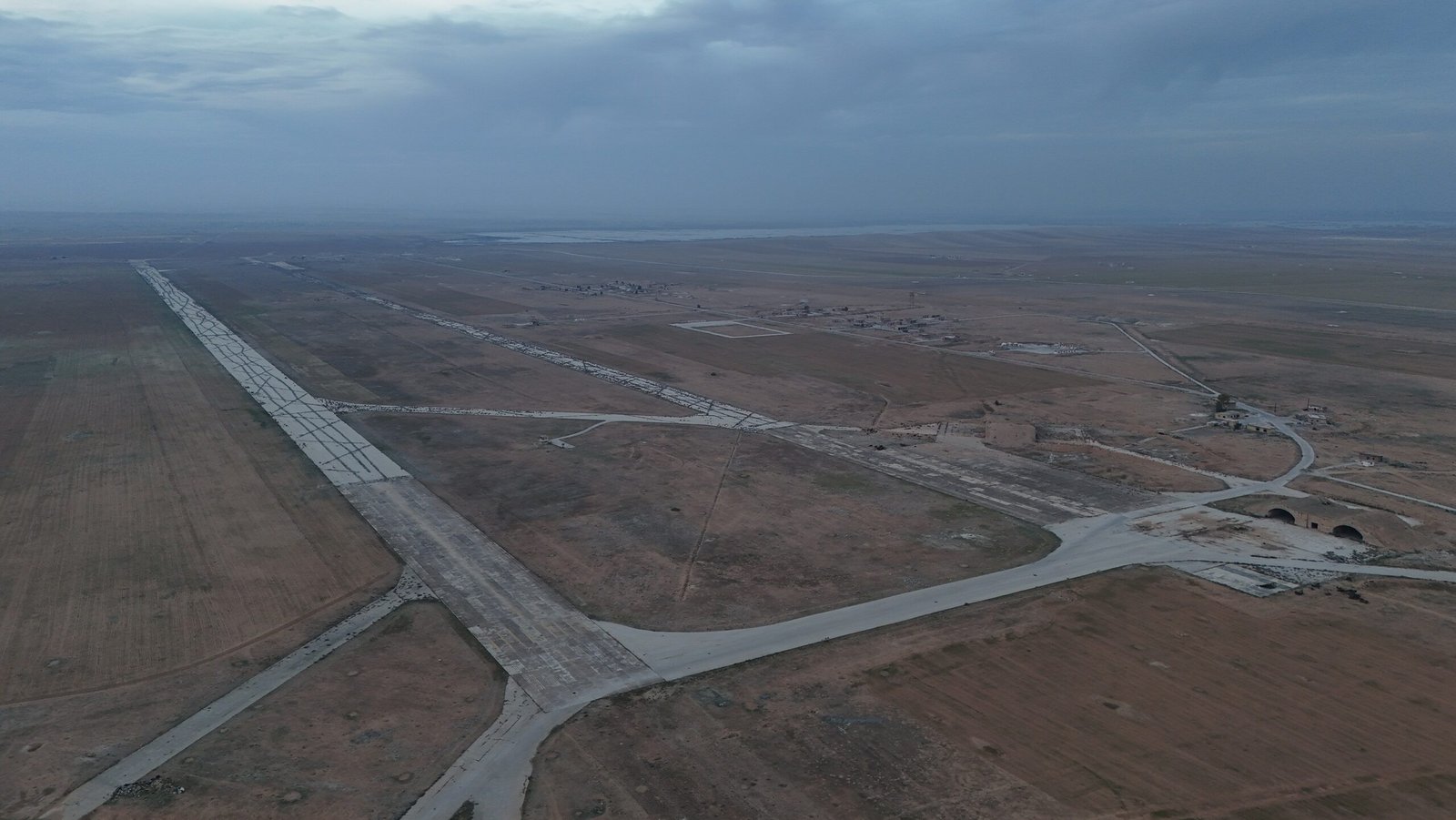
The raids on Abu al-Duhur lay the equation bare. The strike came hours after a Turkish military delegation inspected a runway under repair, following the precedent set in April at Palmyra, T4 Airbase, and Hama Military Airport. This was not a response to an existing capability; it was an attack on one still taking shape—a logic that kills deterrence in the cradle.
Still, reading Ankara as merely a lawful actor shortchanges the analysis. Turkey has an influence project, not a charitable mission. Its goals include acquiring strategic depth in a neighborhood that has slipped out from under Russian and Iranian tutelage, settling the Kurdish question on its own terms, and securing both a market and a field laboratory for its defense industry. Ankara buys influence with the currency of partnership; Tehran bought it with the currency of infiltration. The same third party pays the bill: Damascus.
Here is the most uncomfortable paradox. The Syria whose airfields are being bombed is not in a declared state of hostility with the country bombing them. A negotiating track under American sponsorship is underway, and discussion of a security agreement—or a return to the 1974 disengagement arrangements—has never stopped. Damascus negotiates over its security in one room while its military infrastructure is destroyed in the field. This contradiction is not at the margin of the story—it is the story, because it precisely measures the gap between sovereignty as rhetoric and sovereignty as capacity. Washington, which opens its doors to the Syrian president, cannot—or will not—restrain Israeli aviation. Its description of the raids as an unjustified escalation demonstrates the limits of its influence, not the absence of that influence.
Are we heading toward a direct Turkish-Israeli confrontation? Probably not. Ankara’s membership in the North Atlantic Treaty Organization, the deconfliction channels, and its preference for building its presence gradually—because time works in its favor—provide stronger restraints than the temptation to invoke “the Turkish threat” in Israeli electoral politics. The likelier outcome is a war of attrition conducted through messages: slow construction, periodic demolition, and an implicit understanding that personnel will not be targeted.
Three possible trajectories bear watching: a prolonged negative equilibrium; a conditional opening that trades a freeze on heavy Turkish deployments for an end to the strikes and a phased Israeli withdrawal in the south; or a slide toward confrontation triggered by Turkish casualties. Three indicators will determine which course prevails. Will rehabilitation work resume or remain frozen? Will Turkey move from radar installations to an operational air-defense system? Will the negotiating track survive each strike?
Syria today does not have the luxury of choosing its trajectory. Yet, if it manages time well, it may be able to make the cost of turning its territory into an arena higher than the potential returns for every party involved.