
The 2025 US National Security Strategy (NSS) asserts that America must prevent China from establishing “tolls” in the South China Sea to preserve the freedom of navigation.
Half a year later, practically the entire national security establishment is fixated on the issue of maritime “tolls” — those Iran seeks to impose in the Strait of Hormuz.
Washington fears a link between the Persian Gulf and the western Pacific is gaining traction. Speaking in Manila recently, Secretary of State Marco Rubio warned of “a very dangerous precedent which will repeat itself in other parts of the world, including in this region.”
Yet with respect to China, these concerns are wholly misleading. It simply makes no sense that Beijing would be inspired by Tehran’s actions on tolling.
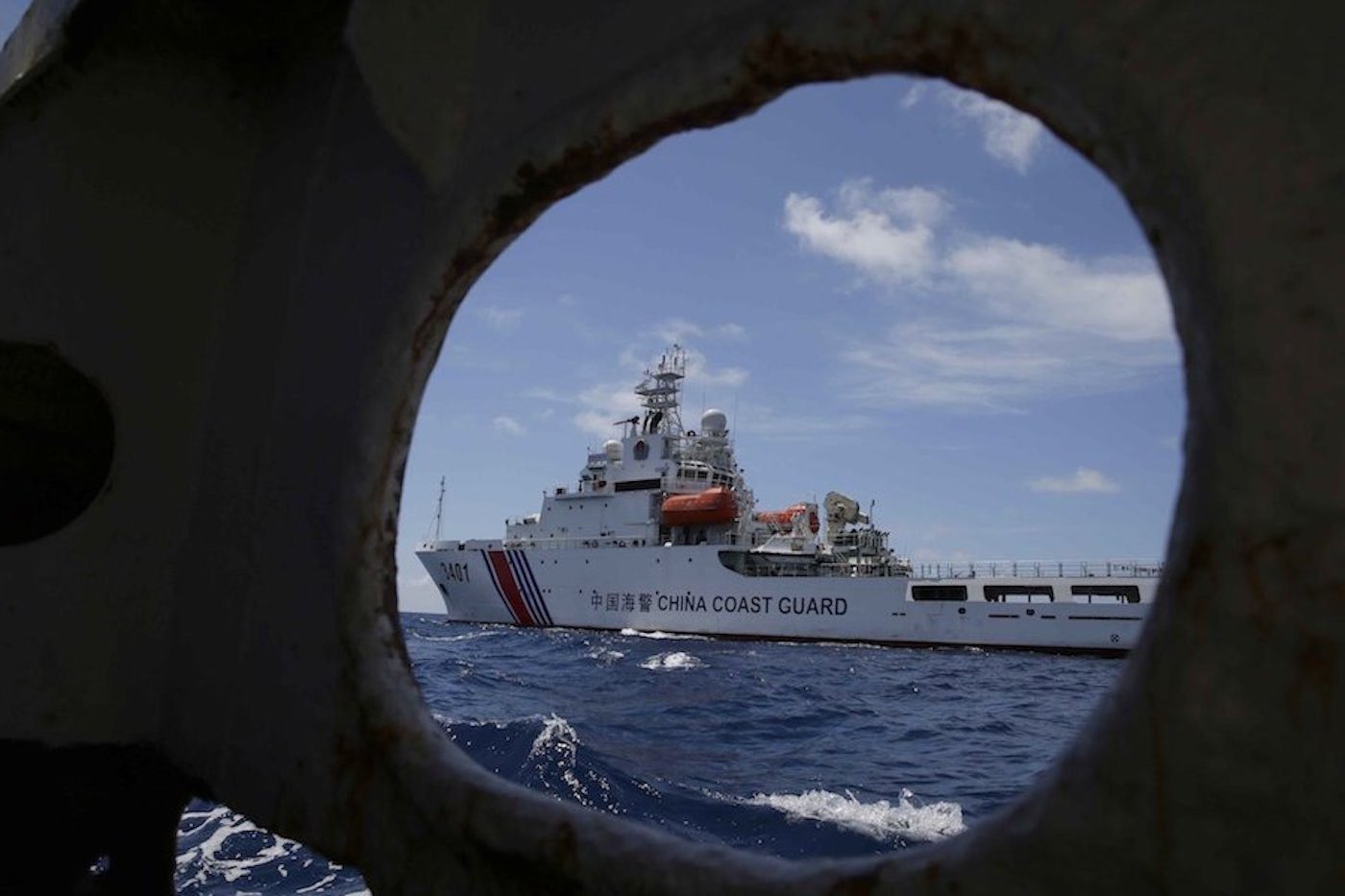
The odd use of the word “toll” in the China context reflects a basic but all too pervasive misunderstanding of Chinese maritime activities in the western Pacific. Yes, Beijing does frequently deploy coast guard and so-called “maritime militia” forces to contest fishing access and hydrocarbon exploration, but these activities are distinct from any hypothetical move to establish tolls on the commercial transit of vessels.
What China is doing isn’t unusual. There are ongoing, intensive fishing and undersea hydrocarbon disputes all over the world. Concerns over Chinese tolls seemed to find ground in June when Beijing declared that it would begin maritime law enforcement in the sea east of Taiwan.
As one leading newspaper reported: “Chinese coast guard ships have operated east of Taiwan before, including as part of military exercises. The difference now is that the patrols are intensive and coordinated, and accompanied by declarations of a political intent….”
According to that same article, a handful of vessels were asked by the China Coast Guard to report their destination along with details about their crews. At least some of the vessels complied. The report concluded that Beijing is “practicing steps that could be part of a blockade.”
However, it should be noted that China’s actions have an ostensible cause. Back in May, Japan and the Philippines announced that they would hold bilateral negotiations to delimit their adjoining Exclusive Economic Zones that seemingly come together in the waters east of Taiwan. This set off a furious reaction from China.
To complete the fireworks, the US joined with France, Germany, and the UK in late June to condemn “recent Chinese activities off the east coast of Taiwan, where China has mounted Coast Guard patrols, saying they threaten regional stability and freedom of navigation.”
That unusual statement was no doubt connected to the current worldwide focus on freedom of navigation through the Strait of Hormuz. However, the linkage to China and related strategic quandaries is specious. The giant Chinese economy does not require tolls, since its aggregate trade flows make any such fees tiny by comparison.
Moreover, the geography is very different from the famous Middle East chokepoint. There is no comparable maritime chokepoint in the Pacific. Ships going to Japan use sea routes proximate to China, but it would not be overly hard to divert them farther east and south.
Beijing strategists have long talked about the so-called “Malacca Dilemma,” but the concern has been that other states, most obviously the US, might try to inhibit Chinese shipping rather than the other way around. And no wonder – the US has had a long track record of stopping Chinese ships going back decades.
And this continues to the present day, as the US is attempting to block transit of vessels going between China and the Persian Gulf without any persuasive legal framework.
While the US is not demanding tolls, one could certainly suspect that Washington is suffering from the psychological phenomenon of “projection,” in which one attributes to others a practice that they themselves could be accused of.
It’s certainly true that China has built up a large apparatus for so-called “gray zone” coercion in the maritime domain. This consists of the world’s largest coast guard, a maritime militia comprised of hundreds (or more) fishing vessels, and Beijing’s rapidly advancing navy.
While this has unnerved US allies like Japan and South Korea, and even precipitated some injuries in the case of the Philippines, China’s preference for deploying white hulls versus grey hulls indicates it is looking to avoid bloodshed.
Nor does the US have good options to counter China’s non-military maritime coercion, thanks to a glaring asymmetry of interests. This is China’s maritime periphery and very distant from America’s shores. Beijing possesses not only advantageous geography but can deploy vast resources and has the will to take significant risks.
The truly frightening scenario is that China’s “games” aren’t preparations for tolls but a precursor to a full-spectrum blockade of Taiwan. The sad truth is that the island remains vulnerable to a blockade, whether focused on energy or even food supplies.
The most essential point, however, is to differentiate between perceived and mostly baseless threats to freedom of navigation and genuine sovereignty claims. Confusing the two could prove to be a catastrophic error in the age of nuclear weapons, wherein China claims Taiwan as “the core of China’s core interests.”
Lyle Goldstein is director of Asia engagement at Defense Priorities.

Lyle Goldstein is the director of Asia engagement at Defense Priorities and a visiting professor at the Watson Institute of Brown University. Follow him on Twitter @lylegoldstein.






 asserts that America must prevent China from establishing “tolls” in the South China Sea to preserve the)