Totally Interactive’s collaboration with Mashabim marks the first time that immersive spaces will be adapted specifically to help students readjust to school and build resilience in the aftermath of the war
You are standing inside Van Gogh’s painting “Starry Night.” The sky is swirling around you. The glowing stars seem as if you could touch them. Then you switch to another of his paintings, moving through different periods of his life and learning about the artist and his techniques as if you are inside the paintings themselves.
Now, you are on a virtual tour of Los Angeles, with street signs and a compass to help you navigate. Famous people stop to tell you about where you are standing. You hear the cars honking. You see the diversity. You become lost in the city.
“You really can bring someone into another world and extend that world around them,” said Erez Noked, CEO and founder of the Israeli company Totally Interactive, which creates these immersive learning spaces. “The more senses that are involved, the more opportunities there are for engagement and retention of knowledge.”
The more senses that are involved, the more opportunities there are for engagement and retention of knowledge
Totally Interactive is now partnering with the Mashabim Community Stress Prevention Center to create these spaces to help children struggling in school in the aftermath of nearly three years of war, especially in northern Israel, where rockets have fallen almost continuously throughout the war. Many children were displaced from their homes for more than a year and a half.
Dr. Nira Kaplansky, a trauma expert and head of the innovation and development department at Mashabim, is leading the project. She told The Media Line that the team is not developing therapeutic trauma protocols for the spaces, but rather resilience-enhancing protocols for children who have been living under prolonged and continuous stress since October 7.

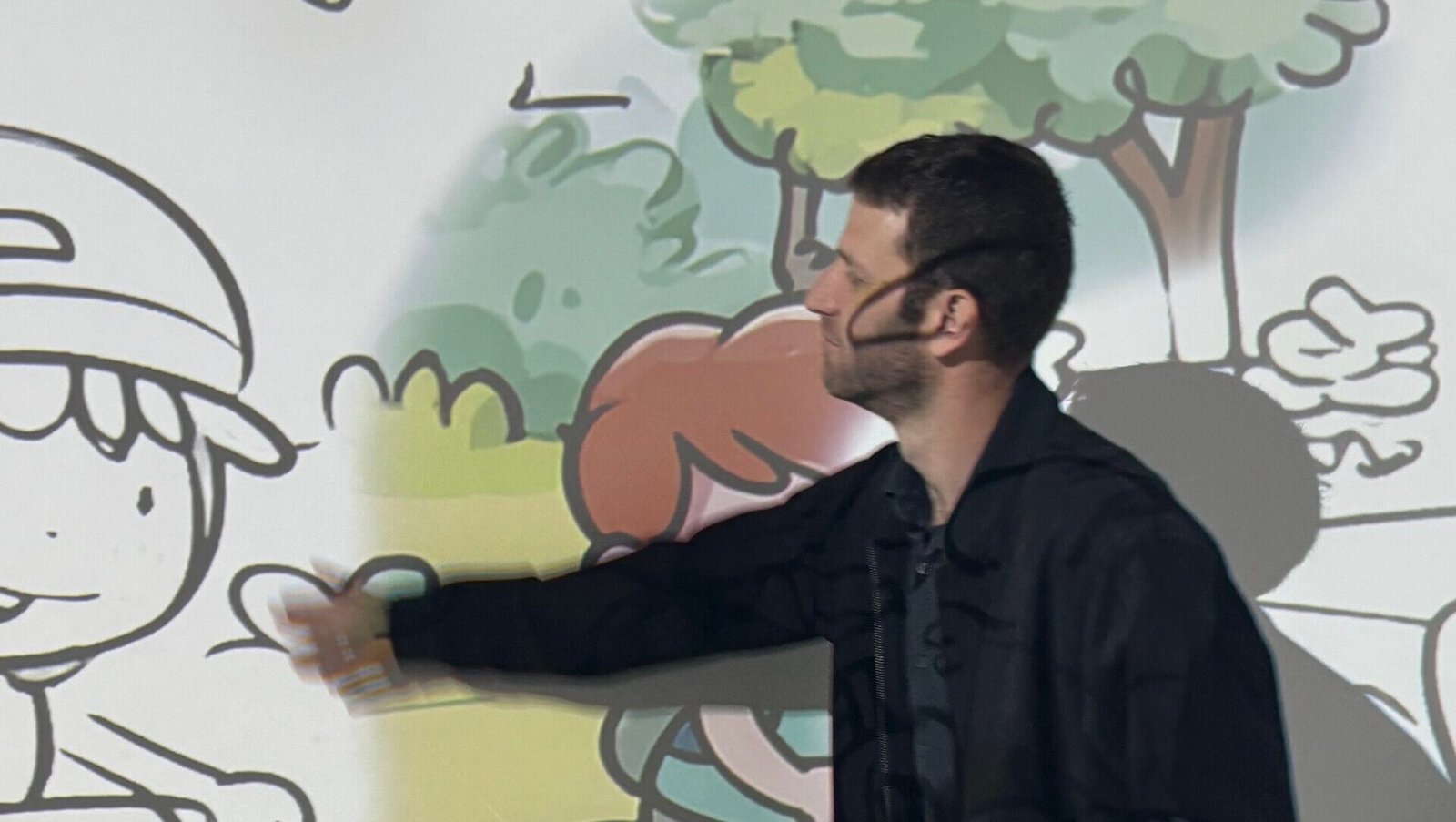
Erez Noked CEO and founder of the Israeli company Totally Interactive demonstrating the technology. (Maayan Hoffman / The Media Line)
“Even the most ‘normal’ children who didn’t develop PTSD [post-traumatic stress disorder] symptoms were all affected by October 7 and the wars that came after,” Kaplansky said. “It’s very natural that they will have some hard times adjusting back to the classroom. So what we have done is translate into the immersive space protocols for small groups of children.”
She added, “There is a component of magic in these rooms.”
There is a component of magic in these rooms
Totally Interactive has been providing interactive technological solutions since 2013. In the beginning, Noked explained, they were designed primarily to address the needs of people with disabilities and other special needs. The idea was to use different types of sensors to create an impact or trigger so that every touch or movement produces some multimedia event, whether video, sound, or movement within a space.
Over the years, based on demands that came directly from the field, Totally Interactive developed into a company providing engaging solutions for a much broader range of needs. Most products on the market today are mass-marketed and are designed for the mainstream. They are not necessarily adapted to specific populations or designed as technologies that can be customized for therapeutic purposes.
“Our solutions can be used by people of all ages and at different ability levels,” Noked told The Media Line. “In recent years, the platform has developed into an entire immersive room.”
The platform is open, meaning that with the press of a button, users can completely change the room’s purpose and how it is used. In general, the technologies are based on some touch or interaction that generates a trigger, which might change an image, encourage movement, produce a sound, or generate another response.
“If we compare this technology with immersive experiences you might see elsewhere in the world or in museums, the difference is that this isn’t a single exhibit built around one experience or one artist. You can essentially bring an entire gallery into this space,” Noked said. “We already have thousands of different environments and subjects for learning, play, and therapy.
We already have thousands of different environments and subjects for learning, play, and therapy
He added, “There are also medical applications, including physiotherapy, occupational therapy, speech and communication therapy, and art therapy. It can also support community activities and educational subjects. It can be incorporated into a training program, used for advertising or branding, or used for professional simulations.”
Totally Interactive already works with experts in medicine, education, simulations, and other areas. Together, they identify needs, develop scenarios, and then translate those scenarios conceptually into the platform to make the most of the immersive environment. Their latest work with Mashabim marks the first time the immersive spaces, already present in more than 130 locations throughout Israel, will be adapted specifically to help students readjust to school and build resilience in the aftermath of the war.
Kaplansky explained that the goal is to develop protocols that help children return to the regular classroom, beginning with basic psychoeducation that helps them understand what happens in their bodies and minds when they are exposed to stress.
The team developed a series of protocols for students. One is based on the BASIC PH multimodal framework for coping with stress and building psychological resilience, created by Israeli professor Mooli Lahad, who founded Mashabim. The model identifies six channels through which people cope with stress and crises: belief and values, affect, social connection, imagination, cognition, and physiology. The BASIC PH model is incorporated into a lesson within the immersive space.
Another protocol focuses on developing empathy, Kaplansky said, teaching children about the components of empathy and how to identify and respond to others’ feelings. There is also a protocol centered on playfulness, which she said is “instrumental for resiliency,” and another that explores the relationship between fantasy, reality, and imagination. The team is also developing a separate protocol specifically for teenagers, while most of the protocols developed so far have focused on elementary school children.
“We wrote the protocols, and then we gave them to Totally Interactive to translate them into an immersive interactive environment,” Kaplansky told The Media Line. “We are not technicians; we don’t know how to make those games work with the computer. We needed them to do the translations.”
The first two protocols are ready, Kaplansky said, while the others are still in development. In November, the preliminary protocols will be introduced in approximately 10 to 12 schools alongside a research project that will monitor how children respond to them and whether they are effective. Initially, all of the participating schools will be located in northern Israel.
A small trial already took place over several weeks this summer with children attending camps to determine whether the concept worked in practice. Parents were asked to complete questionnaires at the beginning and end of the trial, and Kaplansky said the preliminary results appeared promising.

Erez Noked CEO and founder of the Israeli company Totally Interactive demonstrating the technology. (Maayan Hoffman / The Media Line)
When the larger research project begins in November, researchers will also use smartwatches to measure certain physiological indicators, such as heart rate, to assess the children’s responses. They will follow up with the students afterward to determine whether any changes are sustained over time.
Kaplansky said that if the results are beneficial, the goal is to expand the protocols to as many of the country’s available immersive rooms as possible for use with schoolchildren.
Noked said the immersive space differs from virtual reality, which tends to be a more individual experience. With these spaces and the Mashabim protocols, he said, “You have an enabling environment that is also collaborative.”
“You can incorporate different physical objects. You can bring in a bed, crutches, or a wheelchair and make them part of the environment,” Noked said. “You can also work with several patients simultaneously or work with groups. That allows you to reach a larger number of patients.”
He added that there is also a significant shortage of professionals today, and this kind of tool can help professionals reach people at earlier stages and provide different forms of therapeutic training.
Ultimately, Noked said, the power of the technology comes from allowing people to enter an experience rather than observe it.
Instead of simply seeing something, people experience it
“Instead of simply seeing something, people experience it,” Noked added. “They aren’t just being shown something. They become active participants within the environment itself. Instead of telling people to close their eyes and imagine something, you tell them: ‘Open your eyes. You’re there.’”
This report is part of Traumatech, a series developed and created by Maayan Hoffman and debuting on The Media Line. The series explores how Israel is building and exporting breakthrough mental health technologies that can transform life at home and bring hope to communities worldwide.