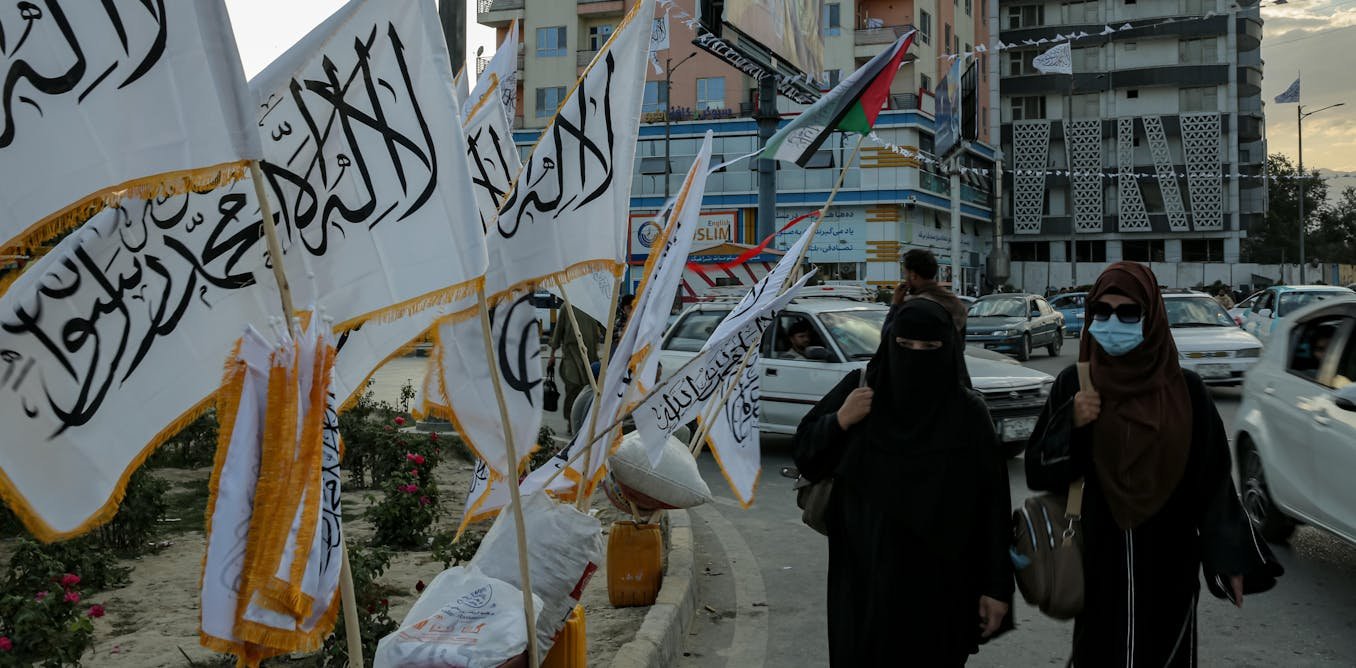
Five years on from seizing power in Kabul on August 15 2021 and consolidating its hold through the whole of Afghanistan, the Taliban claims to have ended the country’s decades-long war and achieved security.
International troops have withdrawn and the former Islamic Republic of Afghanistan has collapsed. Daily security incidents, such as suicide attacks and roadside bombs that were mostly carried out by the Taliban in their two-decades-long insurgency, have since decreased. Conflict indicators such as those gathered by the Uppsala Conflict Data Program (UCDP) – a widely used metric for assessing whether a country is at war based on conflict-related civilian casualties – suggest that Afghanistan has been at peace since 2022.
Officials of the Islamic Emirate (IE) of Afghanistan, the name chosen by the Taliban for the country’s government, regularly refer to improvements in security conditions as part of their image projection. A June 2025 statement on the webpage of the Arg – the presidential palace – by IE spokesperson, Zabihullah Mujahid, rejected a UN report on ongoing security risks from Afghanistan and claimed that the country is at peace for the first time in decades.
But it is difficult to verify the security conditions under the IE’s rule under the regime’s tight control on information. Legitimate doubts can also be raised about the regime’s interpretation of security.
War-related casualties have indeed dropped. But the generalised intimidation and fear that afflicts Afghanistan seriously undermines the IE claims regarding security achievements.
The severe repression particularly affects the mental and physical security of Afghan women and girls, who make up more than half of the population. Around 2.2 million girls are currently excluded from secondary school. Women have also been progressively pushed out of public life.
The IE has issued more than 100 decrees that violate the fundamental rights of women and girls. The UN has assessed that a state of gender apartheid now exists.
Based on a report by the UN’s rapporteur on human rights in Afghanistan, Richard Bennet, successive decrees have intensified and expanded discrimination against women and girls. The report highlights the wide-ranging restrictions on civic space and violations against ethnic and religious groups. It also reports an alarming increase of corporal punishment under the IE’s rule.
In one of its first acts after seizing power in August 2021, the IE reestablished the Ministry of the Propagation of Virtue and the Prevention of Vice. The ministry was notorious for its violent and arbitrary methods in prosecuting what it considered un-Islamic behaviour during the Taliban regime of the mid-1990s. It has issued a series of draconian laws which have re-established a climate of fear among Afghans in recent years, according to the UN.
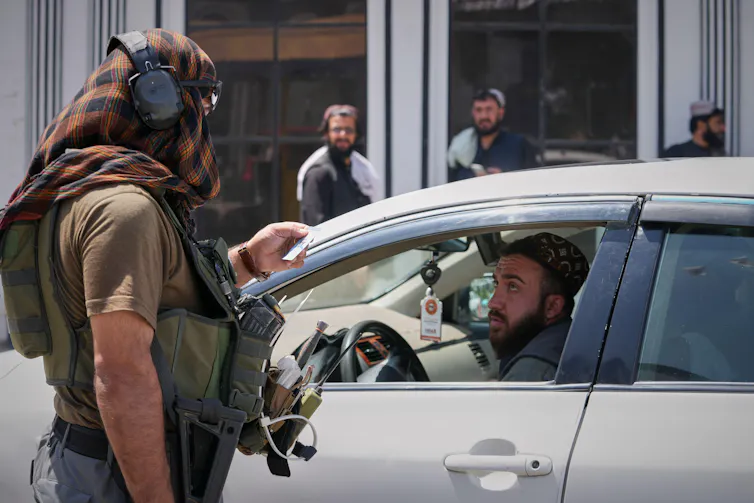
Independent reports have also documented systematic persecution of former government officials, despite the regime’s granting of a general amnesty.
Meanwhile, recent border clashes between the IE and neighbouring Pakistan belie the IE’s claim of having restored total security. The IE is accused by Pakistan of hosting members of the Pakistani extremist group Tehrek-I Taliban (TTP) that has increased its attacks in Pakistan in recent years.
Pakistani attacks on targets in Afghanistan, including aerial bombardments, have led to many casualties. A Pakistani attack on what it said was “military and terrorist infrastructure”, but what was actually a rehab centre in Kabul, killed 269 people.
In a sign that Iran might also be growing impatient with the IE, the Islamic Republic invited opposition figure, Ahmad Massoud, leader of the National Resistance Front of Afghanistan (NRF), to attend the funeral of Iran’s former supreme leader Ali Khamenei, who was killed in a US-Israeli bombardment on February 28.
While the NRF operates primarily as a small-scale armed opposition, Massoud remains a prominent political figure for some key Afghan constituencies. By hosting Massoud alongside an official Taliban delegation, Iran reiterated regional preferences for a negotiated political settlement involving a cross-section of Afghan interests rather than recognising the Taliban’s territorial dominance as a full and consolidated peace.
The relative security in today’s Afghanistan is due to the main perpetrator, the Taliban, ceasing its violence after gaining political power – hardly a notable success.
Coercive order
The regime’s officials have also highlighted achievements in other areas, such as revenue collection. Recent reporting by the World Bank shows a 6% year-on-year increase in revenue collection in 2026. However, the level of domestic revenues in Afghanistan remains generally low.
And even if it were possible to cast revenue collection in a positive light, the regime’s fiscal policy remains opaque because it does not report how it allocates the revenues it collects. Merely collecting money from ordinary people under coercion does not constitute proper governance.
Afghanistan’s people continue to rely on foreign aid to receive basic public services such as healthcare. Drastic reductions in assistance pose a serious challenge to efforts to address the intensifying humanitarian disaster affecting ordinary Afghans under the IE’s rule.
The stability of Afghanistan’s currency, the Afghani, has also been hailed by the regime as a success story. It was feared that the Afghani’s exchange rate would undergo sharp devaluation due to exposure to domestic and external shocks after the collapse of the former republic and the freezing of Afghanistan’s reserves. But this didn’t happen. Much of the currency’s stability can be attributed to the continued inflow of billions in aid, which has been instrumental in supporting the Afghani’s exchange rate.
Dependence on foreign aid has been the single most important economic story in Afghanistan over the past five years.
The Taliban’s record should therefore neither be dismissed nor accepted at face value. Its achievements show that it has become remarkably capable of imposing coercive order. Five years on, the harder question is what kind of order it has created, who gets to participate in it, and what Afghanistan is being asked to sacrifice to sustain it.