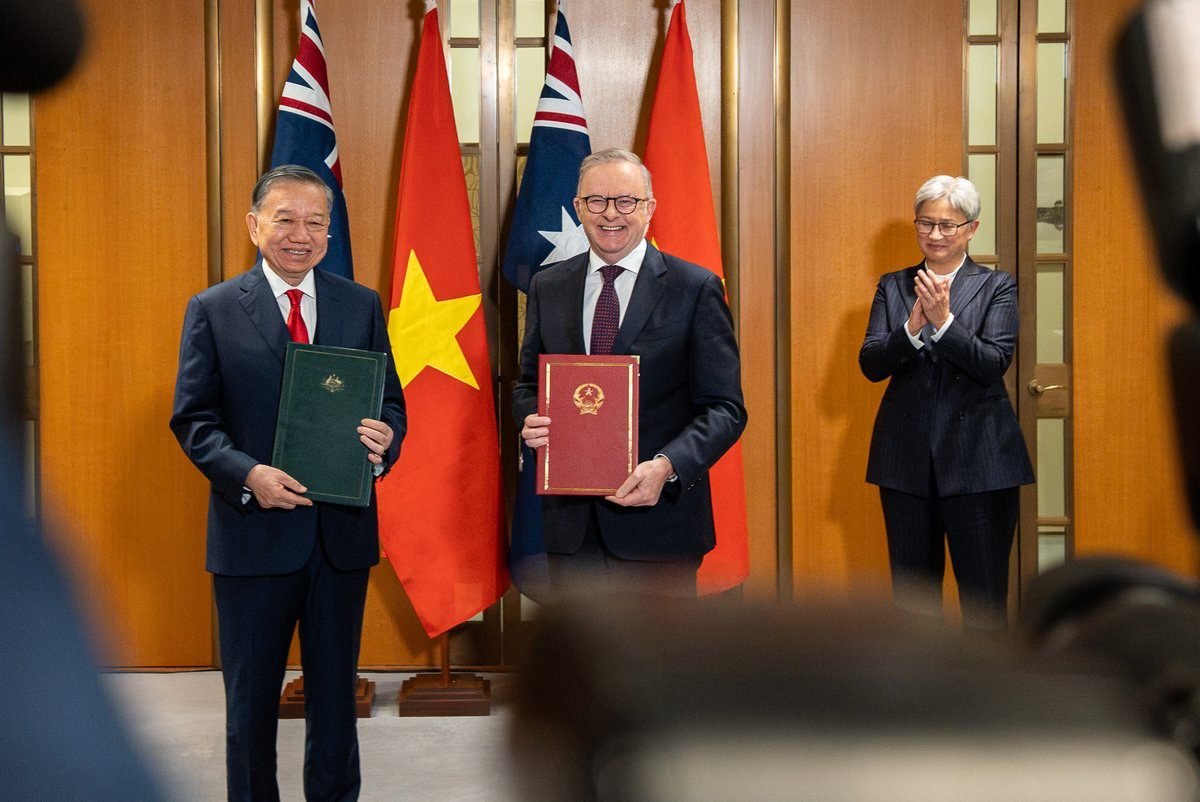

To Lam’s visit to Canberra on August 11 was the first state visit to Australia by a Vietnamese head of state since the 1975 reunification and the first meeting between the two leaders. Since taking the presidency in April, To Lam has visited China, India, Sri Lanka, Thailand, Singapore and the Philippines, and the Australia trip precedes a stop in New Zealand to meet Christopher Luxon.
Australia and Vietnam elevated relations to a comprehensive strategic partnership in March 2024, Hanoi’s highest partnership tier. The CSP designation was once reserved for a handful of major powers, but they have expanded rapidly the last few years. Both governments have spent two years building institutional mechanisms on top of the framework, including an inaugural trade ministers’ dialogue and ministerial security dialogue in 2024, and the announcement of a new energy and minerals ministerial-level dialogue. The joint statement issued on 11 August, read against the 2024 elevation statement, reflects steady, incremental progress on commitments already made.
The 2024 statement’s headline commitments are being delivered. The ministerial security dialogue was inaugurated in 2024. The peacekeeping partnership agreement was signed in July 2025. A defense cooperation plan for 2025–2027 is in place. The ministerial energy and minerals dialogue, committed in 2024 and still not convened as of the August 2025 foreign ministers’ meeting, was finally held alongside this visit. These are concrete follow-throughs, and they distinguish the CSP from partnerships where elevation produces communiques but little institutional change.
Defence cooperation has continued to build incrementally on that base. An updated Joint Vision Statement on Further Defense Cooperation was signed. Vietnam’s participation in Exercise Kakadu for a second consecutive cycle, in 2024 and 2026, and its observation of Exercise Talisman Sabre in 2025 extend a pattern of gradually expanding operational engagement. A maritime law enforcement agreement and a cooperation and mutual assistance agreement are in negotiation. These are meaningful for a country whose defense policy rules out military alliances.
On economics, the visit produced no new quantified commitment. The only significant figure in the statement is Export Finance Australia’s A$1.3 billion in finance to support infrastructure development and exports to Vietnam since 2017, a cumulative reporting figure rather than new money. Vietnam is a key focus of Australia’s blended finance portfolio, receiving A$83 million, over a third of Australia’s total financing.
The Aus4Skills program was extended for nine years to 2035. An amended investment registration certificate was issued for RMIT University’s Hanoi campus. These commitments share a common feature: all are publicly financed or government-facilitated. No private sector investment target was set, nor was any bilateral trade target agreed.
A new element is the Joint Statement on Economic Resilience Cooperation, which frames supply chain resilience across critical minerals, semiconductors, clean energy, grid infrastructure and agricultural essentials. Whether economic resilience cooperation acquires operational substance or remains a framing document will depend on whether specific projects follow. Currently, Australian figures put two-way trade in goods and services at A$30.0 billion in 2025, while the total stock of two-way investment sat at A$2.0 billion.
Several structural factors constrain investment beyond the partnership’s political settings. Vietnam caps aggregate foreign ownership in commercial banks at 30 per cent of charter capital. Foreign individuals and organizations do not hold land use rights under Vietnamese law, and are limited to leasing arrangements capped at 50 years under the 2024 Land Law. On the Australian side, institutional investors have limited exposure to frontier markets such as Vietnam. These are not problems a joint statement can solve, but they explain why the CSP’s economic section remains dominated by public finance rather than private capital.
On technology, the TechConnect forum launched in Sydney on 10 August and a Joint Statement on Science, Technology and Innovation Connectivity was signed, alongside a health cooperation MOU. Vietnam has pursued parallel technology cooperation with Japan, South Korea and Singapore in recent months, including joint semiconductor research projects with Japan and semiconductor and data center agreements with South Korea. What Australia can offer centers on research training, critical minerals supply chains and governance frameworks rather than in commercial technology.
The relationship carries significant people-to-people depth. Australia is home to around 350,000 people of Vietnamese heritage, and Vietnam is Australia’s fourth-largest international student market, with approximately 35,000 students currently enrolled and over 160,000 alumni. Vietnam’s Deputy Minister of Foreign Affairs Nguyen Manh Cuong’s briefing described this people-to-people dimension as social capital that cannot be created overnight by any agreement.
Yet, while both governments treat the diaspora as a bilateral asset, the community is not monolithic. A substantial portion is descended from refugees who arrived after 1975, and organized Vietnamese-Australian groups have routinely protested visits by Vietnamese leaders to Canberra, reflecting a historical distrust of the Communist Party leadership that annual Black April commemorations and the continued use of the heritage flag keep visible.
While the older generations are aging and the newer ones are less engaged with the political legacy, the absence of a substantive gesture from the party-state toward the community’s historical grievances has made reconciliation and efforts to tap into the diaspora’s full potential considerably more difficult.
The overall trajectory of bilateral relations is consistent. The CSP’s 2024 commitments have been acted on, which is itself a credible outcome. The new instruments agreed during this visit are largely continuations of existing programs, frameworks not yet operational, or reporting of cumulative public expenditure. The relationship continues to deepen where governments act directly, through defense exercises, public finance and publicly funded capability programs. It remains thin where progress depends on private actors whom neither government controls, and where political will to shift existing settings has not been forthcoming.