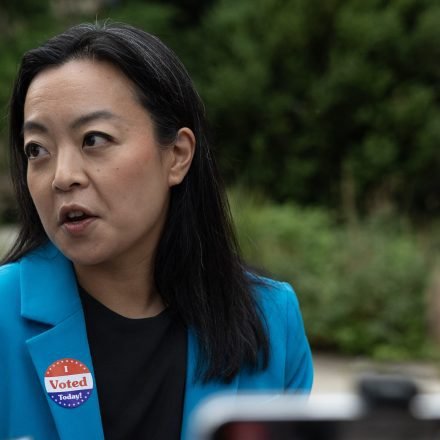
The stunning momentum of the insurgent left hit a roadblock this week when democratic socialist Francesca Hong narrowly lost her primary race for Wisconsin governor to Milwaukee County Executive David Crowley, a moderate who garnered significant support from establishment Democrats.
“The collective power of that Democratic establishment in a state, where there is a Democratic governor and there is a real Democratic Party establishment machine, all of that power was required to eke out a 0.4 percent victory in the party’s own primary against a previously unknown candidate running as a Democratic socialist,” The Lever’s David Sirota tells The Intercept Briefing.
This week on the podcast, host Jessica Washington speaks with Sirota, founder and editor-in-chief of The Lever, about the primaries and how the left is building power within the Democratic Party.
There were bright spots for progressives on Tuesday night. In Minnesota, progressive Lt. Gov. Peggy Flanagan defeated AIPAC-backed Rep. Angie Craig, D-Minn., in the Senate primary race. Craig had previously voted for the Laken Riley Act, which requires the federal government to detain people for certain crimes, including shoplifting and burglary. Flanagan, by contrast, told supporters on election night: “We need to rip ICE apart and stop them from terrorizing our communities.”
“What you’re seeing now is, and I don’t want to call it a Democratic Tea Party, but it is certainly organizing and pressuring to take back power in an adversarial way from a set of forces to the left of the Democratic establishment,” says Sirota. “That is what’s new, and that is what’s driving the political dynamic now.”
Washington and Sirota also discuss the intensifying democracy crisis unfolding in the United States. According to Sirota, it “stands on two pillars: concentrated executive power and the supremacy of money.”
Sirota explores this theme and more, in the new season of his show, Master Plan: The Kingmakers. The podcast is all about how a once-fringe legal theory moved into the mainstream and transformed the power of the American presidency.
For more, listen to the full conversation of The Intercept Briefing on Apple Podcasts, Spotify, YouTube, or wherever you listen.
Transcript
Jessica Washington: Welcome to The Intercept Briefing, I’m Jessica Washington, politics reporter at The Intercept.
On Tuesday night, democratic socialist Francesca Hong narrowly lost her primary race for Wisconsin Governor to Milwaukee County Executive David Crowley.
Hong lost by less than a percentage point. But her defeat was a blow to the anti-data center movement, which she had championed throughout her campaign, even as her detractors tried to make the race about her opinions on Thanksgiving and other major holidays.
But the night was not a total loss for progressives. In Minnesota, Lt. Governor Peggy Flanagan defeated AIPAC-backed Congresswoman Angie Craig for Senate.
Peggy Flanagan: And now let’s talk about Donald Trump’s out of control ICE force [crowd boos]. We need to rip ICE apart and stop them from terrorizing our communities.
JW: Last year, Craig voted in favor of the Laken Riley Act, which requires the federal government to detain people for a host of crimes, including nonviolent ones like shoplifting, and it allows states to sue over immigration enforcement, giving power to state attorneys general to shape immigration enforcement policy regardless of which party holds the White House. That vote appears to have cost her in a state that largely rose up in defiance of the Trump administration’s brutal immigration crackdown, after federal immigration agents shot and killed two U.S. citizens.
For more of our reporting on the primaries and the anti-data center movement, visit TheIntercept.com.
This week on The Intercept Briefing, I speak to David Sirota, founder and editor-in-chief of The Lever, about the primaries and how the left is building power within the Democratic Party.
David also talks about the parallels between how the left and the right have consolidated power, and we get into the second season of his amazing series Master Plan, resuming this week.
This new season is called The Kingmakers and is all about how a once-fringe legal theory moved into the mainstream and transformed the power of the American presidency.
It traces the people and institutions behind that campaign — from Richard Nixon’s downfall and Dick Cheney’s post-9/11 power grab to pivotal Supreme Court decisions and Project 2025.
David, welcome back to The Intercept Briefing.
David Sirota: Thank you. Thanks for having me.
JW: So Tuesday night, Francesca Hong narrowly lost her primary race for Wisconsin governor to the more moderate candidate, David Crowley. But it wasn’t a total loss for the left. In Minnesota, Lieutenant Governor Peggy Flanagan defeated AIPAC-backed Angie Craig. Hong’s race was plagued by, honestly, the dumbest issues, like whether she supports Thanksgiving or how she views her “proximity to whiteness.”
David, what did you make of Tuesday night’s results? Does this, as The New York Times called it, show the “limits of the left,” or is something else at play here?
DS: I think this is a good test of the power dynamic in American politics right now, specifically inside the Democratic Party. I’m going to state a few empirical facts about what happened. People can use these facts to try to confirm their priors. But here are the facts that we know. Fact one is that the entire establishment of the Democratic Party came together towards the end of this race, really consolidated to try to shut down Francesca Hong’s campaign and defeat her.
“All of the power of the old Democratic machine was required to eke out the narrowest of victories against the longest of long-shot candidates.”
The collective power of that Democratic establishment in a state, where there is a Democratic governor and there is a real Democratic Party establishment machine, all of that power was required to eke out a 0.4 percent victory in the party’s own primary against a previously unknown candidate running as a Democratic socialist who was wildly under-resourced, did not air any television advertisements through her own campaign. So the point being that all of the power of the old Democratic machine was required to eke out the narrowest of victories against the longest of long-shot candidates.
A candidate who, by the way, had been effectively abandoned by other national left-of-center icons and politicians, democratic socialists. Bernie Sanders did not endorse Francesca Hong. AOC did not endorse Francesca Hong. The candidates who have been winning as democratic socialists did not come to Wisconsin to campaign with Francesca Hong. We can discuss why that is and the mistakes or stumbles that Hong made as a candidate. But the point is that the machine with all of the power and advantages it had against a candidate with no advantages at all, that ran to say the least, an imperfect campaign, still needed all of its power to barely win a race in Wisconsin.
So to me, what that says is that the Democratic establishment that has gotten very used to being able to easily control primary outcomes is now having to marshal all of its collective power and have everything break right for it in order to eke out these primary wins. That, I think, is a fundamental difference of the political topography of the Democratic Party.
JW: I’m thinking about the fact that we didn’t see Bernie Sanders supporting her. Obviously, AOC had come out and said that it was because she wanted to focus on Congress. So we can have that conversation.
But we also didn’t see that support for Cori Bush either. And she lost.
Do you think that progressives are making a smart play here by trying to decide who’s more electable in a general election? Or, is that just more of the same silly stuff we’ve seen from the Democratic Party in terms of electability and making those decisions before voters do?
DS: Yeah, I’ve said this before and I’ll say it again. My take on so-called electability is that nobody really knows who is electable or not electable. I’m old enough to remember when the same media machine and Democratic Party apparatus insisted with certainty that Barack Obama could never possibly win a general election. I remember when that same machine laughed at the idea that Donald Trump could be elected president.
I tend to believe that this whole discussion about electability is silly, but also a Jedi mind trick that the establishment of the Democratic Party uses to try to manipulate voters into not voting for candidates and not seeing elections as forums for voting for good policies.
They’re trying to turn primaries into — and they’ve been successful at it in the past — trying to turn primaries into this idea that, “Don’t vote for the candidate who may be offering you policies that you actually support. Vote for our view of who is actually ‘electable’ in a general election. Forget the fact that we told you that Barack Obama wasn’t electable or Donald Trump wasn’t electable. Forget all that.” So my basic take is that the whole electability discussion is this moving target and a real sort of engine of manipulation.
I think that in every race, candidates are looked at for their viability, for how well they are running, and their basic competence as a candidate. It’s not wrong for folks and political organizations and activists on the left or really any political faction to try to evaluate the competence of candidates that they are going to spend resources on or organize for or endorse. That’s part of the political process in America, and that’s not a perfect process. But sometimes you can make mistakes. That happens all the time.
Did Francesca Hong not get endorsements because she was evaluated to be a less competent candidate? Same thing for Cori Bush. Were those candidates seen as not competent? Competent meaning as candidates, not as people, as candidates running a campaign. Were they seen as not competent versus was Abdul El-Sayed seen as a highly competent candidate?
My guess is that those calculations were at play here. I’ve worked on a lot of campaigns in my life at this point. A candidate’s competency is this intangible that’s really important.
So my guess is though all of those questions were on the table in the way that these decisions were made to endorse certain candidates and not go all in for other candidates.
JW: That makes a lot of sense. We’re also talking about having to run these candidates against the right, against the massive money machine that the right has.
So I want to talk a little bit more about Republicans and their power. Recently on your podcast, Lever Time, you spoke to Reed Galen, co-founder of the anti-Trump political action committee, The Lincoln Project. Galen talked about leaving the Republican Party and his warning that Democrats are making the same mistakes Republicans made, mapping the transition of the GOP to the Tea Party movement takeover.
Can you talk about that conversation and what Galen sees as the kind of dangerous mistakes the Democratic Party is making, and what’s your view?
DS: Yeah, I agree with his story of history, which is that to understand the current Republican Party, you have to really rewind history and look at what created it. You can go all the way back to Barry Goldwater and tell the story from there.
But in modern times, what you can see is that in 2008, Barack Obama won the presidency. A lot of the center-left foment gets driven into the Democratic Party and into Obama as a personality, and a lot of the center-right and hard-right unhappiness with our political system was driven first into the Tea Party, which ultimately became MAGA, which ultimately became the Trump presidency.
The Tea Party was operating outside of the Republican Party, although in conjunction with it, to transform that party. Ultimately, Donald Trump’s presidency, first the MAGA movement and then Trump’s presidency, becomes the culmination of all of that foment outside of the party.
Obviously the party has been transformed. It is a much different party than it was even 10, 15 years ago. I think a similar dynamic is happening right now vis-a-vis the Democratic Party and the American left. Obviously on totally different issues. They don’t share ideologies, they don’t share policy agendas.
But politically speaking, just the raw politics of it, I think this is delayed, I think it’s been belated. Whereas in 2008, there was a moment in the middle of the financial crisis where center-left discontent could have been channeled into something like a center-left Tea Party. I reported on this for a long time.
There was Occupy Wall Street and the like. But certainly it wasn’t as big a movement as the Tea Party on the right because a lot of that energy was, again, channeled into Obama and the Obama presidency. We’re now here 18 years later, many of the grievances of that moment back in 2008 in the middle of the financial crisis, really the supercharging of oligarchy, they’re still here.
But the difference is here — in the here and now — if you look at polls of people on the left, center-left, before in 2008 they were fairly confident in Democratic leaders to channel their grievances. Today, they have lost faith in the Democratic leadership. They are angry at the Democratic Party for what they perceive to be capitulations and unnecessary compromises with corporate power and with Trump and MAGA.
“What you’re seeing now is … certainly organizing and pressuring to take back power in an adversarial way from a set of forces to the left of the Democratic establishment.”
What you’re seeing now is, and I don’t want to call it a Democratic Tea Party, but it is certainly organizing and pressuring to take back power in an adversarial way from a set of forces to the left of the Democratic establishment. That is something I think we have not really experienced in our lifetimes. That is what’s new, and that is what’s driving the political dynamic now.
Whether it’s in any of these races happening across the country or in Congress itself, which I expect the next session of Congress, if Democrats take it back, to be a lot of push and pull inside the Democratic caucus, which of course will overlay the 2028 presidential campaign.
I very much expect candidates in the Democratic primary to be competing for that positioning. You might want to call it the Bernie Sanders lane, but it’s really the lane to say, “I am the outsider that is going to take back the White House for a particular faction,” or representing a particular faction of the Democratic Party. A faction that is most certainly not the corporate old-school establishment that has been running the party into the ground for the last 30 years.
I see the whole push and pull right now as something very healthy. I don’t think it is healthy for democracy, for an establishment of one of the major parties in this country to have clung onto power for so long, offering so little change through so many electoral defeats and through the rise of Donald Trump and authoritarianism.
For that establishment to still be able to hold on to power without much change at all really is the democracy crisis in practice. So the effort to change that party through democratic means, is entirely long overdue, is entirely necessary. People listening to this may agree or disagree with specific different parts of the policy platform being pushed by those outside the establishment, but the process itself is the democracy working.
“The democracy crisis is a set of elite power brokers being able to cling on to a political party’s power regardless of what is happening in the world and in a way that sells out voters.”
A lot of liberals think about the democracy crisis. The democracy crisis is a set of elite power brokers being able to cling on to a political party’s power regardless of what is happening in the world and in a way that sells out voters. That’s what’s been going on in the Democratic Party for a long time, and the effort to significantly change it and revitalize the party through democratic means is a healthy expression of democracy.
[Break]
JW: We have multiple crises of democracy happening. We obviously have Trump, but we also have the establishment [Democrats] and the fact that they’ve allowed Republicans to gain control of the government from the House to the Senate to presidency, and I would argue, also the Supreme Court.
Last week, the president’s personal attorney, Todd Blanche, was confirmed as attorney general with, to me, what seems like a clear mandate to target the president’s enemies. Then on Tuesday, it was reported that the DOJ issued a sweeping memo giving broad authority to the president to conceal his communications with so-called private advisers in what seems like just a clear effort to undercut Democrats’ ability to investigate the president if they retake Congress. That doesn’t even touch on the fact that we’re over 100 days into war with Iran without congressional approval.
I want to talk about how we got here, and you explore that in the new season of your show, Master Plan: Kingmakers, which is out this week, by the way. It tracks how a once fringe legal theory has transformed the American presidency into a pseudo-monarchy with term limits.
I listened to the first episode and loved it, by the way. It also feels incredibly relevant right now. David, how did we get here?
“We’ve turned elections into auctions. We’ve equated money with free speech, we’ve equated corporations with people, giving them human rights.”
DS: To my mind, it is the second part of a two-part story to understand the real democracy crisis. The democracy crisis I think, stands on two pillars: concentrated executive power and the supremacy of money.
They’re obviously interrelated. Season one of Master Plan traces the secret 50-year plot to effectively legalize corruption, deregulate the campaign finance system and make bribery essentially a permissible act in the United States. We all understand, implicitly, that we’re now living in that reality when we’ve turned elections into auctions. We’ve equated money with free speech, we’ve equated corporations with people, giving them human rights.
So we are living through that project of the American right to effectively legalize corruption, to turn the democracy from a “one person, one vote” democracy into a “one dollar, one vote” oligarchy. I think we all see the evidence of that. That came about through, among other things, the infamous Powell Memo.
That’s the sort of origin story where a lot of it started, which was a call to arms for corporations in the early 1970s when corporations and oligarchs felt under attack from the New Deal policies of the mid-20th century. The Powell Memo was a call to essentially make monetary investments in buying democracy.
The democracy was functioning too well. It was becoming too responsive to what people actually wanted, and the idea was we have to legalize corruption to be able to rig the system so that we can buy outcomes, we the oligarchy. So that was season one of Master Plan.
The other pillar of the democracy crisis is then to concentrate as much power in the executive branch in the hands of really one person so that the small-D democratic institutions of government have much less power, so that power is less diffuse. It’s all in the hands of one person, because if that’s your guy — you the oligarchy — then you’ve essentially ended democracy. This story starts in Watergate. Watergate was the moment that was seen as a so-called imperial presidency, a presidency that had gotten out of control and stepped over the boundaries and thresholds that had been established for the executive branch.
Congress passes a series of laws that are designed to take power away from the executive branch. So the story really starts there at a kind of small-D democratic moment of triumph, but it also hatches a backlash, and that’s what the new season of Master Plan is about, The Kingmakers.
It hatches a backlash among conservatives starting in the Ford administration with Dick Cheney, who was chief of staff to make legal arguments and start creating legal doctrines that are designed to grab back the power that was taken in the post-Watergate era, put it back in the White House, and then significantly expand it.
“The original Project 2025 was The Heritage Foundation’s Mandate for Leadership, a policy bible whose through line was how to use executive authority.”
That’s what happens soon after Ronald Reagan gets elected president. We all have heard of Project 2025. Back in the late 1970s into 1980, the original Project 2025 was The Heritage Foundation’s Mandate for Leadership, a policy bible whose through line was how to use executive authority to do what the conservative movement wanted regardless of what Congress or any other institution wanted, and how to grab as much of that power as possible under a new legal rubric called the unitary executive theory.
I’m guessing some people have heard that. This is cooked up inside of the Reagan Justice Department in its battles with a Democratic Congress. A legal doctrine that is then tested in the courts in strategic ways to try to get it enshrined into the law.
From the Reagan era into obviously the Bush era, the Bush’s war on terror, Dick Cheney, the guy who had been spearheading parts of this when he was in the Ford administration and when he was in Congress, the Bush administration sees a huge consolidation of power under the veneer of the so-called war on terror.
“All of these powers, from the unitary executive theories that were forged in the Reagan administration to the drone war national security powers that were fortified by Obama after the Bush era, all of this is now resting in the Trump White House.”
Then in probably our most controversial episode of this season, we go into how the Obama administration ended up consolidating power in truly unprecedented ways. The Obama administration didn’t champion the unitary executive theory, but it did make a set of precedential legal arguments about the executive branch’s alleged power to execute and target for assassination American citizens without charging them even with a crime.
I’m talking about the drone war here. Some may say that the drone war was necessary, others may say it wasn’t, but the legal architecture and the outlining of the powers asserted by the executive branch were unprecedented and were effectively validated during the Obama presidency. Powers that are now, fast-forward to today, all of these powers, from the unitary executive theories that were forged in the Reagan administration to the drone war national security powers that were fortified by Obama after the Bush era, all of this is now resting in the Trump White House.
So the point of this is that what we’re living through today didn’t just happen because Donald Trump showed up to the White House. Donald Trump, when he got to the White House, had a series of levers, if you will, an entire control panel of executive powers, unprecedented executive powers, that were created for him.
So when we see him use those powers, it’s not to say we shouldn’t be terrified by it or outraged by it, but it is to say, let’s understand where those powers came from, because they didn’t just happen. They weren’t just seized randomly, and they weren’t just created by Donald Trump himself.
JW: As you just mentioned, efforts to bring the unitary executive theory to reality have been decades in the making. We saw President George W. Bush’s administration push in that direction, and now it’s reached just a whole other level under Trump. First, just to make it clear, can you briefly explain just how powerful is the American presidency under Trump, and what is the unitary executive theory?
DS: The unitary executive theory is this idea that the president singularly is the controller, the master, the decider of every single thing that the executive branch does. The executive branch, that’s one term for it. Another term for the executive branch is the federal government, right?
At one level they are one and the same, but I bring that up so that people can understand how radical the unitary executive theory actually is. When I use the federal government, maybe you’re thinking of the military. Maybe you’re thinking of the Agriculture Department, the scientists working on food safety in the Agriculture Department.
We’re talking about everything, the sort of basic functions, the on-the-ground functions of the government. Technically all of those agencies are operating in what we understand in terms of separation of powers. We understand them to be the executive branch. There’s Congress that makes the laws. There’s the president that executes the laws. There’s the courts that adjudicate battles between Congress and the president, adjudicate what the law is actually saying, et cetera, et cetera.
The unitary executive theory is saying that the president as the head of the executive branch has complete and total power to effectively do whatever the president wants inside of the executive branch.
So the unitary executive theory undergirds something like DOGE, the rampage that we all experienced right when Donald Trump came into his second term. He said, for instance, I’m shutting off all previously approved congressional grants across the entire United States. I’m asserting my executive authority to do that.
Now, Congress had passed laws saying that the money must be spent, but Trump and his administration were essentially arguing the president makes the decision on whether to execute those laws. So I give that example as a way for people to understand how radical an idea this is.
By the way, this came up recently with independent federal agencies. There are a set of agencies that Congress had set up and that presidents had signed laws, signed them into law in the past, saying that, the FTC or the Securities and Exchange Commission that these agencies are quasi-independent because the commissioners have set terms.
It’s much harder to fire them. Donald Trump went into court saying, I’m the unitary executive. These independent agencies structurally are unconstitutional. I should be allowed to hire and fire whoever I want at any time for any reason. And the Supreme Court largely agreed with him.
So this is about an unprecedented consolidation of power in the hands of one person to say that at any level of the federal government, any granular level, there’s some EPA scientist who is issuing a report about climate change that the president doesn’t like, the theory would hold that the president has a right, regardless of what Congress has passed, regardless of what the courts have adjudicated, the president has the right to reach into the EPA, target that one person, and fire them himself.
So you can see the dangers of this, because here’s the thing: Part of the way modern civilization has modernized from the old era of medieval royal courts, is that we have professionalized a lot of the functions of government. Like line scientists doing food safety reviews or environmental reviews or making all sorts of technical technical determinations, et cetera, et cetera. We had previously said this is going to be insulated at some level from the political whims of just one all-powerful king, whichever party it is. There’s a civil service, there’s a sort of a professionalized bureaucracy, if you will, and the unitary executive theory is trying to dismantle all of that.
Now, I want to add one thing very quickly here. I do think there’s an argument that, when a bureaucracy, a professionalized government bureaucracy, is so insulated from what voters are voting for, there can be an undemocratic disconnect there. If voters are voting for certain kinds of change and a kind of permanent bureaucratic government, because of job protections and the like over many years, is not responding to what people want, I do think there is a nugget of an argument there that there has to be ways that elections happen and policy changes then flow from those election changes.
But I think the unitary executive theory is a radical overcorrection for that kind of alleged problem. The solution to that theoretical problem is not to turn the president into an all-powerful king who can wake up at any day or any moment, ignore all of the laws on the books, and do whatever he wants.
JW: It sounds like there’s a lot that’s going to be happening in your podcast, and I’m, for one, really looking forward to listening to the rest of the new season of Master Plan: The Kingmakers. David, where can people listen to it?
DS: They can find it on our website at levernews.com. You can also go on your podcast app and just type in Master Plan. And you can go to our YouTube page. We have video versions of the episodes. That’s youtube.com/@levernews. The URL, the easiest way to find it, masterplanpodcast.com.
JW: David, thank you so much for joining us on The Intercept Briefing.
DS: Thank you. Thanks so much for having me.
JW: We want to hear from you. Tell us what you’re following or want to see more coverage of. Email us at podcasts@theintercept.com or leave us a voicemail at 530-POD-CAST, that’s 530-763-2278
That does it for this episode.
This episode was produced by Laura Flynn. Ben Muessig is our editor-in-chief. Maia Hibbett is our Managing Editor.
Fei Liu is our product and design manager. Nara Shin is our copy editor. William Stanton mixed our show. Legal review by David Bralow.
Slip Stream provided our theme music.
This show and our reporting at The Intercept do not exist without you. Your donation, no matter the amount, makes a real difference. Keep our investigations free and fearless at theintercept.com/join.
And if you haven’t already, please subscribe to The Intercept Briefing wherever you listen to podcasts. Do leave us a rating or a review, it helps other listeners to find us.
Until next time, I’m Jessica Washington.