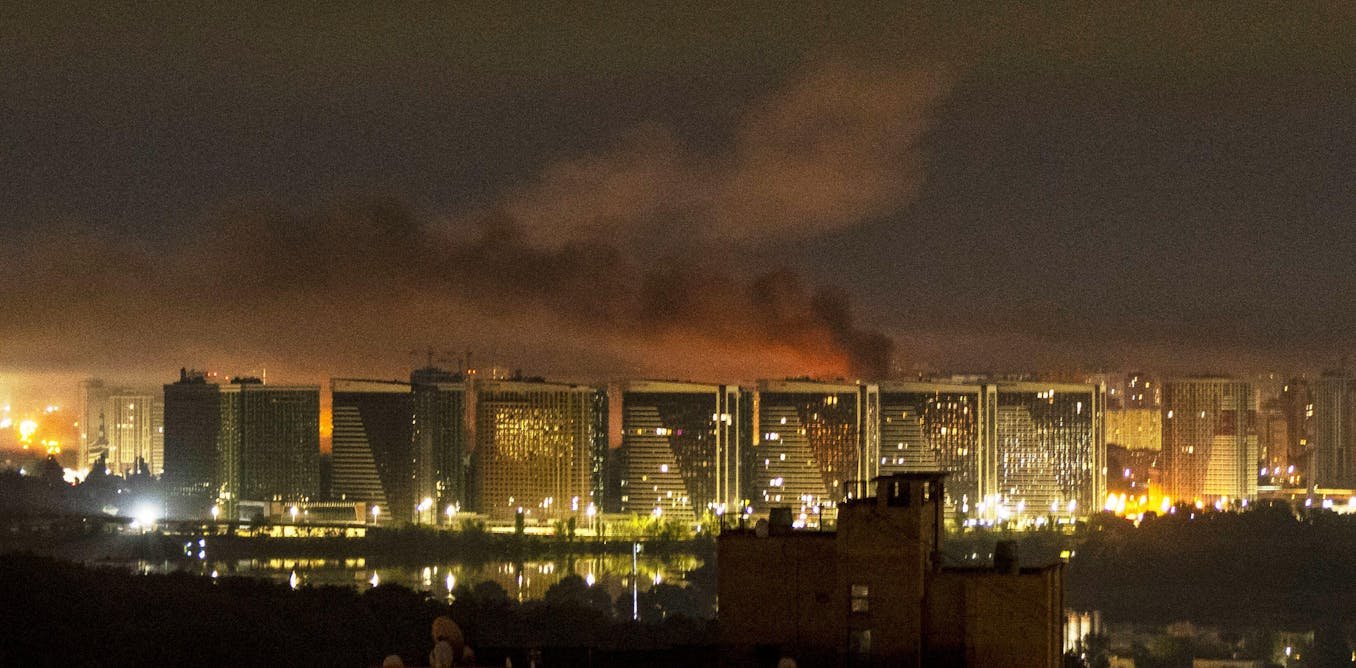
Some ominous news out of Ukraine this week in the form of an air defence assessment from Ukrainian intelligence official, Major-General Vadym Skibitsky. Skibitsky reported that Russia is rejigging its defence industry to prioritise the production of ballistic missiles. This, he said, would mean a concerted campaign of strikes against Ukrainian energy infrastructure ahead of the coming winter.
Ukraine has already depleted its stocks of air defence systems. It was getting most of these systems from the US, initially directly in the form of military aid and more recently via its other allies which have been buying them from the US to supply Ukraine. But all reports indicate that the six-month US air campaign in Iran has left the US very short of Patriot and Thaad interceptors, which are most effective against Russia’s ballistic missiles.
Matthew Powell, who researches air power at the University of Portsmouth, writes that Ukraine is already struggling to protect its cities against Russia’s missiles. Now, he believes that with Kyiv’s European allies also labouring to source enough air defence systems for their own security, Ukraine is bracing for what national security experts fear could be the harshest winter of the war so far.
Read more: Russia bets on ballistic missiles to combat the success of Ukraine’s drone warfare
That’s not to say that Ukraine’s success with its strategic use of drones has been anything less than remarkable. Kyiv has of late been targeting Russia’s energy infrastructure including oil refineries and oil storage depots. And in recent weeks it claims to have struck 218 Russian shadow fleet vessels, including 134 in the Sea of Azov and 84 in the Black Sea.
Now Ukraine’s campaign of drone strikes targeting warehouses run by e-commerce giant Wildberries, Russia’s version of Amazon is bringing the war home to consumers, writes economist Yerzhan Tokbolat, of Queens University Belfast. And not just consumers – as Tokbolat notes, Wildberries also allows small businesses to use its online marketplaces to sell their products. So the loss of their inventory, with little or no compensation, is hitting them hard too.
Read more: Ukraine assault on Russian retail giant Wildberries brings war home to consumers and retailers
Ukraine’s nimble and innovative use of drones has been a feature of its stubborn defence against the Russian onslaught. More recently, the development of more powerful unmanned aerial vehicles with much longer ranges has enabled it to strike at targets deep inside Russia.
Ukrainian military drones use modified Xbox controllers and “play” for a system of bonuses where operators can score points for hitting a range of targets. Under the Army of Drones Bonus (ADB) programme, a Russian (or quite often a foreign fighter recruited by the Russians) is worth 12 points, while you get 20 for damaging a tank and up to 50 for destroying a mobile rocket system.
Points can be exchanged for money and so far, military equipment worth over US$5 million (£3.7 million) has been “won” for the war effort. It’s part of the “gamification” of war, write Azmeary Ferdoush and Sarah Mills, of Loughborough University.
It’s tempting, in light of the misery imposed on the people of Ukraine by Russia’s four-and-a-half year war of aggression, to applaud the lateral thinking behind programmes like this. But, our the authors remind us, “whether gamified or not, the lives that are lost are very much real”.
Read more: How warfare has been ‘gamified’ in Ukraine
Meanwhile, if you want do something personally to support Ukraine, you should try buying its books, writes Lauren Warner-Treloar of Kingston University. Ukrainian writers are helping to keep their country’s distinct cultural identity alive against Putin’s insistence that Ukrainians are really the same as Russians.
Read more: Want to support Ukraine? Read its books
An ‘Islamic Nato’?
To Riyadh, where a recent defence and security pact concluded without huge fanfare – in the west at least – was signed between Saudi Arabia, Turkey and Pakistan. Not unexpectedly, it was greeted – particularly by Israel’s media – as an “Islamic Nato”, which would be likely to pose a threat to their country’s security.
Waqas Haider, however, believes that designation misses the mark. Haider, a doctoral researcher in international relations at Lancaster University, thinks this agreement is far more likely to reflect their growing concerns over Washington’s reliability when it comes to their security.
One thing the Iran war has shown up has been that, despite all the US bases throughout the Gulf, the American security umbrella hasn’t protected Gulf states from Iranian missile attacks. But it’s not so much of a divorce as a diversification, writes Haider. The pact will not supplant the need for US security in the Gulf. What it does mean is that normalisation of relations between Israel and Saudi Arabia is unlikely any time soon, given the antipathy towards Israel in Ankara and Islamabad.
Gaza: why history give little cause for optimism
Rather predictably, Benjamin Netanyahu rejected the Board of Peace roadmap for Gaza sponsored by the US president, Donald Trump. As always seemed likely, the Israeli prime minister is refusing to pull his troops out of the Palestinian enclave before Hamas completely disarms. And while Hamas has agreed on a staged decommissioning process, it stipulates as a condition that Israel withdraws.

So the long-suffering people of Gaza remain trapped in a deadly Catch-22 situation.
The word “long-suffering” is used advisedly here. As Anne Irfan writes, Israel has had designs on Gaza for pretty much its entire existence. Founding prime minister, David Ben-Gurion proposed annexing the Strip as long ago as 1949 at a conference in Lausanne to discuss the Palestine question.
Irfan, a historian of the modern Middle East at University College London, has recently published a book: A Short History of the Gaza Strip. She walks us through repeated Israeli occupations of Gaza, beginning in 1956 and continuing through decades of settlement until then prime minister Ariel Sharon pulled Israel out in 2005.
Now Israel’s electorate has moved much farther to the right on Palestinian issues. And, with defence minister Israel Katz planning to build three military outposts in the 65% of Gaza occupied by Israeli troops – of the sort that often precede the building of settlements – you could be forgiven for thinking that Israel may be planning to stay for the long haul.
Read more: Netanyahu rejects Trump’s Gaza roadmap – history tells us Israel may be planning to stay