
The recent decision by Benjamin Netanyahu to reject the Board of Peace plan for Gaza sponsored by the US president Donald Trump is concerning – but is hardly surprising.
The 15-point roadmap, published by Trump’s Board of Peace, envisages Hamas’ disarmament and Israel’s phased withdrawal from the Gaza Strip.
The Palestinian territory would then be run by the US-backed National Committee for the Administration of Gaza – a transitional body consisting of Palestinian technocrats. The plan was endorsed in November 2025 by UN security council resolution 2803.
At the end of July, Hamas said it had accepted the deal and would begin a staged disarmament process – provided Israel carried out its own obligations under the deal, to end “all forms of aggression” and withdraw its forces from Gaza.
Hamas’s disarmament had been a major sticking point in talks, and its acceptance of the plan was touted as a breakthrough. But Netanyahu has now put it in doubt, stating that Israel “will not carry out any withdrawal until Hamas is genuinely disarmed”.
Israel’s stance will not have improved Netanyahu’s often fractious relationship with Trump. Despite boasting about their closeness, Netanyahu has repeatedly drawn Trump’s ire both publicly and privately for his refusal to acquiesce to US demands.
In June, the US president shouted and swore at the Israeli prime minister in an angry phone call over Israel continuing its aggression in Lebanon, despite the memorandum of understanding which mandated a ceasefire in both Iran and southern Lebanon. And last summer, he posted a warning online for Israel to cease its bombardment of Iran.
With Israeli elections scheduled for October, and Netanyahu’s domestic approval ratings at 33%, his ability to manage Israel’s relationship with its closest ally – something he has long cited as a strength – is under the spotlight.
But, while Netanyahu faces significant internal opposition, his policies towards the Palestinians in general and Gaza in particular are typically areas of consensus in Israeli politics. If there are differences among mainstream parties, it tends to be over details and tactics, rather than the overall military strategy.
When Netanyahu’s defence minister, Israel Katz, declared that Israel “will never leave all of Gaza”, his statement was not an outlier among the Israeli political establishment.
In fact, Gadi Eisenkot, Netanyahu’s main challenger for the premiership – who served in Netanyahu’s cabinet for the first eight months of the war on Gaza – also opposes the Trump deal and Palestinian sovereignty. He boasted recently: “I have never in all my 66 years said the words ‘Palestinian state’.” Yair Lapid, leader of the centrist Yesh Atid party, has similarly voiced support for Israeli territorial expansionism.

This shared opposition to relinquishing control of Gaza is perhaps unsurprising in view of public opinion. Since October 2023, polls have shown increased Israeli support for annexing and settling Gaza. In one poll taken in June 2025, 82% of Jewish Israelis were found to support the ethnic cleansing of Gaza. Meanwhile, Israeli support for Palestinian statehood is at a historic low.
Israel’s long claim on Gaza
Israeli claims on Gaza long predate the current era. Israel insists its current occupation of Gaza is in response to Hamas’s aggression, most notably its brutal attack of October 7 2023. Yet, as I discuss in my book A Short History of the Gaza Strip, Israel first invaded Gaza in 1956 – more than 30 years before Hamas was created, and 50 years before it came to power in the Palestinian enclave.
Israel’s founding prime minister, David Ben-Gurion – the country’s longest-serving premier before Netanyahu – first proposed annexing Gaza as early as 1949, during talks at the Lausanne Conference on Palestine. His proposal failed – but the idea remained. Six years later, Ben-Gurion – then serving as defence minister – tried to push through a cabinet proposal for Israel to occupy Gaza.
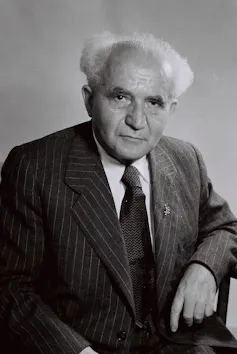
In 1955, foreign minister Golda Meir (who would herself go on to be Israel’s prime minister) declared openly that Gaza was “an integral part of Israel”. These were not just words. A year after Meir’s statement, Israel invaded and occupied Gaza for the first time.
Israel withdrew from Gaza after four months following direct intervention by US president, Dwight D. Eisenhower, but during that time the occupying regime developed plans for building Jewish settlements in Gaza. When it reoccupied the Strip a decade later, it put those plans into action.
Israel has arguably remained the occupying power in Gaza since 1967. Although it removed its settlements and redeployed its military in 2005, it never relinquished control of Gaza’s airspace, water, commercial crossing and entry points, fuel, electricity, or population register.
As a result, many legal experts have argued that Israel continued to occupy Gaza after 2005, despite the evacuation. In 2023, of course, its military re-entered on the ground too.
Israeli plans today
For most of its history, then, Israel has occupied Gaza, a fact that may shed further light on its politicians’ views today. And as in 1956, Israel is now developing plans to maintain its occupation long into the future. Last month, Katz confirmed funding to establish three new military outputs in northern Gaza of the kind that historically preceded civilian settlements.
And while Netanyahu has claimed that Israel will not resettle Gaza, his Likud party recently sponsored a far-right rally calling for exactly that. Members of Netanyahu’s cabinet took part.
In view of all this, it is unsurprising that Netanyahu has rejected a proposal for leaving Gaza. But finding a way forward may need to go much deeper than simply replacing him.
This article features references to books that have been included for editorial reasons, and may contain links to bookshop.org. If you click on one of the links and go on to buy something from bookshop.org The Conversation UK may earn a commission.