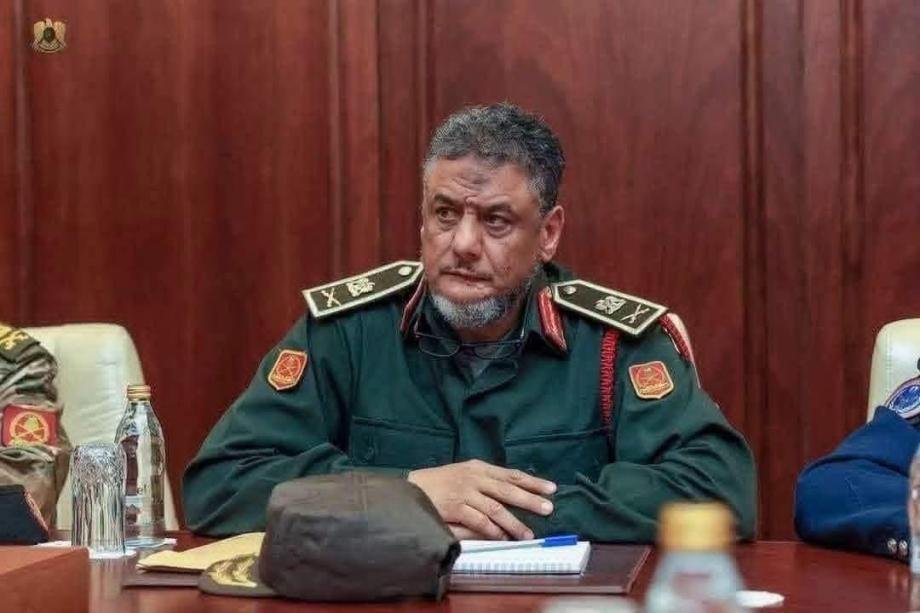
The killing of Libyan journalist and BBC broadcaster Mohamed Mustafa Ramadan outside London’s Central Mosque in 1980, and the recent assassination of Major General Fawzi al‑Mansouri, head of military intelligence in eastern Libya, as he left a mosque in Benghazi, are separated by nearly half a century. Yet the architecture of eliminating opponents has barely changed. The mindset that governs political violence in Libya remains stubbornly intact, as if frozen in time.
Ramadan was a journalist whose voice challenged Muammar Gaddafi’s authoritarianism from London’s airwaves, becoming a familiar presence to Arabic‑speaking audiences. Al‑Mansouri, by contrast, operated within a far more fragmented and combustible landscape: a Libya split between east and west, where rivalry is no longer ideological but existential—rooted in competing claims to resources, legitimacy, and power.
What binds the two murders, despite the gulf in time and context, is a chilling symmetry: both men were killed moments after leaving a house of worship. It is a stark reminder that Libya’s political history has not moved forward. The era of Gaddafi and the era that followed his death are twins in their reliance on elimination as a political tool.
To understand this continuity, one must look at what analysts at Chatham House describe as Libya’s “violent deep state.” The security institutions inherited from Gaddafi were never rebuilt on professional foundations. They remained networks of personal and tribal loyalty, where violence is not an aberration but a structural feature. As one study notes, regimes that rely on informal power networks tend to reproduce violence even after the ruler falls.
Ramadan’s assassination in London and al‑Mansouri’s killing in Benghazi are not isolated episodes; they are chapters in a book Libya has never managed to close—a book written in the language of fear.
The repetition of such scenes is not a coincidence. It reflects the reality that today’s political and military elites—east and west alike—are modernised versions of the old system. Warlords and militias have resurrected the “Gaddafi operating manual” with remarkable fidelity: dissent is erased, and political or military disagreement is translated into bullets or explosive devices. Gaddafi may have left the stage physically, but his philosophy of rule—through intimidation and destruction—remains embedded in the minds of those who inherited the vacuum.
For years, authorities in eastern Libya projected an image of relative stability compared to the armed chaos in the west. The assassination of al‑Mansouri shattered that illusion. It exposed the fragility of the supposed calm and underscored how deeply violence is woven into Libya’s political fabric.
International Crisis Group analyses describe Libya today as an “economy of violence,” where assassination is part of the mechanism through which resources are allocated. Violence is not merely a tool to silence rivals; it is a way of reshaping the balance of power within networks of influence. A 2023 report notes that militias use force not only to secure political gains but to guarantee continued access to Libya’s vast rent‑based economy.
READ: Libyan leaders discuss advancing political process to end transitional phases
In this sense, al‑Mansouri’s killing is not just a security breach—it is a political and economic message. Those who control the means of violence control the flow of oil, and by extension, the state itself. Assassination becomes an extension of the spoils system, not a criminal anomaly.
Libya today is governed by two rival administrations: the Government of National Unity in Tripoli, led by Abdulhamid Dbeibah, and the eastern government appointed by the House of Representatives, led by Osama Hamad. The United Nations mission has spent years attempting—and failing—to broker a settlement that could restore a sense of direction to a country floating atop immense reserves of oil and gas.
The core of Libya’s crisis is structural. The struggle between east and west has never been about building a national project or constructing state institutions. It has always been a competition over power and access to rent.
The “spoils economy” has replaced citizenship. The ongoing division provides a convenient smokescreen for corruption, the entrenchment of armed elites, and the protection of their interests.
As long as this stalemate persists, Libya’s rulers will continue operating in the “grey zones” where the state is absent, the law is suspended, and oil revenues cloak every abuse.
Western scholarship on democratic transitions—particularly research from Carnegie—describes Libya as a textbook case of a “broken transition.” The old state collapsed, but no new one emerged. The absence of a national project after 2011 allowed armed actors to fill the void, turning Libya into a battleground of competing authorities.
In such an environment, assassination becomes part of the political landscape. When judicial and security institutions fail to monopolise force, killing becomes a language understood by all parties. Al‑Mansouri’s assassination is a symptom of this failure: a country without institutions, authorities without legitimacy, and a society without protection.
The crisis goes beyond administrative dysfunction. It strikes at the very idea of the nation‑state. While factions divide the spoils and trade accusations, millions of Libyans remain the only true victims—trapped between two governments, two geographies, and two imagined states, with no access to stability or justice.
Al‑Mansouri’s killing is not a passing criminal incident. It is an alarm bell that exposes the myth of “cautious calm” and confirms that Libya’s culture of political assassination did not die with Gaddafi. It merely splintered into multiple centres of power.
As research from Columbia University on divided states argues, assassination becomes a tool of governance when the state fails to monopolise violence. That is precisely Libya’s condition: the state is absent, violence is present, and armed actors are the ones writing the country’s political script.
From London in 1980 to Benghazi today, death remains the most consistent vocabulary in Libya’s political dictionary. And the state remains the missing word.
OPINION: Fear: The new tax on power
The views expressed in this article belong to the author and do not necessarily reflect the editorial policy of Middle East Monitor.