Japanese electric vehicle (EV) makers have fallen so far behind BYD and other Chinese competitors, and been so brightly outshone by Tesla, that it is easy to forget that the Nissan Leaf was the world’s first mass-market EV.
People might also fail to notice that the Japanese auto industry has launched more than 20 new and upgraded EV models in the past year, and that EVs are full of Japanese components.
The new models include the third generation Nissan Leaf, three other Nissan brand models, and a modified Leaf built for Mitsubishi Motors; five Toyota and three Lexus brand models; three Subaru models, with one more on the way; two built by Mazda’s joint venture with Changan in China; two minicar EVs from Suzuki in Japan and an electric SUV from Maruti Suzuki in India.
This marks a step beyond the hybrid vehicles that have so far dominated the new energy vehicle sales of Japanese automakers. Not only Toyota but the entire industry is shifting toward EVs, and with the war in the Middle East threatening oil supplies, this seems likely to continue.
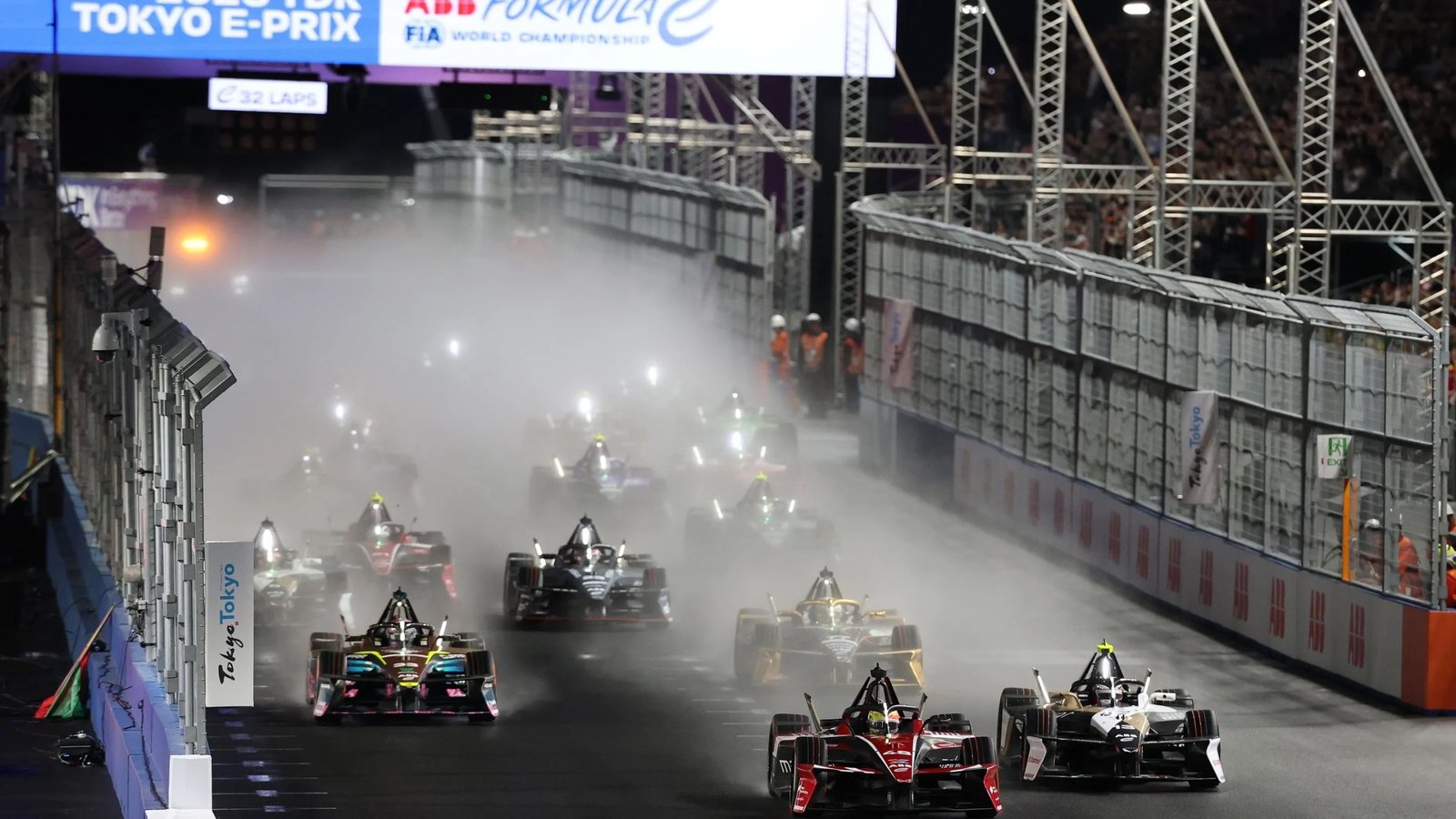
Meanwhile, putting a spotlight on Japan’s renewed interest in EVs, rounds 14 and 15 of the 2025/26 ABB FIA Formula E World Championship were held in Tokyo on July 25 and 26 (after Shanghai and before the finale in London). It was the third time for Formula E to be held in Tokyo.
Formula E is the world’s premier all-electric vehicle racing event. The FIA (Fédération Internationale de l’Automobile) is the governing body that overseas both Formula E and Formula 1, its predecessor and motorsport rival. ABB, the Swedish-Swiss engineering company, is the official title sponsor and a technical partner of Formula E.
The Tokyo rounds, also called the 2026 TDK Tokyo E-Prix, were sponsored by Japanese electronic component maker TDK and supported by the Tokyo Metropolitan Government. Tokyo Governor Yuriko Koike sees the event as a way to accelerate the adoption of zero emission vehicles and contribute to the city’s climate action plan, which targets net zero CO2 emissions by 2050.
The Tokyo races were held on a track constructed on the roads running around the Tokyo Big Sight convention center (not really on “public roads” as Koike had said). They were also held at night, when it was cooler, with an exceptional view of the city lights, giving the governor a chance to promote tourism as well as sustainability.
Looking down at the track, we saw a wall covered with the letters TDK, the sponsorship reflecting the fact that electric vehicles are full of TDK products.
TDK was founded in 1935 in order to commercialize synthetic ferrite, a magnetic ceramic material invented in 1930 by Japanese scientists Yogoro Kato and Takeshi Takei at the Tokyo Institute of Technology. Ferrite is made by sintering iron oxide (Fe2O3) with metal oxides such as nickel, zinc or manganese.
TDK, which stands for Tokyo Denki Kagaku (Tokyo Electric Chemical), used ferrite to build businesses in magnetic recording tape, hard disc drive (HDD) read/write heads, and other applications in consumer and industrial electronics, including EVs.
TDK also has a large automotive business in China, supplying EV makers with capacitors, inductors, transformers, and sensors made in factories located in China. It has a long-standing relationship with Chinese battery maker CATL. Including smart phone batteries and other components used in consumer electrics and information equipment, about 55% of TDK’s total sales are made in China, 32% in the rest of Asia (including Japan), 7% in Europe and only 6% in the US.
The primary suppliers of passive (non-semiconductor) electronic components to the auto industry are
- TDK, Murata, Taiyo Yuden, Kyocera and other Japanese companies;
- South Korea’s Samsung Electro-Mechanics; and
- Yageo along with other Taiwanese companies.

TDK ranks third, after Murata and Samsung Electro-Mechanics. The US company Vishay ranks eighth, according to market research organizations.
Chinese passive component makers, including Fenghua High-Tech and Faratronic, have also benefited from the advance of the Chinese EV industry and have started moving into overseas markets.
The Saturday race (Round 14) of the Tokyo Formula E double-header was won by English driver Dan Ticktum in a vehicle based on a Porsche powertrain. Ticktum took the lead in a sensational final lap, which is worth watching on video:

A Mahindra vehicle driven by Nyck de Vries of the Netherlands won the Sunday race (Round 15).
Two Japanese automakers, Nissan and Yamaha Motor, the latter through its partnership with Lola and ABT, have cars in Formula E. The Lola Yamaha ABT partnership combines chassis design and powertrain integration developed by Lola Cars of the UK with Yamaha’s electric motor, inverter and gearbox. Japanese power supply and energy management company Takasago provides bench-testing of high-voltage components.
Nissan’s drivers, Oliver Rowland and Norman Nato, are British and French. Lola Yamaha ABT’s drivers, Lucas di Grassi and Zane Maloney, are from Brazil and Barbados. Other drivers are from Europe and New Zealand. There are no American or Chinese drivers.
Four teams have American financial backing, but there are no American powertrains in the 2025/2026 Formula E. China’s Envision uses a Jaguar powertrain. Other powertrains come from Stellantis/DS/Citroen and Mahindra. Tesla does not have a motorsports program.
If it seems odd that Chinese automakers are not major participants in Formula E, it may be that they think their highly successful EV business does not need the brand enhancement provided by motorsport.
Matthew Marsh, Porsche Carrera Cup Asia Champion and founder of Sinpapore-based motorsport consultancy EDJ, explained for Asia Times the differences between Formula E and Formula 1 from the perspective of a professional driver:
Formula E cars are heavy as a consequence of being battery powered. The whole thing about EVs is the energy density of a battery is less than that of gasoline so you need more weight. Anyway, the Formula E cars are heavy which makes them less agile than other single seater race cars.
Then they have very little in the way of grip provided by aerodynamic downforce. Because that downforce would also create drag which squares with velocity. And again the last thing a battery powered vehicle needs is drag. If Formula E cars generated the downforce F1 cars can, the battery would run out in about 15 minutes.
The tires used in Formula E are much closer to road car rubber than racing. Because the sport is predicated on sustainability, slapping on new tires all the time would be antithetical. Instead, each driver has 1.5 sets to use for each event. Three fronts and three rears. And these tires need to work in the cold as well as in the heat. In the wet as well as in the dry. In other words, durability trumps grip.
Additionally, a key component of Formula E is that the car generates its own energy during the race through recovery under braking as all EVs do. I think it generates about half the energy that it’s going to use during the race. The point being the driver can’t just drive flat out. He has to develop a technique for going fast efficiently.
One other point is the very even nature of the competition. The cars are all provided by the league. I mean the chassis, bodywork and suspension. Also the battery. The drive trains come from the manufacturers (Nissan, Porsche, Stellantis, etc). These being motors, inverters, gearboxes. And associated software. In short, there’s not much differentiation so it’s highly competitive.
Formula 1 has been hybrid since 2014. But the percentage of electrical power was originally about 20%. This year it has moved to 50%. And essentially there’s not enough. So deployment and harvesting of that electrical power is now critical.
Apparently F1 teams are now more interested in listening to feedback from drivers in Formula E than they were in the past. I don’t think this is a massive thing thing for Formula One. But you can imagine the Formula E people are happy to tell the story.
Next season, Formula E will introduce its Gen 4 technology, which includes 71% greater peak power, faster acceleration than Formula 1 (zero to 100 km/h in1.8 seconds), top speeds exceeding 205 mph (in theory), enhanced regenerative braking capable of recovering nearly 50% of the energy used during a race, and other innovations. Japan’s Bridgestone will supply the tires.
Formula E is a laboratory where the auto industry pushes the boundaries of speed, energy efficiency, weight reduction and safety under extreme conditions. The technologies refined in the pursuit of motorsport filter down into commercial EVs, making for quieter cities with cleaner air, and contributing to the pursuit of sustainability in spite of the roadblocks thrown up by politicians.
Next season – the 21-race 2026/2027 Formula E – is scheduled to start in Jeddah on December 18 and finish in Tokyo on July 25. Races will also be held in two cities in the US, Miami and Austin; two cities in China, Sanya on Hainan island and Shanghai; and in Mexico City, Sao Paulo, Berlin, Monaco, London, Madrid, and Zandvoort in the Netherlands.
The final races of this year’s Formula E – the 2026 Hankook London E-Prix, sponsored by the South Korean tire maker – will be held in London on August 15 and 26.
Matthew Marsh, founder of Sinpapore-based motorsport consultancy EDJ, contributed to this article.
Follow this writer on X: @ScottFo83517667






 makers have fallen so far behind BYD and other Chinese competitors, and been so brightly outshone by Tesla, that it is easy)