
Global warming is leading to more extremely hot weather. There is perhaps no more obvious consequence of climate change. But changing how we analyze this problem can still help scientists think about it in a different way that may yield surprises.
Generally, studies on heat extremes work with some combination of daily minimum, maximum, and mean temperatures. Sometimes they focus on multi-day heatwaves using those metrics, since the discomfort and health impacts increase for longer events. There are different thresholds you can use to define extreme heat in these analyses, either based on past statistics or on the human body’s physiological limits.
A new study led by Weilin Liao and Xuanzong Zhang at Sun Yat-sen University tried breaking down heat extremes to the hourly level instead, which reveals some interesting nuances.
Hourly reports
The researchers calculated each hour of the day separately, comparing 8 am temperatures only to other 8 am temperatures. They defined extreme heat as anything above the 90th percentile of recorded temperatures at that time of day between 1981 and 2010. To put this in context, the global average over the last four decades has been that people experience about 270 hours of “hourly heat extremes” each summer. But that average obscures a very obvious trend: that number has been increasing by 62 hours each decade.
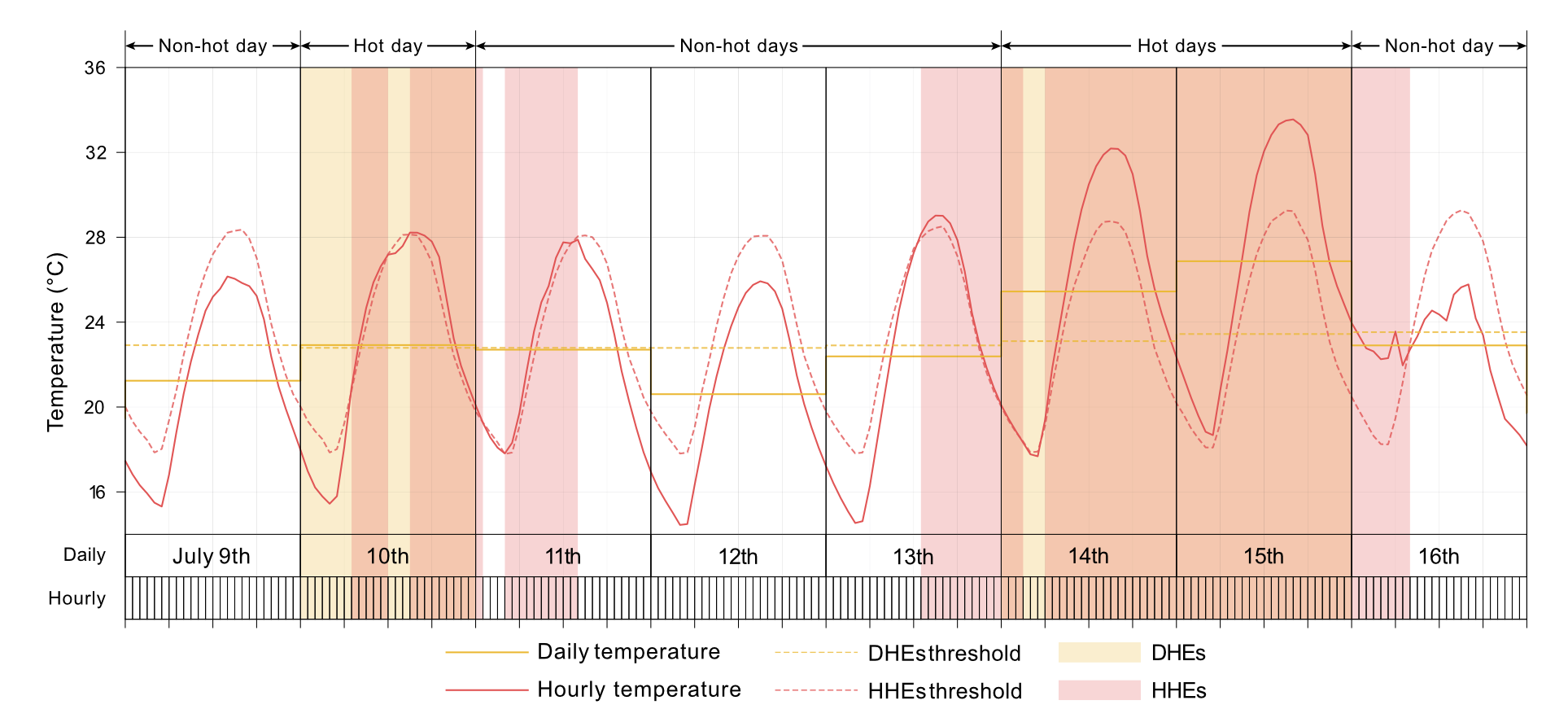
To project this into the future, the researchers used climate model results from two scenarios of future greenhouse gas emissions—one with medium emissions leading to 3°C (about 5.5°F) warming by 2100, and one with high emissions and 5°C (9°F) warming.
Comparing the past couple of decades to 2070–2099, the total number of hourly heat extremes triples in the medium scenario and increases by 4.5 times in the high scenario. For every half a degree C (almost 1°F) of global average temperature increase, the study shows an increase of about 200 hot hours per summer.
The trend is worst in the tropics, even though overall warming is stronger at higher latitudes. The researchers say this is because temperature variability increases in the tropics, making extremes more frequent.
Hot nights
The number of hot hours also increases more at night than it does during the day. This is where the hourly analysis can start to seem more relatable than metrics of temperature change or counts of days. Days that fail to qualify as “hot days” still see an increase of several hot hours—mostly at night. This wouldn’t show up if you just counted the number of hot days. And these shorter hot periods often precede or follow hot days, extending the stress a heatwave puts on your body.
Obviously, those hot days also see an increase in hot hours. Right now, the average hot day contains about 16 hot hours, but that increases to 19 hours in the medium scenario and 21 hours in the high scenario. So the miserable part of the day gets longer, reducing the hours that grant some relief.
The researchers also looked at differences in these trends for countries at different income levels and compared the lifetime total exposure to hot hours for people born in 1981 and 2023. Low-income countries see the strongest increase in hot hours. But even at the global average, those born in 2023 would experience about 1.4 to 1.8 times as many hot hours, depending on the greenhouse gas emissions scenario.
While the overall trend in hot weather is well known, the hourly details matter. They highlight that the number of hot hours is increasing even faster than the number of hot days, for example. But the details also help us better represent what this means for human health.
The researchers write, “As heat risks continue to intensify, hourly-scale assessments will become essential for anticipating health impacts, informing equitable adaptation strategies and designing responsive early warning systems that reflect the new reality of round-the-clock heat exposure.”
Nature Climate Chane, 2026. DOI: 10.1038/s41558-026-02724-8 (About DOIs).