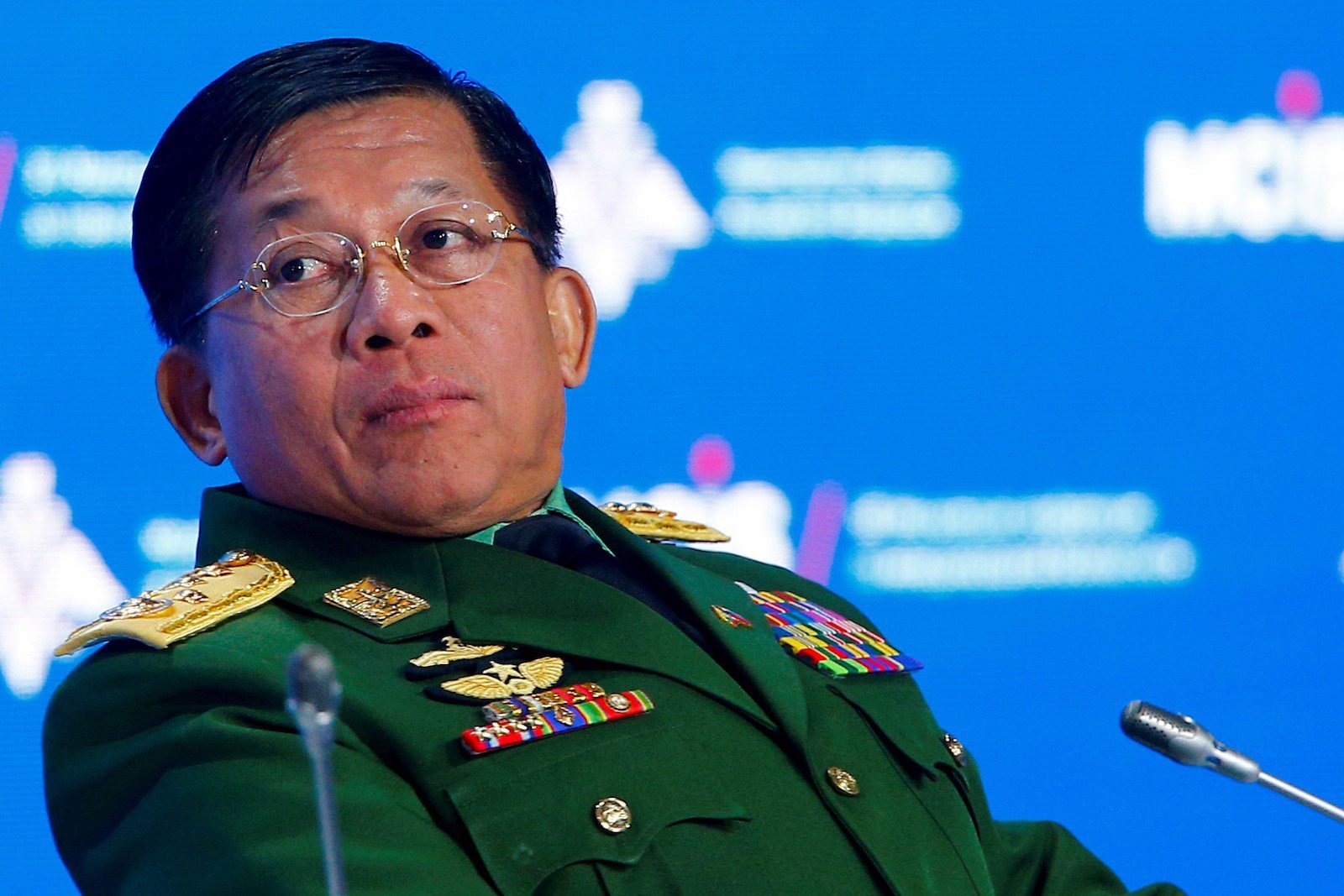
Neighbors are busy rehabilitating the diplomatic standing of Myanmar’s junta-chief-turned-president Min Aung Hlaing just as his regime openly shreds the regional bloc’s peace plan.
Min Aung Hlaing may have traded his general’s uniform for civilian clothes and a practiced smile on his recent diplomatic tours, but Myanmar’s military leadership remains entirely unchanged. Its latest message to the Association of Southeast Asian Nations (ASEAN) has stripped away whatever civilian disguise remained.
By dismissing the need for a future ASEAN special envoy, rejecting renewed pressure for the release of detained civilian leader Aung San Suu Kyi and warning against external “interference,” the military-backed government is signaling that it believes it can dictate the terms of its regional relationships. This defiance comes after five years of ignoring ASEAN’s Five-Point Consensus Min Aung Hlaing himself agreed to.
ASEAN had just reiterated that its envoy should meet all parties, including Suu Kyi, and again called for her unconditional release. Naypyitaw’s answer was essentially: we no longer need your mediation, and we will handle Myanmar’s crisis on our own terms. Only days earlier, Min Aung Hlaing was smiling for cameras in Bangkok.
Red carpets abroad, lethal realities at home
India received him in late May, China in June and Laos in July. Thailand rolled out the red carpet in August while pushing for Myanmar’s eventual return to full participation in ASEAN.
The Thai-Myanmar joint statement went further, pledging Thai support for Myanmar’s “full and equal participation” in ASEAN mechanisms, while Naypyitaw thanked Bangkok for “facilitating the normalization” of its relations with the bloc.
These governments may call their approach pragmatism or “calibrated re-engagement.” But from Naypyitaw, the lesson looks completely different: Min Aung Hlaing can brush aside ASEAN’s demands and continue a brutal civil war at home while still receiving handshakes, honors and diplomatic standing from neighboring capitals.
While regional diplomats arranged those handshakes, Myanmar’s air force was doing much of the talking at home.
According to the independent conflict monitor ACLED, state repression and aerial bombings intensified after the military command was reshuffled in March, just before a pro-military parliament installed Min Aung Hlaing as civilian president in April after sham elections in December and January.
The political makeover did not reduce the violence. In the first half of 2026, the military perpetrated more than a dozen mass killings that left over 450 civilians dead, according to ACLED’s data.
For people living under those aircraft, regional normalization is measured not in communiqués and business forums, but in bodies, burned homes and displacement.
Bilateral escape route
This defiance did not emerge in a diplomatic vacuum. It has been encouraged by creeping normalization.
Min Aung Hlaing’s diplomatic offensive is doing more than restoring his personal standing; it is giving Naypyitaw an escape route around ASEAN. If China, India, and individual ASEAN members deal with his government bilaterally, he has far less incentive to meet ASEAN’s collective conditions.
He can gain diplomatic standing, investment and security cooperation from individual capitals, while rejecting the political obligations demanded by the bloc. Every bilateral red carpet makes ASEAN’s collective leverage a little cheaper to ignore.
The Five-Point Consensus, however ineffective, remains ASEAN’s agreed regional framework for the Myanmar crisis. If the consequential dealings with Naypyitaw increasingly take place outside of those collective conditions, ASEAN centrality becomes purely ceremonial.
The generals’ treatment of Suu Kyi shows exactly how this hostage diplomacy works. On August 3, before Min Aung Hlaing’s visit to Thailand, authorities allowed an International Committee of the Red Cross representative to meet her. ASEAN welcomed the meeting.
But within days, Naypyitaw slammed the door, rejecting the bloc’s demand for her unconditional release.
Illusion of effective control
There is, of course, a transactional case for engagement. Thailand needs cooperation on energy, labor, trade and cross-border crime. China wants relative stability around the China-Myanmar Economic Corridor. India wants border security and critical minerals. None can simply pretend Naypyitaw does not exist.
Crucially, however, Min Aung Hlaing cannot guarantee the very things his neighbors want. Myanmar’s borderlands remain fragmented; Chinese infrastructure routes cross contested territory; strategic rare-earth deposits lie in Kachin areas outside regime control. A presidential handshake in Bangkok cannot manufacture effective authority on the ground.
That is why ASEAN’s exclusion of Myanmar’s political leadership from top-level meetings still matters. The Five-Point Consensus has failed to stop the war, but failure is not an argument for surrendering the little leverage ASEAN still possesses over Myanmar.
Engagement only matters when it produces something measurable, not when the meeting itself is framed as the achievement. The bloc should demand measurable steps now: an end to attacks on civilians, the release of political prisoners, genuine humanitarian access and serious and sincere initiatives for dialogue with the opposition and ethnic armed organizations that control large parts of the country.
The price of surrendering leverage
In 2007, Singapore’s founding leader Lee Kuan Yew told American diplomats that dealing with Myanmar’s generals was like “talking to dead people” and he “had given up on them a decade ago.”
Now, nearly two decades later, Min Aung Hlaing has replaced his uniform with a suit and added “President” to his title. Yet the old habit statesman Lee identified remains: take what outsiders offer, concede as little as possible and wait for the pressure to fade.
The lesson to learn for ASEAN is that talking does not require surrendering leverage. For five years, ASEAN has rightly kept Myanmar’s political leadership out of its highest-level meetings.
That exclusion has carried a message that communiqués could not: Myanmar remains an ASEAN member, but membership does not automatically entitle Min Aung Hlaing to a seat at the leaders’ table. That seat is one of the few bargaining chips ASEAN has left.
The critical issue now is whether bilateral rehabilitation will allow Min Aung Hlaing to bypass ASEAN’s collective conditions and secure the leadership seat he still clearly craves. If ASEAN restores political-level participation without securing meaningful concessions, the bloc will have paid in legitimacy for the privilege of talking to the dead.
Nyein Chan Aye is a Washington-based Burmese journalist who previously worked for the BBC and Voice of America and writes on Myanmar, China, the US and regional affairs.