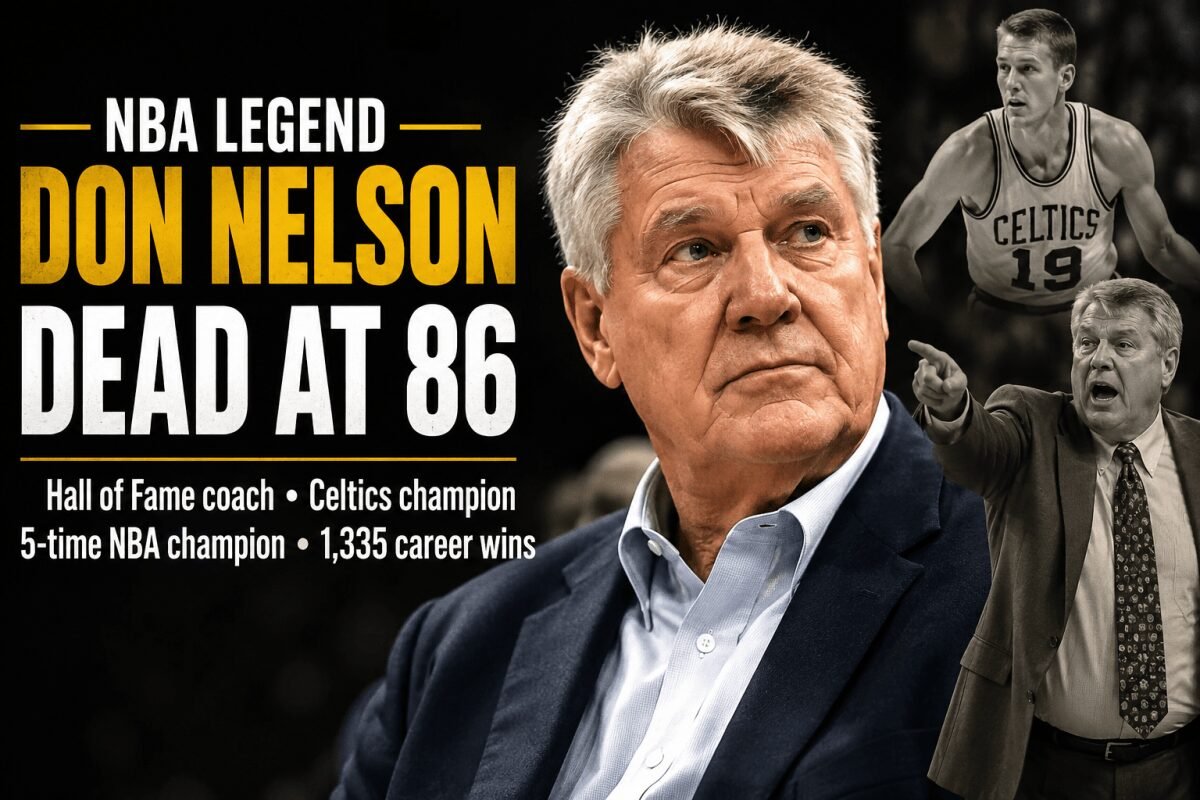
NBA legend Don Nelson, the Hall of Fame coach who helped reshape modern basketball and won five championships as a player with the Boston Celtics, has died at 86.
Nelson died peacefully Sunday morning surrounded by his family, according to a statement released by his loved ones. His cause of death was not immediately disclosed.
“On Sunday morning our beloved husband, dad, grandfather and great-grandfather Don Nelson peacefully went to be with the Lord, surrounded by his loving family,” the family said, according to NBA reporter Marc Stein.
They added that Nelson spent his final days surrounded by friends and relatives who shared stories and treasured memories from his remarkable life.
Nelson leaves behind one of the most colorful and influential careers the NBA has ever seen — first as a championship-winning player, then as the mastermind behind an unconventional style of basketball that helped change the league forever.
Before becoming known simply as “Nellie,” Nelson was a 6-foot-6 forward who spent 14 seasons in the NBA.
The Chicago Zephyrs selected him in the third round of the 1962 NBA Draft after his college career at Iowa. He also played for the Los Angeles Lakers before finding his greatest success with the Celtics.
In Boston, Nelson became part of one of basketball’s great dynasties, winning five NBA championships.
He finished his playing career averaging 10.3 points and 4.9 rebounds per game.
But Nelson’s second act would make him just as famous.
After becoming an assistant coach with the Milwaukee Bucks in 1976, Nelson suddenly found himself thrust into the head coaching job when Larry Costello resigned following a miserable 3-15 start.
Nelson was only 36.
“I expected to be an assistant at least two years, maybe longer, before trying for a head coaching job,” Nelson said at the time, according to The New York Times. “I don’t have the most experience in the world.”
He apparently didn’t need it.
Nelson would never serve as an assistant coach again.
He remained in charge of the Bucks until 1988 and turned Milwaukee into a perennial contender, leading the team to at least 50 victories in seven straight seasons.
He was named NBA Coach of the Year in 1983 and again in 1985.
After briefly stepping away from basketball, Nelson took over the Golden State Warriors before the 1988-89 season.
That was where his wildly creative approach to the game became famous.
Nelson embraced smaller, faster lineups at a time when NBA teams were still heavily focused on traditional positions and powerful big men.
His system became known as “Nellie Ball.”
He was also one of the pioneers of using a “point forward” — allowing a bigger player to handle the ball and run the offense like a guard.
“Most of all I wanted to have all my best players on the court at the same time — regardless of position,” Nelson wrote in The Players’ Tribune in 2016.
It was a philosophy that would eventually become commonplace throughout the NBA.
Nelson earned his third Coach of the Year award in 1992 while leading Golden State.
His first Warriors stint ended in February 1995, when he resigned with the team holding a 14-31 record.
Nelson’s next stop brought him to New York.
The Knicks hired him to replace Pat Riley ahead of the 1995-96 season, but the marriage did not last long.
Nelson was fired after only 59 games.
His career, however, was far from over.
Nelson took over the Dallas Mavericks during the 1997-98 season and helped transform a struggling franchise into a contender.
One of the biggest moments came in the 1998 NBA Draft, when Dallas landed a lanky German prospect named Dirk Nowitzki with the No. 9 overall pick.
Nowitzki would eventually become one of the greatest players in NBA history.
By the 2000-01 season, the Mavericks were back in the playoffs.
Nelson later returned to Golden State for one final coaching run, taking over a Warriors franchise that had not reached the playoffs since his previous departure.
His comeback immediately produced one of the greatest postseason upsets in NBA history.
The eighth-seeded Warriors stunned the top-seeded Mavericks in the opening round of the 2007 playoffs.
Nelson would never return to the postseason before leaving Golden State in September 2010, but he still managed to help launch another historic career.
During Nelson’s final season on the bench, he coached rookie Stephen Curry.
Curry said Sunday that Nelson was “one of the big reasons I was drafted by the Warriors.”
“The story is he never liked rookies,” Curry said. “But from Day 1 he challenged me and gave me an opportunity to be my best self on the court.”
Curry said Nelson had an “immeasurable impact” on basketball and would be remembered as “one of the greatest minds in the history of the game.”
“He’s a true icon and will be missed by the countless number of people he touched, including myself, during a legendary career,” Curry added.
Nelson finished his coaching career with 1,335 regular-season victories, placing him second on the NBA’s all-time coaching wins list behind former San Antonio Spurs coach Gregg Popovich.
His impact stretched far beyond the numbers.
The Warriors called Nelson “a true basketball visionary who saw the game differently and was never afraid to challenge conventional thinking.”
Former Warriors star Chris Mullin said Nelson “was more than a coach to me,” while Mitch Richmond remembered how Nelson “made the game fun.”
Nowitzki credited his former coach with recognizing abilities in him before he even saw them himself.
Tim Hardaway summed Nelson up simply.
“Nellie was ahead of his time,” he said, “and there was nobody else like him.”
Nelson was inducted into the Naismith Memorial Basketball Hall of Fame in 2012, cementing his place among the sport’s legends.
From collecting five championship rings with the Celtics to experimenting with lineups and strategies that would eventually reshape the modern NBA, Nelson spent nearly five decades refusing to play basketball by anybody else’s rules.
And the game was never quite the same after him.