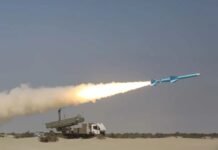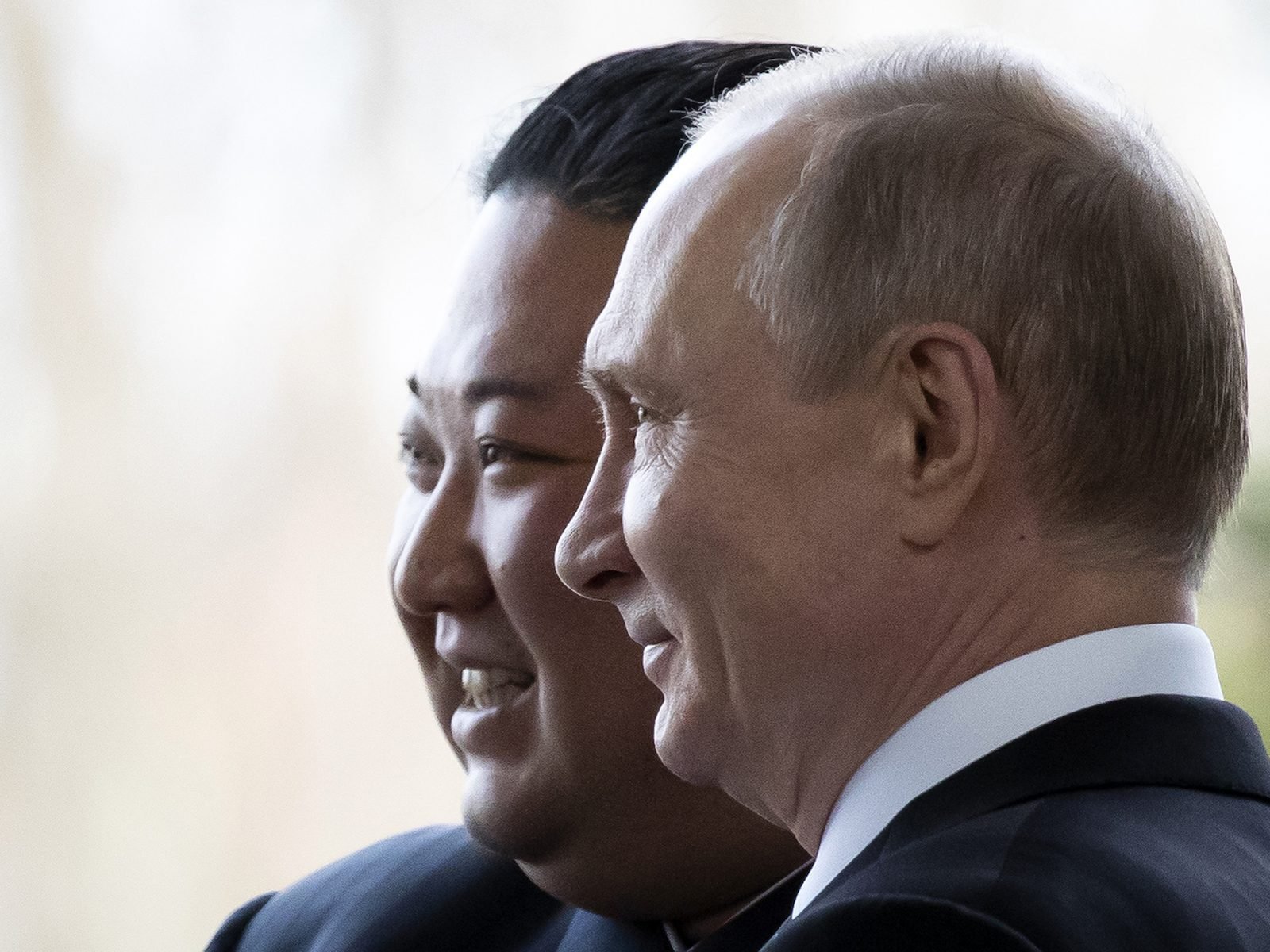
North Korea’s renewed ballistic missile exports are helping Russia sustain its campaign in Ukraine while accelerating weapons development and military learning that may ultimately reverberate across Northeast Asia.
This month, multiple media outlets reported that North Korea has resumed shipments of KN-23 and KN-24 tactical ballistic missiles and mobile launcher units to Russia to replenish Moscow’s depleted munitions stocks, while preparing to deploy an additional 30,000 North Korean troops to the frontline, according to Ukrainian military intelligence.
Citing intelligence assessments, Ukrainian President Volodymyr Zelensky warned that Russia has been readying accommodation facilities in the southwestern Voronezh region since June to host incoming personnel.
Simultaneously, North Korean state media confirmed plans to expand domestic missile manufacturing capacity 2.5-fold over five years to support expanding exports.
Early battlefield deployments of the KN-23 suffered from severe inaccuracy, with error margins reaching up to 1,500 meters. However, joint technical modifications by Russian engineers have drastically refined the weapon’s precision, tightening its error margin to between 1 and 5 meters.
Western and Ukrainian officials caution that these transfers transform the war in Ukraine into a live-fire testing ground for North Korea’s military hardware, allowing North Korean forces to gain operational combat experience and enhance weapons systems that directly threaten stability across the Asia-Pacific region.
As to the specifications of North Korea’s KN-23 and KN-24 missiles, Tianran Xu and Jaewoo Shin note in an Open Nuclear Network report that the KN-23 achieves an extended maximum strike range of approximately 600 kilometers, enabled by a wider 1.1-meter airframe housing more solid propellant, allowing it to target high-value assets deep across the Korean Peninsula using non-ballistic depressed trajectories.
By comparison, they say that the KN-24 reaches a shorter maximum range of roughly 400 kilometers but provides sufficient coverage to saturate frontline military installations and logistics hubs across South Korea.
On how those missiles may be deployed in Ukraine, Marcus Welsch and other writers in a report this month for the Center for Strategic and International Studies (CSIS) describe Russia’s long-range strike campaign as a coercive punishment strategy centered on geographic targeting rather than the pursuit of air superiority.
Welsch and others note that Russia combines high-precision ballistic and cruise missiles with large numbers of low-cost Shahed-type drones to bypass air defenses. They point out that these attacks target energy grids, transport infrastructure, industrial hubs and major urban centers, particularly during winter, to intensify civilian, economic and political pressure.
They say that drones provide persistent attrition, while missiles strike high-value targets and extend the battlefield deep into Ukraine’s rear.
But as the increasingly stalemated Russia-Ukraine War drags on, such an intense and prolonged campaign may already have strained Russia’s ballistic missile production capability to the point of it requiring external assistance to maintain strikes on Ukraine.
Ukrainian defense source Militarnyi reported in May 2026 that Western sanctions and Ukrainian strikes have derailed Russia’s Iskander-M ballistic missile production targets, with procurement documents showing that the Kolomna Machine-Building Design Bureau ordered 1,202 9M723 Iskander-M missiles for 2024–2025.
However, Militarnyi says Russian forces deployed just 813 total ballistic missiles across all types during that timeframe—including foreign North Korean imports and air-defense munitions—while maintaining a flat reserve of 200–250 missiles.
Militarnyi notes that intelligence analysis of recovered debris confirms newly manufactured missiles are deployed immediately after production, proving Russia’s failure to build stockpiles and highlighting how systematic attacks on defense supply chains have forced the military into a severe manufacturing deficit.
Looking at the scale of North Korea’s ballistic missile production, A.B. Abrams mentions in an August 2024 article in The Diplomat that the country’s ceremonial commissioning of 250 tactical launchers carrying 1,000 KN-24 short-range ballistic missiles demonstrates an unprecedented peacetime industrial capacity.
Abrams says that equipping the 250 launchers displayed in 2024 would require annual production of 200 to 300 missiles, potentially exceeding 400 when reload stocks are included. He says that output would surpass global ballistic missile production rates except for Russia’s wartime Iskander-M manufacturing surge.
But what does North Korea get in return for its extensive military assistance to Russia, encompassing munitions, troops and ballistic missiles?
A March 2026 report from the Institute of National Security Studies (INSS) says North Korea may have earned US$7.67 billion to $14.4 billion by supporting Russia’s war effort between August 2023 and December 2025.
The report mentions that North Korean munitions exports netted $7.05 billion to $13.78 billion, while deploying 21,000 troops generated $620 million in wages and compensation. The report also adds that physical goods, food, and hard cash comprised only 4% to 19.6% ($580 million to $1.5 billion) of delivered payments.
Revenue from arms sales and troop deployments, combined with access to Chinese capital, may be contributing to signs of stronger economic activity in North Korea, according to the Wall Street Journal (WSJ) last month. WSJ notes that the North Korean economy grew by 3.7% in 2024, while major housing projects, businesses, electric vehicles and digital services have increasingly reshaped Pyongyang.
North Korea may have also received various military technologies from Russia. For instance, the country’s new nuclear-cruise missile-armed Choe Hyon destroyer is believed to be based on Russia’s Admiral Grigorovich-class frigate and is armed with Russian Pantsir-M air defense systems.
Aside from that, Russia is alleged to have transferred nuclear propulsion technology for North Korea’s nuclear submarine program. These developments may aim to further cement North Korea’s nuclear status, with regime survival remaining the country’s overriding priority.
North Korea’s troop deployments in Ukraine give it real-life experience in high-intensity modern warfare, which is rare to come by in the Korean Peninsula. Forces News reported in February 2026 that since late 2024, about 3,000 North Korean troops may have returned to their country to serve as instructors, teaching other units how to integrate Russian tactics and technologies such as using first-person-view (FPV) drones.
Beyond cash, technology and combat experience, North Korea’s arms exports and troop deployments to Russia could enhance its independence.
Although China has traditionally been North Korea’s main economic supporter, building stronger ties with Russia helps North Korea reduce over-reliance on China and sustain strategic autonomy by balancing its relationships with both countries.
The longer the Russia–Ukraine war continues, the more Russia–North Korea cooperation could evolve from a temporary wartime exchange into a durable military-industrial partnership that strengthens North Korea’s ability to threaten South Korea and complicates allied deterrence across Northeast Asia.
At the same time, North Korea’s growing access to Russian technology, revenue and battlefield experience may make it less dependent on China, weaken Beijing’s leverage over Pyongyang and make future regional crises harder for any single power to contain.