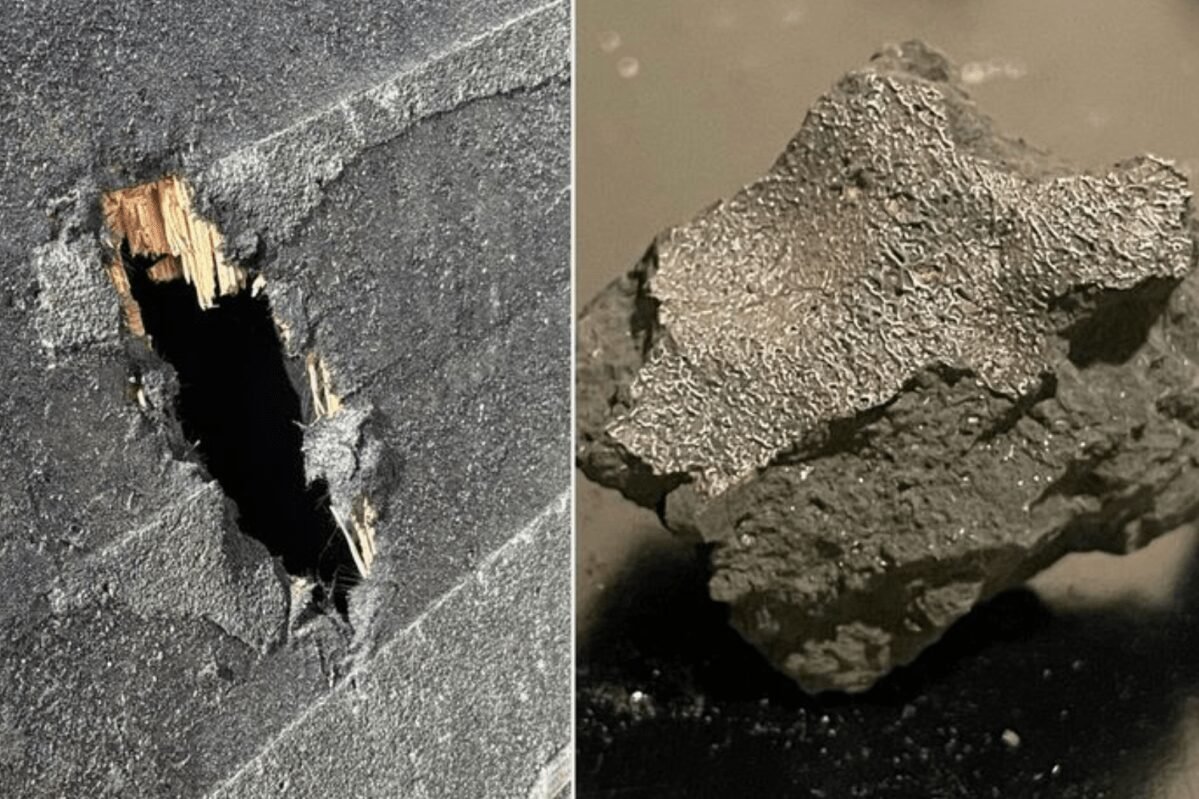
A meteorite that smashed through the roof of a New Jersey home is now giving NASA scientists a rare look at the earliest days of the solar system — and the possibility that some of life’s key ingredients were already moving through space billions of years ago.
The space rock crashed into a house in Hillsborough, New Jersey, in Somerset County, on July 16, 2024, according to a new study published in Science Advances and authored by multiple NASA scientists. What could have been dismissed as a bizarre freak accident quickly became a major scientific opportunity, thanks to the homeowners’ careful response.
According to NASA, one of the residents is an amateur astronomer and immediately understood that the object might be scientifically important. Rather than handling it casually or throwing it away, he collected the meteorite fragments with protective gloves and safely preserved them until they could be turned over for study.
That quick thinking allowed researchers to examine a rare, freshly recovered meteorite that had a documented fireball path across the sky. Scientists used video footage of the meteorite’s trajectory, along with detailed lab analysis, to trace where the rock likely came from in the asteroid belt.
“When we have both a documented fireball and a quick recovery of its meteorite, we can learn not only what the rock is made of, but where it came from in the asteroid belt,” said Peter Jenniskens, the study’s lead author and a meteor astronomer at NASA’s Ames Research Center in California’s Silicon Valley and the SETI Institute, according to NASA.
Inside the meteorite, scientists found something especially intriguing: evidence that ancient salty water once moved through the asteroid the rock came from. Using powerful microscopes, researchers discovered deposits left behind by brine, offering clues about the watery history of the asteroid long before the meteorite broke away and eventually slammed into the New Jersey home.
Even more striking, the study’s authors found that the salty water contained amino acids that are rare on Earth and are believed to be “likely extraterrestrial in origin.”
Those findings could help scientists better understand how water shaped rocky objects in the young solar system, and how some of the building blocks associated with life may have formed or traveled through space long before Earth became the planet we know today.
“If you follow the water through the solar system, you’re actually following life,” said Mike Zolensky, a meteorite researcher and co-author of the study, according to NASA.
“Following the history of water through the solar system is an essential part of understanding the origin of life,” he added.
The discovery makes the meteorite more than just a space rock that punched a hole through someone’s roof. It is a preserved fragment of ancient cosmic history, one that may help scientists piece together what conditions were like when the solar system was still forming billions of years ago.
Photos credited to M. Kirschner and M. Hankey of the American Meteor Society show both the rooftop hole where the meteorite landed and the meteorite itself.
The homeowners, who have chosen to remain anonymous, told ABC 6 that they understood almost immediately how unusual the event was.
“We knew almost immediately that what happened to us was incredibly rare and we felt a responsibility to preserve the meteorite for the scientific community,” the homeowners said in a statement to the outlet.
They said the experience still feels hard to believe.
“It’s still surreal to think that this meteorite traveled through space for millions of years before ending its journey in our home,” they added. “The entire experience has been incredible, and we’re honored to have played a small part in advancing scientific understanding through its study.”